

























































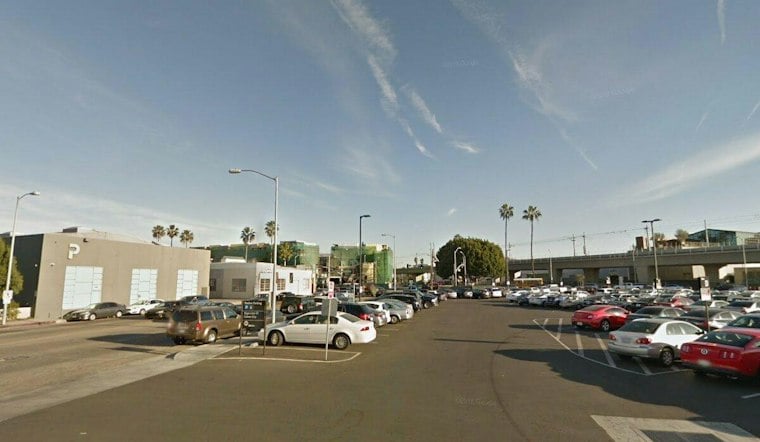
A towering metal frame is rising around a mature ficus tree at the intersection of Washington and National boulevards in Culver City, part of a public-art installation that began last month and is expected to continue through the end of the year. The piece, called A Frame for a Tree, is the work of Los Angeles-based artist Charles Gaines and measures roughly 56 feet by 98 feet, wrapping a rectangular metal structure around the living tree rather than replacing it.
According to westsidecurrent.com, the city says installation work will continue through the end of the year, with the metal framing designed to allow the ficus to keep growing undisturbed inside it. The tree sits beside the E Line’s Culver City station and Ivy Station, according to Urbanize LA, placing the sculpture squarely in one of the city’s busiest transit corridors.
Timelines for the project have shifted. Culver City News reported that a city statement said the installation had been delayed by several weeks and was then expected to begin in mid-October 2026, with no major road closures anticipated — though brief, localized slowdowns were expected during early-morning equipment load-ins. The outlet also noted conflicting duration estimates: one city statement put the installation timeline at approximately six weeks, while the same report elsewhere described an eight-week duration. Hoodline could not reconcile the discrepancy.
An Arborist Watches Over Every Lift
Protecting the tree itself has been central to the project from the start. The same report noted on-site supervision by a certified master arborist throughout all structural lifts, a safeguard meant to keep the ficus healthy as the heavy metal framing goes up around it. Westside Current’s account of the city’s original 2025 project announcement similarly described an arborist engaged throughout all phases to support the tree’s continued growth and health.
The idea for public art at this intersection isn’t new. Per the same westsidecurrent.com account, Culver City has planned public art at the site as a gateway and a means of visually unifying the intersection since 2016. The City Council unanimously approved fabrication and installation of the artwork in May 2025, and the city’s proposed 2025–26 budget included $1,491,472 for the project’s Phase III, funded through the Cultural Arts Fund.
Gaines’ Long History With Trees and Systems
Gaines has spent decades exploring how meaning takes shape at the intersection of systematic logic and natural forms, and trees specifically have figured prominently in his work since the mid-1970s, according to the same report. The artist, who created a separate work displayed outside the Intuit Dome in Inglewood, said in 2025 that creating A Frame for a Tree had been a profound experience centered around a dialogue with the ficus, the surrounding urban landscape, and the viewer.
Gaines has also said he hopes viewers will consider the natural space’s context and come away with new insight once they encounter the piece. He compared his ambitions for the sculpture to one of the country’s most recognizable public monuments, saying he hopes this public work becomes an iconic gateway for Culver City in the same way that Eero Saarinen’s “The Gateway Arch” represents St. Louis in the public mind.
Part of a Larger Transit-Area Makeover
The sculpture isn’t rising in isolation. Urbanize LA reports that an adjacent rail viaduct area nearby was transformed into a seating area and open space alongside a neighboring commercial development, and the new public art is expected to complement that seating and open space below the viaduct. Taken together, the city is positioning the tree-framing sculpture as both a piece of civic art and a functional anchor for pedestrians moving through the Washington and National corridor.
Installation is expected to be completed later in 2026, though the evidence available does not specify an exact completion date. For now, commuters passing through the E Line’s Culver City station and Ivy Station will watch the frame continue taking shape around the ficus in the coming weeks.





