























































Cuyahoga County wants another 12,000 solar panels on the Brooklyn landfill, and the borrowing proposed to pay for them would put the county's property-tax power behind the debt. A resolution before County Council would authorize up to $7.5 million in bond anticipation notes, short-term borrowing governments use before issuing longer-term bonds.
Officials expect federal investment tax-credit proceeds to repay the principal once the expansion is producing electricity, and they want that payoff to come without the general fund. The resolution would still pledge the county's full faith, credit and property-taxing power if the federal money is not available when payments come due. Cleveland.com reported the proposal Thursday from a Nov. 4 Education, Environment and Sustainability Committee packet. That packet holds the proposed resolution, not a completed borrowing.
Notes First, Bonds on Paper
The notes would mature five years after issuance. The county fiscal officer could set that date as far out as 61 months, a month past the five-year mark. Annual interest could not exceed 4.75 percent.
The rate actually charged, the payment schedule and any early-repayment provisions would be established when the notes are sold. Until a sale, those terms do not exist.
The resolution also sketches the longer bonds the notes are written to anticipate: an estimated 5.5 percent interest rate, and 20 annual principal installments beginning in 2032. Bond anticipation notes let a government borrow now and refinance later. This resolution does not guarantee that refinancing will be available, or that the additional bonds will be issued.
The levy does not wait on that second step. While the notes are outstanding, the county would impose what the Nov. 4 attachment calls "the same tax that would have been levied if the Bonds had been issued without the prior issuance of the Notes." The short paper is capped at 4.75 percent and due in about five years. The tax beside it is the tax for a 20-year bond estimated at 5.5 percent.
Priority Inside the Tax Limitation
While the notes are outstanding, the county would have to levy property tax on taxable property throughout the county. Collections would be deposited in the bond retirement fund, pledged to principal and interest. The pledge is for timely payment, not a hope that some other account is full when the bill arrives.
Inside the applicable tax limitation, the levy would take priority over other items. Ohio's 10-mill limitation restricts certain property taxes imposed without voter approval. One mill equals $1 of tax for every $1,000 of taxable property value. Priority would put this debt-service levy ahead of other items sharing that limitation. The resolution never says how many mills that would take.
Cleveland.com reported that the resolution does not calculate how much property-tax revenue, if any, would need to be collected. It also does not explain the levy's effect on existing property-tax allocations, other debt payments or available county revenues. The legal hook is written out. The household bill is not.
Qualifying federal money can bring the levy down, and the attachment is specific about when. The tax "shall be reduced by the amount so available and appropriated," provided the proceeds are not designated for additional projects. A credit payment pointed at another installation would not, under that sentence, shrink this one.
Counting on Elective Pay
The principal and the interest are supposed to come from different federal sources. Officials expect investment tax-credit proceeds to repay principal after the expansion is completed and producing electricity. They have said federal grant dollars would cover interest. Repayment without the general fund depends on those proceeds and on the financing finally arranged.
Elective pay is what lets an eligible local government receive money for qualifying clean-energy investments even though it generally owes no federal income tax. The IRS says state, local and tribal governments can take advantage of certain business tax credits even if they have no taxable income to apply the credits against. An authorized representative has to create an Energy Credits Online account to make the election, and the government has to complete registration and filing. The project itself has to meet construction, completion and other federal requirements. The IRS description does not establish this expansion's eligibility, a dollar amount or a payment date.
Reimbursements could arrive six to 18 months after the project begins operating. If the added panels start producing sometime in 2027, a payment on that range could fall between mid-2027 and mid-2029, depending on the month generation begins. The notes can run about five years from issuance. When they mature, Section 8 pledges toward repayment any money from subsequent bonds or renewal notes, plus excess proceeds from the original notes.
If the federal money is late or short, the county would still owe the debt. The resolution does not treat that delay as an automatic property-tax increase, a draw on the general fund or a default. Officials want the borrowing repaid as quickly as possible without the general fund. In Austin, Indiana, the city council approved a resolution to transfer rainy-day funds so a solar-project bond anticipation note could be paid after staff said tax-credit timing had delayed the payoff.
An Expansion of the 2018 Farm
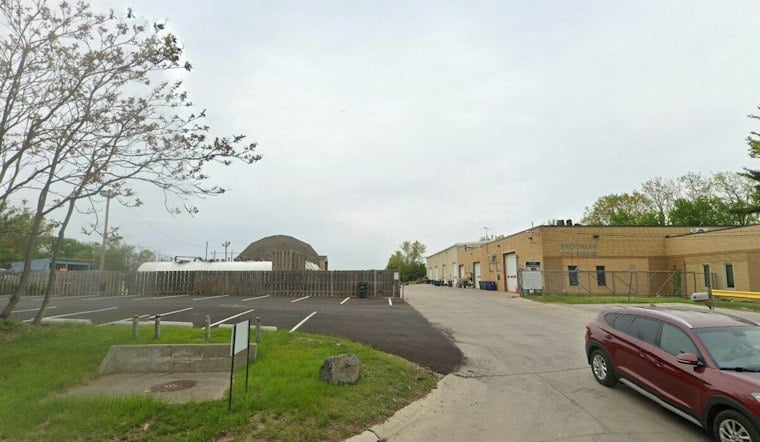
The Brooklyn landfill already has an operating solar installation. In September 2018, Ideastream reported that the county's solar farm there covered 17 acres at 9400 Memphis Avenue. The county has since told council that the expansion would add 12,000 panels.
Those panels should begin producing electricity sometime in 2027. That is the county's timetable, and it is the one the credit plan uses. The expected principal payment is tied to the expansion, after it is completed and generating, not to the farm already operating on Memphis Avenue.
The notes would finance the additional panels before a reimbursement that, on the county's account, follows the new electricity rather than preceding it. Eight years after the first 17 acres went in, the proposal in front of council is an enlargement of a working site, with the federal payoff still on the far side of construction.
The Buyer, and the Nov. 24 Calendar
Under a proposed cooperative arrangement, the Northeast Ohio Public Energy Council would purchase the notes. NOPEC is a regional council of governments that buys electricity and natural gas for member communities. On this borrowing it would be the buyer of the county's short-term debt.
The proposal is already public. Cleveland.com reported Nov. 9 that the county is seeking a $7.5 million loan from NOPEC to cover renewable-energy project costs while federal reimbursements are pending. The financing takes the form of the bond anticipation notes, which NOPEC would purchase, so the loan and notes are one proposed borrowing, not a $15 million total. Related measures expected alongside the borrowing resolution cover NOPEC membership, technical assistance and energy purchasing.
Council is expected to consider final passage on Nov. 24 of the borrowing resolution and those two related measures. The expectation is not a completed vote. If the notes are authorized and sold, the fiscal officer sets maturity, up to 61 months out, and the sale sets the rate under the 4.75 percent cap, along with any early-repayment terms.
Until that sale, the number in the packet is a ceiling with a tax clause attached: up to $7.5 million, a countywide levy while the notes are outstanding, and a reduction only when qualifying federal money is available, appropriated and not designated for another project.