

























































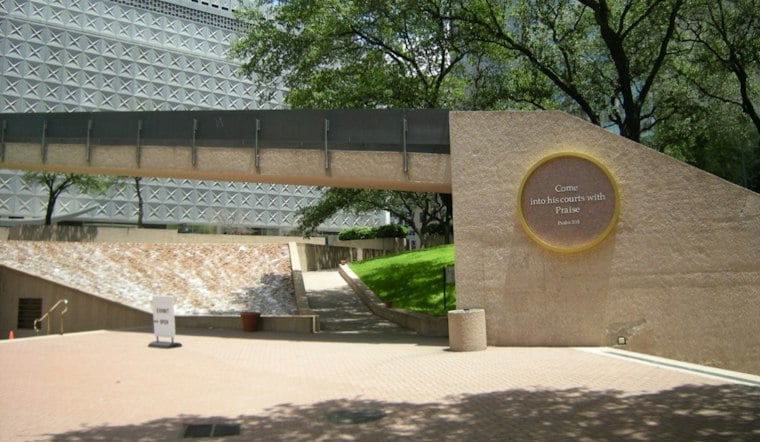
Dallas has stopped paying the Thanks-Giving Square Foundation roughly $500,000 a year under a decades-old lease, and the nonprofit that runs the downtown park has sued the city to try to force it to keep paying. The dispute arrives just as the foundation celebrates the 50th anniversary of what is considered downtown Dallas's first park, even as it says the lost funding represents more than half of its annual revenue.
According to the Dallas Observer, the city notified the foundation in April that it would immediately halt the annual $500,000 payments, citing a lack of public benefit and the city's own financial issues. Dallas had signed a 75-year lease with Thanks-Giving Square back in 1973 covering the pedestrian tunnels that run beneath the park, and under that agreement the city had been paying about $65,000 in annual rent. The foundation maintains its contract with the city is solid and is seeking to enforce it; the Thanks-Giving Square Foundation filed suit against Dallas in October.
City officials have reportedly discussed the payments to the foundation since at least 2024, and the foundation says it was told the $500,000 would not be paid this year or in any future year. City Manager Kimberly Bizor Tolbert sent foundation president Kyle Ogden a letter informing him of a decision the council made in executive session, and the report notes Tolbert identified reworking the agreement, terminating the lease, or settling the matter in court as the possible paths forward. Ogden, for his part, said he empathizes with city officials but disagrees with their view of what is right.
A Park Born Out of Tragedy, Now Fighting for Funding
Thanks-Giving Square traces its roots to Dallas businessmen who envisioned the space after President John F. Kennedy was assassinated, in the late 1960s. Dallas civic and business leaders dedicated the park's interfaith chapel on Thanksgiving Day in 1976, the same year the city funded the convention center, the J. Erik Jonsson Central Library, and Dallas City Hall through the Goals for Dallas bond program. The site today includes an above-ground park, the interfaith chapel, and the underground tunnels woven into the city's pedestrian network.
Ogden has acknowledged that the tunnels are less busy than they once were, though he said some of that underground space could become viable again if demand grows. Despite the funding fight, he told the Dallas Morning News the shortfall could represent a potentially lethal blow to the organization — but he insists the foundation itself is grateful to its supporters and no less thankful because of the dispute. Private donors have reportedly helped the foundation bridge the funding gap in the meantime, and the nonprofit says it aims to position itself as a cultural leader in the city. As part of that push, the foundation planned to run print ads featuring a Thanksgiving prayer for the first time, alongside a targeted social media campaign, this Thursday.
Budget Squeeze Sits Behind the City's Decision
Dallas's move to cut the park payments comes as the city grapples with its own fiscal strain. City staff have projected that revenues for fiscal year 2026-2027 will fall roughly $51 million short of planned expenditures, a preliminary figure reported by the Dallas Observer. The size of the prior year's gap is described differently depending on the source: the Observer's reporting tied to the Thanks-Giving Square dispute put it at $30 million, while a separate Observer report on the broader budget crunch pegged last year's shortfall at $36 million, noting that council members closed the Skillman Southwestern Library and three community pools to close that gap.
City staff have pointed to a declining population and shrinking tax base, a stagnant job market, rising costs, and falling commercial property values as drivers of the projected deficit, the outlet reported. Dallas City Manager Kimberly Bizor Tolbert put it plainly in a statement to CBS News Texas: “The city's traditional revenue patterns are no longer keeping pace with spending.” Dallas has proposed a $5.66 billion budget that would eliminate 296 jobs and save $17.3 million, according to the same report, with 30 Parks & Recreation positions on the chopping block and special-events funding for aquatics resources ending altogether.
The city council ultimately voted to downgrade its healthcare plan, lay off employees, and reduce parks maintenance funding in the adopted budget. Other proposed cuts reportedly included stipends for the Dallas Zoo, the Dallas Arboretum, and Cedar Ridge Preserve, and the park department had been weighing roughly $14 million in reductions that could have closed three recreation centers and cut back on mowing at public parks, per the Observer's earlier reporting. Dallas has described the budget pressure as stemming from rising costs, stagnating revenue, and state-imposed revenue caps.
What the Law Says, and What It Doesn't Settle
Texas law does give municipalities some leeway to lease public property. A provision in the Texas Local Government Code's Chapter 253, cited in the dispute, allows a municipality to lease a street, alley, or public square so long as the lease bars the lessee from using the surface — though the available excerpt does not spell out how that rule applies to the Thanks-Giving Square tunnels specifically. A separate provision in Chapter 272 allows a political subdivision to lease property it owns to promote a public purpose, but again the text available does not resolve the underlying dispute between the city and the foundation.
With the lawsuit pending, the exact legal footing of both sides — and how a court might ultimately rule — remains unresolved. For now, the Thanks-Giving Square Foundation is marking its 50th year leaning on private donors and a public appeal for goodwill, even as it fights in court to keep the payments it says the city promised more than five decades ago.





