

























































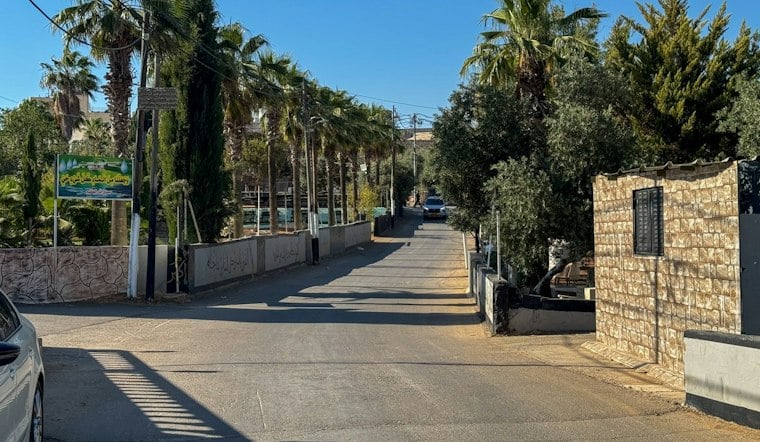
Mohamad Ihmoud grew up in Dallas and spent his summers at his family's plot of land in the West Bank village of Turmus Ayya. Last month, he says his family got a phone alert that someone was breaking into that village home — and it turned out to be Israeli forces, not burglars. The family has since returned to Turmus Ayya demanding their house back, only to find the U.S. Embassy unwilling to intervene on their behalf.
According to The Dallas Morning News, Ihmoud and his family contacted the U.S. Embassy repeatedly for help after Israeli forces took over the house. The embassy turned down their requests, instead advising the family to go back to Turmus Ayya themselves and ask Israel's military to return the home. The account mirrors a pattern playing out across the same village and the broader occupied West Bank.
Eight days earlier, Palestinian-American writer Andaleeb Mahmoud described a strikingly similar ordeal in Turmus Ayya in a first-person account published by Zeteo. Mahmoud wrote that Israeli soldiers invaded her family's home on Oct. 25, 2026, and occupied it for nearly three weeks. She says she, too, repeatedly asked the U.S. Embassy for assistance and was told, in her words, “I was expected to go to my property and face the armed soldiers myself.”
A Husband Pushed, Tear Gas Fired
Mahmoud's account says her husband, Naji Abu Awad, was pushed and threatened with arrest when he tried to speak with the soldiers stationed outside their home, and that soldiers fired tear gas at people who had gathered there. She wrote that the troops eventually left on a Friday and that the family returned to find their home trashed.
Mahmoud's account also describes her husband, Naji Abu Awad, visiting the home.
A Wider Pattern Across the West Bank
The Turmus Ayya cases sit alongside a string of other disputes over land access and home seizures documented elsewhere in the West Bank this month. In Deir Abu Mishal, resident Saleh Zahran said settlers attacked his family's vehicles when he and his brothers tried to reach their own land for the first time in five months, as detailed by Al Jazeera. “They threw stones, smashed the family's truck and his brother's four-wheeler and slashed the tyres,” the outlet reported. On November 10, an Israeli High Court decision granted the village just two days of army-coordinated olive harvesting.
Al Jazeera's reporting also cites a Yesh Din legal objection in the village of al-Mughayyir, which found that a closure order there was enforced only against Palestinian landowners while settlers continued to graze, plough and build on the same plots. Researcher Dror Etkes told the outlet that such closures, imposed without formal orders, are common across the occupied West Bank. A Kerem Navot and Peace Now report cited in the same piece found that farm outposts effectively controlled more than 1 million dunams — about 18 percent of the West Bank — by the end of 2025.
Deadly Violence Near Jericho
Some of this month's incidents have turned fatal. A 72-year-old Palestinian woman, Fadda Fuhaidat, was shot and killed near Jericho, according to Palestinian officials and eyewitnesses cited by CNN. The Palestinian Health Ministry said six other Palestinians were shot and injured during the same incident. CNN reported that Israeli settlers had taken over eight Palestinian homes near Jericho roughly two weeks before the shooting, and the network separately noted a photo showing an olive tree and a Palestinian-owned vehicle reportedly set alight near Turmus Ayya on October 16, 2026.
The station's report described near-daily attacks, thefts or vandalism by Israeli settlers against Palestinians across the West Bank in recent months. In the village of Jalud, south of Nablus, the BBC reported that more than 100 Israeli settlers carried out attacks that stopped the al-Tubasi family from returning to homes that had been seized weeks earlier, with two of the family's houses set on fire during a raid Monday night. The pattern of settler violence extends across the West Bank.
For the Ihmoud family, the broader statistics underscore a dispute that remains deeply personal. Mohamad Ihmoud, born and raised in Dallas, says his family visited its home every summer and has returned to Turmus Ayya to ask for it back; the U.S. Embassy declined to press the matter on their behalf.





