

























































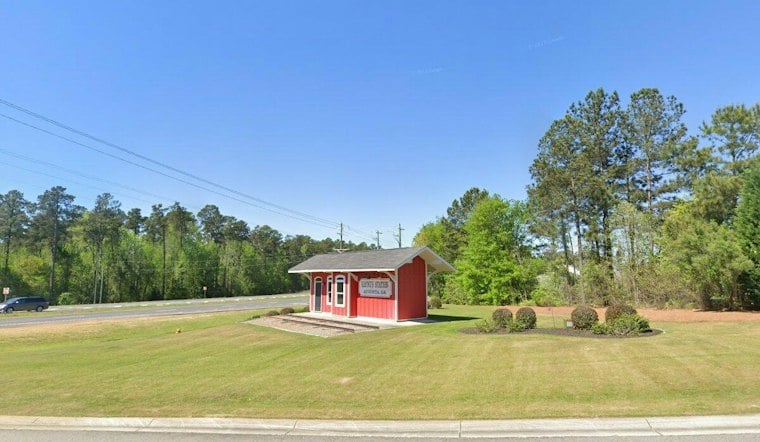
Zakiya Mabery bought her home in Hayne's Station, a neighborhood in Augusta, Georgia, months before a 200-acre, $2 billion data center was authorized a 10-minute walk away. She said she only learned about the project — known as Project Eisenhower — after officials had already approved it. Had she known it was coming, she said, she would not have bought the house.
Her experience is far from isolated, according to reporting from WBRZ, which cites research showing majority-Black communities are more than twice as likely as majority-white communities to host a data center and are less likely to receive notice or a chance to comment before projects are approved. Project Eisenhower was first authorized in 2022 without a public hearing, according to Mother Jones, and construction began earlier this year. The neighborhood closest to the facility is 67% Black, and among people who have moved into Hayne's Station specifically, two-thirds are Black.
“It seems like (processes) are being built to silence citizens,” Mabery said, according to the same reporting. Residents have sought a voice and meaningful representation.
A Tool Tracks Who Gets a Hearing — and Who Doesn't
The hearing disparity shows up nationwide. Communities that received a public hearing before a data center's construction were nearly 80% white on average, while communities that never got one were roughly 60% people of color, per Mother Jones's analysis of a tool called Zoned Out. That tool was created by researchers at Harvard University, according to ABC News, and led by Aino Halonen, a former AI worker. Dozens of AI data centers serving communities home to hundreds of thousands of Americans have been approved without a public hearing in recent years, the outlet reports.
The stakes of a hearing are significant: according to Zoned Out, data centers were blocked 66% of the time when communities got a hearing, but approved 80% of the time when they did not. Whether residents get that chance often comes down to zoning. Rezoning land from commercial to industrial generally requires public notice, a hearing, and a vote — but when land is already zoned industrial, developers can secure permits through administrative review without any opportunity for residents to intervene, the outlet notes.
Researchers Controlled for Income and Power Lines — Race Still Mattered
Researchers from George Washington University Law School and American University analyzed more than 5,200 U.S. data centers, accounting for income, population density, home values, and proximity to major power lines. Even after those adjustments, neighborhoods with larger Black, Latino, and Asian populations remained most likely to report negative experiences with data-center development, ABC News reports. Dhanaraj Thakur, director of the Fair Technology Initiative at George Washington University, said race remains a notable factor even after those controls.
Thakur's research also found that communities of color are less likely to receive major economic benefits from data centers, while Meta, Google, and Microsoft campuses are more likely to be located in majority-white neighborhoods and more likely to generate property-tax revenue and community benefit agreements, according to the same ABC News report.
A North Carolina Developer Moved the Project — and Got a Different Answer
A pattern of relocation after resistance also emerged in North Carolina. In one wealthy, 65%-white community, thousands of residents submitted signatures and comments against a proposed data center, and the developer withdrew the project, per ABC News. Weeks later, the same developer proposed the project in another North Carolina county, where the closest neighborhood was predominantly Black with a median income one-third that of the former community. County commissioners there approved it in a 6-1 vote.
Capital B has reported that developers pursued projects in poorer, majority-Black neighborhoods with laxer hearing requirements after facing opposition in wealthier, whiter areas. Separately, officials in Stokes County, North Carolina voided a rezoning approval for a project known as Project Delta after determining the county had failed to meet statutory notice requirements, according to Data Center Dynamics.
Louisiana's Massive Meta Project Sits Near Majority-Black Towns
In northern Louisiana, Meta is building what is described as North America's largest data center project, near Holly Ridge in Richland Parish. The project is set to span nearly 10 million square feet, or about 229 acres, according to Business Insider. The two towns nearest the site are over 80% Black, and the broader area is home to three times the national-average share of Black residents, Capital B reports.
Meta says the data center will eventually support 1,000 permanent jobs, for which Louisiana has granted the company roughly $3.3 billion in sales-tax exemptions over 20 years, per Capital B's reporting. During a week observing the site last fall, Capital B staff reported seeing or speaking to no Black workers leaving the facility. Separately, in Eatonville, Florida, a data center is being built on part of the former Hungerford School property, which served generations of Black students — a project some residents and advocates argue could limit the futures of the town's Black children, according to a report carried by Yahoo News.
Pollution, Emissions, and a Longstanding Pattern
Data centers have increased PM 2.5 air pollution, and Black Americans die from PM 2.5 pollution at the highest rate in the United States, per the reporting; the pollutant can cause respiratory and cardiovascular disease and has been linked to asthma attacks, strokes, dementia, and cancer. America's largest data centers are responsible for an estimated 25.7 million metric tons of carbon dioxide emissions annually, a contributor to the broader intensification of climate change, according to Mother Jones.
Advocates describe the pattern as an extension of longstanding environmental racism, with Black communities bearing pollution and disinvestment while the wealth data centers generate flows elsewhere. Augusta resident Charles Zabel said residents should have a voice in decisions affecting their homes and lives. Augusta's Board of Commissioners approved a temporary moratorium on data center development this summer, though the moratorium excluded the $2 billion Project Eisenhower construction already underway.
Voters Weighed In — But Not Everywhere Equally
During the November midterm election, more than 40 jurisdictions nationwide let voters decide via ballot measure whether they wanted data centers in their communities. Residents in those jurisdictions were, on average, over 83% white and less than 5% Black, according to Mother Jones's analysis — meaning the communities given a direct vote looked little like the ones where projects have been approved without hearings.
Communities have organized resistance to data center projects. Researchers say media coverage, political influence, and organizing resources are unequal across communities, and Thakur has said that media attention focused on only some opponents can erase the underlying racial inequality. Capital B has separately highlighted Black communities fighting data centers from Memphis to Maryland and Mississippi.
Federal policy has also shifted the landscape. The Trump administration ordered agencies to exempt data center projects from federal environmental review and to revise federal rules to accelerate construction, while President Trump has pushed federal agencies to limit public-comment opportunities — actions advocates say have favored technology companies through the use of government authority, according to the reporting.





