

























































An 1886 house in Dayton's Wright-Dunbar Village that once belonged to a World War I captain and a pioneering Black businesswoman is getting a painstaking second act. Stephanie and Kyle Goens bought the Mallory House in October 2025, and they've spent the months since replacing a leaking roof, repairing 33 Marvin windows, and planning everything from a Victorian wrought-iron fence to a possible small wedding venue.
The home was built around 1886 by Thomas Coffman, and it still retains its original front door, complete with a doorknob bearing a letter B thought to stand for Boone, according to the Dayton Daily News. Harriet Boone acquired the house in 1892 and later left it to her daughter, Flora. Boone herself holds a notable distinction in Dayton history: she was the first African American woman in the city to own a beauty and goods shop, per the same report.
Around 1910, the house received a significant addition, an update attributed to the county recorder's office. That work involved William Avery, a prominent African American contractor who also served as contractor for Zion Baptist Church on Mound Street. Avery was also a local carpenter who, in the late 1800s, helped build gliders — a detail tying the house to Dayton's deeper aviation-era history.
A Captain's Legacy on West Dayton's Doorstep
The home's best-known resident may be Captain Robert H. Mallory, whom the National Park Service associates with the house as a residence. Mallory served as a captain in World War I and later spent 17 years as executive director of the Linden Community Center, working to advance Dayton's African American community interests and quality of life, the paper reports.
The house sits in the Wright-Dunbar Village Historic District, just west of the Great Miami River, a neighborhood with deep roots in Dayton's Black history. African Americans began moving to the city's west side in the 1870s, and from the 1920s through the early 1960s the area became a vibrant center of residential, commercial, and social life for African Americans, according to Preservation Dayton. The district earned its local historic designation in 2002.
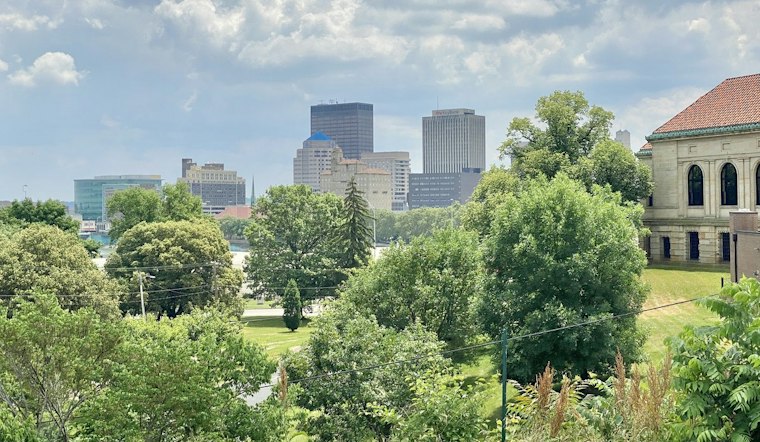
Not every structure in the area survived intact. The City of Dayton tore down other houses near the Mallory House in 1999, the Dayton Daily News reports, leaving the home with a park and water fountain next door today instead of its original neighbors.
From Leaking Roof to Reclaimed Tile
When the Goenses bought the property, it was livable but needed major repairs: a leaking roof, gutters in need of replacement, basement water intrusion, and windows in poor condition, even though electricity and plumbing had already been updated. The couple started with the structural basics, tackling the roof and attic first, before moving on to finishing floors and shifting walls and bathrooms.
Stephanie Goens, who has lived in the Belmont area for 28 years, is treating the porch and front door as her own personal project. Her broader plans include a scullery, landscaping, a Victorian wrought-iron front fence, reclaimed vintage tile, and a garage with a possible apartment above it. She and Kyle are also avid pool players who say they need space in the house for a large pool table, according to the Dayton Daily News report written by Jessica Graue, the paper's digital audience engagement specialist.
Goens has floated an ambitious long-term idea for the property: she believes the Mallory House could become a small historic wedding venue someday. For now, she says she's looking forward to simply moving in and showing the house to longtime neighborhood residents who remember it from before the renovation began.
Recognition and a Neighborhood on the Rise
The renovation work has already drawn outside notice. The Mallory House renovations received an Excellence in Preservation award from Preservation Dayton, and Goens said she and her husband appreciated the recognition for undertaking difficult work on the house.
The Mallory House's revival fits into a broader wave of investment along West Third Street. Just blocks away, the Cornerstone project is transforming three adjacent buildings near Third and Broadway, including the 1912 Sapp Building, into new retail and office space backed by an additional $300,000 in city grant funding meant to help support $6 million in private capital investment in West Dayton, according to Dayton Vistas. That project is expected to bring in XO Burger, Haymarket Deli & Sweets, Saoko Leaf & Wine, and the Greater West Dayton Incubator, which will occupy 4,000 square feet of second-floor office space. It follows the 2022 opening of the West Social Tap & Table food hall nearby.
Elsewhere in Dayton, historic restoration has been drawing comparable investment. The Paul Laurence Dunbar House, the poet's final residence, recently underwent a $700,000 restoration that addressed structural needs and foundation stabilization while preserving its historic appearance, per the Dayton Business Journal. Owners of properties on the Dayton Register of Historic Places are generally required to obtain a Certificate of Appropriateness from the city's Department of Planning and Community Development before exterior repairs or demolition, according to City of Dayton guidance.




