

























































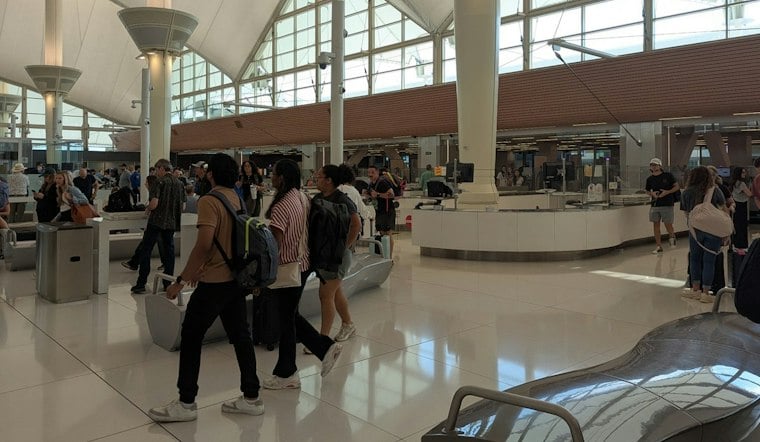
A former food preparer at the Taco Bell inside Denver International Airport has sued the restaurant's operator in Colorado state court, claiming she was never paid for the time she spent clearing security and walking to her workstation before clocking in. She also alleges the company failed to provide paid rest breaks required under state law.
According to Law360, the lawsuit accuses the operator of failing to pay hourly employees for time spent undergoing security screenings and getting to their workstations before clocking in. The same filing alleges the company failed to provide paid rest breaks, a separate claim that mirrors complaints seen elsewhere in Colorado's restaurant industry.
Why Colorado's Wage Rules Could Matter Here
Colorado’s wage rules may be central to the dispute. The Colorado Department of Labor and Employment says required security or safety screenings, including waiting time, can count as paid work under the state wage order. Its guidance gives federally required radiation screening for nuclear plant guards as an example of a mandatory screening that may qualify.
The agency also addresses walking from an entrance to a workstation after paid activity has begun; the state’s travel-time rule includes an exception to the ordinary commute exclusion once compensable work starts. Gary Leff, writing about the lawsuit for View from the Wing, characterized Colorado’s treatment of security screening as unusually favorable to workers compared with other states.
Competing Arguments Over Whose Clock Is Running
In Leff’s account, the concessionaire characterizes the shared airport checkpoint as part of employees’ commute, outside the restaurant’s premises and supervision. The worker argues that screening is a required step to reach her assigned workplace and should count as paid time under Colorado law.
Federal law presents a different framework. In Integrity Staffing Solutions, Inc. v. Busk, the U.S. Supreme Court held that warehouse workers’ time waiting for and undergoing security screenings was not compensable under the FLSA. That decision addressed the screenings in that case; it does not resolve the Denver worker’s claims under Colorado law.
Precedent Cuts Both Ways
A 2024 federal court ruling illustrates the distinction between federal and state claims. In Rael v. Q3 Contracting, a judge dismissed FLSA claims over vehicle inspections and commuting time, finding the complaint did not sufficiently allege that driving was a principal employment activity. The judge allowed claims over the same time under the Colorado Wage Collection Act to proceed, according to the U.S. District Court for the District of Minnesota.
A different outcome favored the employer in 2021, when the Ninth Circuit affirmed dismissal of an airport worker's unpaid-wage claim because the complaint did not allege facts showing that Host International exercised control over him during TSA security checks, according to the U.S. Court of Appeals for the Ninth Circuit, via Justia. That case, like the Denver suit, turned heavily on the specific facts alleged about employer control during screening.
Rest-break claims have also surfaced elsewhere in Colorado's restaurant industry. Law360 separately reported that a proposed class action accused a Benihana operator in the state of denying workers required rest breaks and failing to pay them for time spent working through those breaks, a filing lodged in state court in September.
Colorado’s Paid Rest-Period Rule
The Colorado Department of Labor and Employment’s 2024 COMPS Order poster says employees covered by the order generally receive paid 10-minute rest periods every four hours. The order also has exemptions and variances, so the requirement does not apply universally.
What Comes Next
No ruling or settlement has been reported in the Denver case. Leff predicted in his View from the Wing article that the dispute could end in a negotiated payment rather than a clear win for either side, and could prompt similar claims by airport concession workers subject to the same pre-shift security routine.



