

























































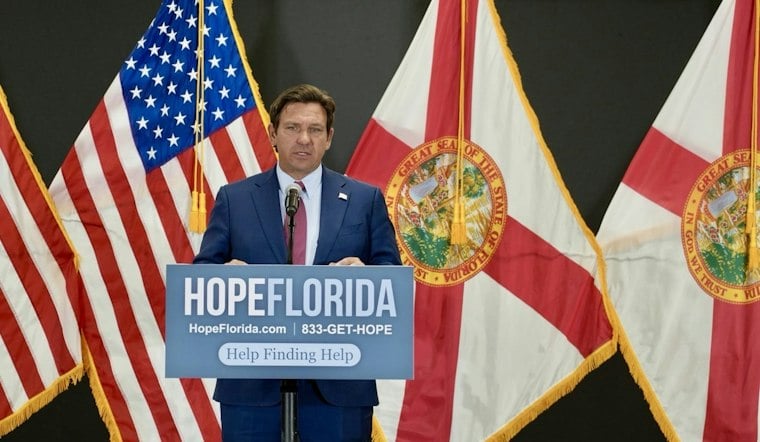
Florida Gov. Ron DeSantis says the U.S. military campaign against Iran went on far longer than anyone expected, failed to topple the government it was reportedly meant to remove, and is now dragging down Republicans ahead of the next election cycle. Speaking Saturday at the Notre Dame Center for Citizenship and Constitutional Government, DeSantis argued the mission lacked a clear public consensus and no real endgame was ever articulated.
“I think their goal was to have the government collapse, and that didn’t happen,” DeSantis said, according to Florida Politics. He drew a sharp line between that broader campaign and Operation Midnight Hammer, the June 2025 strike on Iranian nuclear facilities, which he said he backed. Expanding the mission beyond removing those problematic sites, he argued, pushed the operation into territory that was never tenable.
DeSantis also raised a timeline discrepancy that he said undercut the stated rationale for continued action. He noted that protesters who had been demonstrating in Iran in January were already dead by the time the U.S. moved militarily in late February, per the same Florida Politics report. He separately pointed to confusion at the top of the administration itself, saying Secretary of War Pete Hegseth, the Secretary of State and the Vice President each offered different explanations when the conflict began: “Secretary of War Pete Hegseth said one thing. The Secretary of State (said) something else. The Vice President… they all said a little bit different.”
Competing Accounts of the Mission’s Goals
That claim of mixed messaging stands in some tension with the Pentagon's own public framing of the operation. On March 19, Hegseth said the U.S. objectives in the war against Iran had not changed since strikes began on February 28, describing the goals as destroying Iran's missile launchers, its defense industrial base and its navy, and preventing Iran from ever obtaining a nuclear weapon, according to Reuters. DeSantis's account and Hegseth's public statement describe the moment differently, and the dossier does not resolve which framing governed the administration's actual decision-making.
DeSantis went further, arguing that forcing regime change in Iran outright would require “massive amounts of boots on the ground, massive amounts of treasure” — a commitment of ground troops and spending he said the American public would not support, per Israel National News. He also questioned who exactly the United States would negotiate a lasting peace with, and warned the conflict could drag on indefinitely as an open sore in American politics.
Gas Prices and a Warning to Fellow Republicans
DeSantis tied the war's duration directly to pain at the pump, saying rising energy costs ripple through the entire economy. “When energy goes up, that permeates the economy as a whole,” he said, per the Florida Politics report. Those remarks land against a backdrop of real market movement: the U.S. Energy Information Administration raised its forecast for Brent crude to about $98 a barrel for 2026, an 8% jump from its prior month's forecast, with Reuters reporting the agency attributed the spike to the U.S.-Israeli war on Iran disrupting oil flows through the Strait of Hormuz.
A Dallas Fed working paper by economists Lutz Kilian, Michael D. Plante, Alexander W. Richter and Xiaoqing Zhou modeled how a prolonged Strait of Hormuz closure could ripple through consumer prices. The paper, which marks the Iran War's start as February 28, 2026, discusses a one-quarter closure scenario.
Political Stakes After the Midterms
DeSantis warned that the political cost could be steep for his own party. He said the war and higher gas prices were hurting Republicans broadly, cautioning that if the conflict continued through the rest of Trump's presidency, “it is going to be very, very difficult for Republicans in the next cycle,” according to The Hill. He also noted that Donald Trump had campaigned on avoiding a Middle East war, yet the country wound up in one regardless.
Public sentiment appears to back up part of DeSantis's warning. An Associated Press poll cited by The Intercept found roughly six in ten voters believed the United States made the wrong decision in attacking Iran. Whether that sentiment shifts votes in the next election cycle remains an open question, but DeSantis's remarks at Notre Dame suggest at least one prominent Republican governor sees the war, not just its outcome, as a liability his party will have to answer for.





