

























































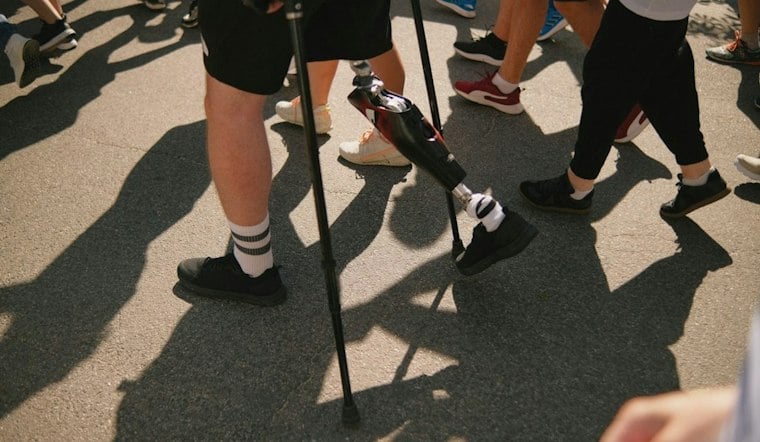
A musician with deep Detroit ties has helped turn concert proceeds into prosthetic limbs for Palestinians who lost arms or legs in the Gaza war, with the small nonprofit he co-founded reporting it has served or coordinated treatment for nine patients as of its October update. Three of those prosthetic limbs went directly to patients inside Gaza, while the organization has also arranged care for six more people scattered between Jordan and the United States.
The effort is called Prosthetics for Palestine, co-founded by musician Tarik “Excentrik” Kazaleh and Jamie Elmasu, who launched it roughly two years ago, according to MLive. The program operates under the nonprofit Physicians for Palestine, which says on its own site that it launched Prosthetics for Palestine in collaboration with the Healing Hands Fund in response to rising amputations in Gaza, according to Physicians for Palestine. Kazaleh and Elmasu now live in California, but the Detroit connection runs through a summer benefit concert and the musician's own history performing in the city's Arab American music scene.
A Scale of Need Far Bigger Than the Response
The gap Prosthetics for Palestine is trying to close is staggering by any measure. SciDev.Net reported that one in five of more than 5,000 people who underwent amputations was a child, according to SciDev.Net; Reuters reported in April 2026 that the World Health Organization counted only eight prosthetists still working in the territory, according to Reuters. A separate report citing an ICRC spokesman put the number of prosthetic and orthotic professionals in Gaza at nine, per SciDev.Net. The same outlet reported that of 2,300 amputees assessed in Gaza between September 2024 and May 2026, fewer than a quarter had received permanent prosthetics, and that 18 shipments of rehabilitation supplies were stuck awaiting clearance as of mid-April 2026, with wait times ranging from 130 to 520 days.
The toll on children has been especially severe. The World Health Organization’s Eastern Mediterranean Regional Office reported that more than 10 children in Gaza lose one or both legs every day, and that over 1,000 children had lost limbs since the conflict began in October 2023, according to the agency. The same report noted Gaza lacks the specialized services and expertise needed to address complex limb-loss cases, and that children often need their prostheses modified, repaired or replaced every six to 12 months or sooner as their bodies grow.
From Hip-Hop Shows to Prosthetic Clinics
Kazaleh, who began performing hip-hop in the 1990s and later joined Arab Summit, a collective of Arab American musicians, now performs with the Shadow Band, blending Arabic music with jazz, funk and hip-hop, per MLive's reporting. He released an album called Watani77 specifically as a fundraiser for Prosthetics for Palestine, and in July 2026 a benefit concert titled Watani77: Prosthetics for Palestine was held at Cairo Coffee in Detroit. That Metro Detroit summer show raised $10,000, and by the time of the organization's October interview, the broader music fundraising project tied to the album had brought in roughly $24,000 total.
Detroit public relations professional Rasha Almulaiki helped organize the July concert, according to MLive. The Detroit Metro Times described a benefit concert with a goal of raising $10,000 through admission and donations, with organizers saying proceeds would help purchase two ambulances, build a prosthetics clinic in Ramallah, and expand rehabilitation and prosthetic services; the report also noted Prosthetics for Palestine works with the Artificial Limb and Polio Centre in Gaza and the Palestinian Red Crescent Society. Kazaleh said the Detroit concert proceeds could cover the estimated cost of five prosthetic limbs. “That's five people whose life has been permanently altered in a positive way,” he said.
How the Prosthetics Actually Get Made and Delivered
Prosthetics for Palestine says it has obtained clearance to bring devices into Gaza and works with the humanitarian shipping organization Airlink and other partners to move supplies. The organization partners with Limber Prosthetics & Orthotics, a San Diego-based company that makes 3D-printed lower-limb devices; its Limber Unileg model uses a largely nonmetallic design. Each device is customized to a patient's measurements, weight and physical needs, and the organization estimates every prosthetic costs approximately $2,000 once liners, shoes and socks are factored in. Patients often need adjustments as their bodies change and they regain mobility and muscle strength, which is why the group is now arranging replacement liners for patients still in Gaza.
Beyond the three patients treated directly in Gaza, the organization has coordinated treatment in Jordan for two Gaza patients who relocated there, and in the United States for four more patients. In one case, the group connected a Palestinian mother who had lost a limb and was accompanying her child in the U.S. with treatment through a Texas provider. A comparable Detroit case made headlines separately this year when 13-year-old Mohammed, who lost his leg in Gaza, traveled to the city to receive a prosthetic through the Detroit Palestine Children's Relief Effort, which arranged a host family for him, according to FOX 2 Detroit. Anew Life Prosthetics and Orthotics donated its services for that fitting, with the provider estimating a leg like his would normally cost at least $10,000 to $12,000.
Mapping Gaps Before Building Permanent Clinics
Elmasu said the initiative’s broader aim is to build a long-term care system led by Palestinians themselves rather than one dependent on outside aid delivered case by case. That ambition echoes the stated goal of the Limb & Life research collective, which says it is dedicated to describing pressing challenges in rehabilitation services and supporting locally led systems of care that reduce dependence on international aid, according to MIT Media Lab. Prosthetics for Palestine is now working with that same collective to assess prosthetic and rehabilitation facilities across Gaza and the West Bank, with the first phase covering 15 facilities as of October 2026.
That facility assessment is meant to identify shortages in equipment, supplies, clinical capacity and other barriers to prosthetic care, with findings expected to guide future investment in clinics, manufacturing facilities and professional training. The organization has also secured a location for a prosthetics clinic in Al Bireh, near Ramallah, which could eventually support manufacturing capabilities of its own. Alongside the physical infrastructure, Prosthetics for Palestine is developing education and credentialing programs meant to train Palestinian prosthetic technicians and support advanced clinical qualifications, since, as Kazaleh put it, there simply aren't enough trained prosthetics professionals to meet the growing need.
Looking to Scale Up in 2027
The group’s October update laid out a goal of expanding patient care to between 50 and 100 people in 2027, a significant jump from the handful of patients served so far. To get there, Prosthetics for Palestine says it is seeking metro Detroit medical professionals and volunteers to help with fundraising, administration, coordination, shipping and procurement, and the organization stresses that volunteers don't need medical degrees to contribute. Residents interested in supporting the effort can volunteer, host a fundraising event, or donate directly.



