

























































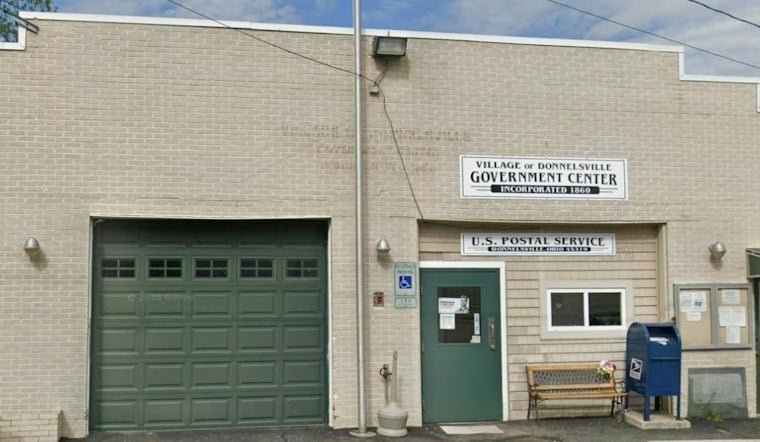
Donnelsville broke ground on a new water tower on November 5, the clearest sign yet that this tiny Clark County village is finally moving past decades of tainted well water. The $10 million project will connect more than 200 residents to municipal water lines, pulling from a well field in Park Layne rather than the contaminated aquifer that sits beneath their own homes.
Every household in Donnelsville currently relies on private wells, and residents have dealt with tetrachloroethylene, or PCE, contamination in their drinking water for decades, according to WYSO. PCE is a carcinogen that is toxic to humans even at low levels, and the chemical and other volatile organic compounds were widely used as industrial degreasers through much of the 20th century. The station reports that many tested wells in the village exceeded maximum contaminant levels for PCE and other VOCs.
A Contamination Trail That Stretches Back to 1990
The chemical was first found in Donnelsville's water supply in 1990, according to the EPA, as reported by the Springfield News-Sun. The Ohio Department of Health first pushed for U.S. EPA testing of Donnelsville's wells in 2011, and that same year the agency installed drinking-water treatment systems in affected homes as well as at the community park, the newspaper's reporting shows. Officials still have not identified the cause of the contamination, though one EPA document cited by the Springfield News-Sun names a former North Hampton Road manufacturer of truck, airplane, car seat and high-chair parts as a possible source — not a confirmed one.
In 2018, the U.S. EPA added the Donnelsville aquifer to the National Priorities List, the federal roster that identifies some of the most contaminated land in the country and makes sites eligible for long-term remedial action and funding under the Superfund law, per the U.S. EPA Superfund Site Profile. The agency is now leading a remedial investigation meant to locate the contamination source and determine how far the underground plume has traveled, work that includes contracting engineering firms to conduct soil borings around Donnelsville's town center. The PCE pollutant may migrate to other wells currently considered uncontaminated, underscoring why the new municipal system is meant to safeguard residents while that cleanup work continues.
Funding Finally Catches Up With a Years-Long Push
Donnelsville has sought funding for a public-water connection since 2018, and the money has arrived in pieces. The Ohio EPA provided an H2Ohio grant for engineering studies in 2023, and the village was awarded a $5 million grant in 2024. The Springfield News-Sun reported that $750,000 in H2Ohio grant funding previously given to the village was later transferred to the county to carry the project forward.
Whatever the exact figure, the Ohio EPA has provided grants and other funding to Donnelsville beyond that, and the remaining project funding will come from the Ohio EPA's Water Supply Revolving Loan Account, according to Clark County commission documents. That financing matters because the village, the state, or the county may ultimately have to pay for remediation of the contamination itself, separate from the cost of building the new pipes and tower.
What the New System Will Look Like
The new water tower will draw from a well field in Park Layne, and the system is designed to connect that well field to Donnelsville via State Route 235. County residents along that route will also be able to connect to the public water system once it's built. The Clark County Utilities Department will construct the system on Donnelsville's behalf and will own and maintain it going forward.
Beyond simply replacing contaminated wells, the municipal system will include fire hydrants and will provide a verifiable water supply tested daily — something individual private wells are not. The water system is expected to become operational sometime between late 2027 and early 2028, per the station's report.
Joe Taylor, who has an environmental engineering background, said the U.S. EPA plans to hold a community meeting about next steps soon, though the agency has not announced a specific date. For a village with a 2021 U.S. Census population of 256 that has spent more than three decades waiting on a fix, the groundbreaking is progress — but residents will keep drawing from their wells for at least another year while the new system takes shape.




