

























































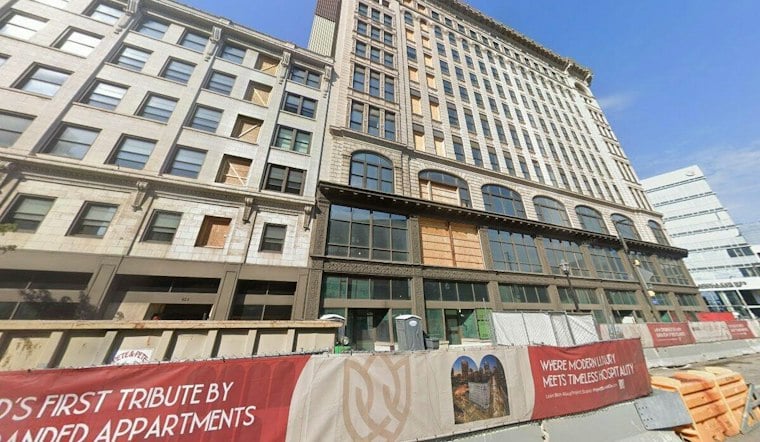
A $108 million redevelopment of two downtown Cleveland buildings into a luxury hotel and residences has become the first project in the city to sign an agreement promising to pay some workers Cleveland's fair employment wage of at least $16.85 an hour. Project Scarlet will transform the Rose Building at 2060 E. 9th St. and the Sloan Building at 823 Prospect Ave., with interior demolition already part of the plan for both structures.
The wage commitment, detailed by Signal Cleveland, covers two distinct phases of the project. During construction, the developer will use good-faith efforts to hire at least 10 Cleveland residents at the fair employment wage. Once the hotel and residences open, the developer has committed to paying that same living wage for two years to some workers in housekeeping, at the front desk, in maintenance and in food service — though the agreement doesn't apply to servers, bartenders and others who primarily work for tips, and it doesn't specify how many total jobs will be covered.
Cleveland's fair employment wage, officially the city's living wage standard, currently sits at $16.85 per hour, compared with Ohio's $11 minimum wage. Both figures adjust annually based on inflation, the same report notes. For context, the MIT Living Wage Calculator puts a true living wage in the Cleveland metro area at $21.14 an hour for a single adult with no children, rising to $52.93 for one adult raising two kids.
Who's Footing the Bill, and Who's Enforcing the Deal
Project Scarlet is receiving at least $13.3 million in city financial assistance, including a loan and tax increment financing, with a tax abatement still to be determined by the city, according to the same report. The agreement was signed under Cleveland's community benefits agreement policy, which the city strengthened in 2023; Tyson Mitchell, director of Cleveland's Office of Equal Opportunity, said the office has now executed 52 such agreements, which negotiate and monitor commitments from developers receiving city support.
Mitchell said many developers have resisted paying the fair employment wage, worried it would make their projects less competitive. Outside of city contracts — where workers must already receive at least the fair employment wage — other employers are only required to pay the living wage if they sign a legally binding agreement like this one.
Mitchell and Cleveland City Council Member Richard Starr, whose ward includes Central, worked together to secure developer support for the arrangement. Starr said residents should receive meaningful employment, fair wages and pathways to financial stability. Mitchell added that the wage commitment matters even though it covers only two years after the hotel opens.
A Developer's Pitch and a Union's Watchful Eye
Gregg P. Cramer, senior vice president of government affairs and business development for Green Harvest Capital/Sparck GHC, said the developer supports paying a living wage to attract and retain qualified workers. Cramer said the project is scheduled to be completed in 2028, and that the developer will reveal the project's official name in 2027.
The agreement also requires outreach to residents of Winton Manor, an affordable apartment building on Prospect Avenue for seniors and people with disabilities, about jobs, training and workforce pathways, and the developer has committed to hosting job fairs for Winton Manor residents.
For comparison, hotel front desk workers in Cleveland average $16.16 an hour, according to ZipRecruiter, while janitors average $15.53 an hour, according to Indeed — both below the $16.85 fair employment wage Project Scarlet has pledged for covered positions. SEIU Local 1, which represents janitors and security guards, launched a citywide campaign in 2024 to raise pay for low- and moderate-wage workers; Yanela Sims serves as the union's Ohio state director.
How This Deal Fits Cleveland's Broader Subsidy Picture
Project Scarlet's agreement arrives against a backdrop of dozens of similar city deals. Across 33 agreements executed from September 2023 through June 2025, Cleveland reported more than $156 million in projected financial assistance supporting more than $959 million in development, with developers committing to more than $147 million in projected contracting opportunities for certified firms, according to cleveland.com. Those agreements commonly set targets of 15% for minority business enterprises, 7% for female business enterprises and 8% for Cleveland small businesses, and typically call for Cleveland residents to perform 20% of construction-worker hours.
Cleveland.com's reporting also cautions that those figures represent contractual commitments, not proof that all benefits have been delivered — the city's public project pages do not consistently show whether hiring, contracting, apprenticeship, internship or neighborhood commitments have actually been fulfilled. Cleveland's community benefits agreement policy applies to projects receiving at least $250,000 in city financial assistance, with a two-tiered system requiring projects of at least $20 million to offer additional benefits, as Signal Cleveland's explainer on the policy lays out.
According to the City of Cleveland, the Mayor's Office of Equal Opportunity oversees contract compliance and provides guidance on prevailing wage laws tied to these agreements. For Project Scarlet, that office's negotiated wage floor now stands as a test case for whether future downtown developments follow suit.





