

























































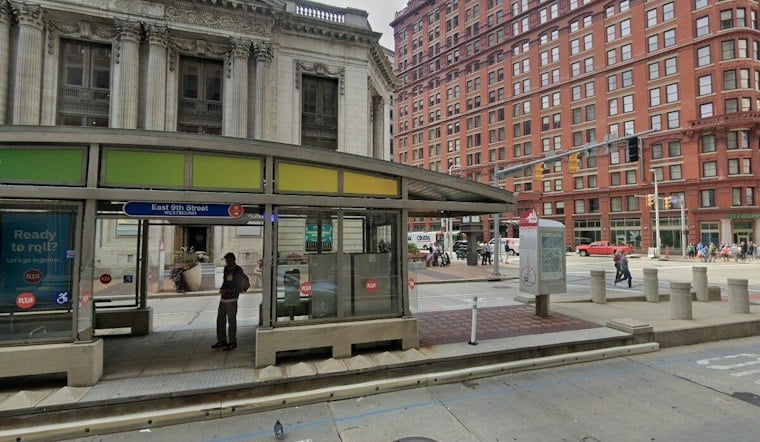
A federal foreclosure case involving The Centennial, a 102-year-old, 1.45-million-square-foot office tower at 925 Euclid Ave. in downtown Cleveland, has been paused until at least Dec. 17. The owner, lender and court-appointed receiver asked a judge to delay the scheduled auction while the owner seeks financing for a redevelopment that would include a data center.
U.S. District Court Judge Charles Fleming granted the joint request, giving owner HH Cleveland Huntington more time to pursue financing, according to neo-trans.blog, with which Cleveland Magazine has a content-sharing agreement. The motion was filed by HH Cleveland Huntington, an affiliate of Cleveland-based Millennia Companies, and principal Frank Sinito, along with Deutsche Bank AG, New York Branch, and receiver John Lane, CEO and managing partner of Mentor-based Inglewood Associates LLC. Boston-based Gordon Brothers had been set to conduct the court-monitored auction the following week.
Why the Auction Got Pulled Back
The foreclosure case has been before the U.S. District Court since January and involves HH Cleveland Huntington’s loan default and unpaid Cuyahoga County property taxes. A review of court records by neo-trans.blog put the combined debt and taxes at $40.1 million. That total differs from an earlier Cleveland Magazine report, which said the unpaid property-tax portion was $1.7 million. In the joint motion, Deutsche Bank and Lane said the owner and Sinito had presented stakeholders, including the county, with a proposal intended to resolve the case without a forced sale.
HH Cleveland Huntington paid receiver Lane a nonrefundable $200,000 deposit as part of the proposal. The joint motion says the receiver believes the proposed resolution could produce a better result for the property and its stakeholders than the scheduled sale. Under the proposal, ownership would remain with HH Cleveland Huntington; the motion also says other claims against the company would not be eliminated.
A Tech Campus Pitched Inside a Century-Old Bank Tower
The proposed redevelopment would convert the former Union Trust Bank Building, also known as the Huntington Building, into a mixed-use campus. The 1.45-million-square-foot tower is downtown Cleveland’s second-largest by floor area. Plans described by neo-trans.blog call for more than 200 apartments, about 420,000 square feet of office space, retail and advanced-technology space, a luxury hotel, a high-end restaurant, and a restored bank hall for conventions and events.
Hyperscape Digital, which describes itself as an AI-infrastructure developer, owner and operator, is identified as the project’s advanced-technology tenant. In an affidavit, co-founder of capital Kevin Carr said he manages a pipeline of more than 3.0 gigawatts of high-density AI compute campuses. Carr also said Hyperscape is working with HH Cleveland Huntington LP on a Cleveland campus combining technology and mixed-use space, and projected that the project would create thousands of jobs in Northeast Ohio. Those are claims in the affidavit; neo-trans.blog also reported that Hyperscape has a future Ohio vertical AI campus planned called the Opal.
Carr's affidavit lays out the financing picture behind the project: two potential lenders are under consideration, one a Silicon Valley family with more than 40 years of history, assets exceeding $3.5 billion, and liquidity exceeding $700 million; the other a private investor with a family-office extension in Orange County, California, with more than 20 years of history, assets exceeding $4 billion, and liquidity exceeding $350 million. HH Cleveland Huntington and its financial and development partners anticipate closing that financing on Dec. 17. “I believe HH Cleveland (Huntington) will be able to get the necessary financing to close on this project on or before Dec. 17, 2026,” Carr stated in his affidavit — a statement of his belief, not confirmation that the financing has actually closed.
Power Plans and the City's Data-Center Debate
Carr’s affidavit says Cleveland Public Power provided the project partners with a will-serve letter. It also says the project is designed to generate its own electricity and that power developed for the building could leave excess capacity for other Cleveland Public Power customers.
The proposal comes amid local debate over data centers. Cleveland Magazine reported that City Council passed a three-month moratorium in July while officials reviewed the zoning code. A cleveland.com report published Oct. 5 said the measure was set to expire Oct. 20; as of that date, no data-center legislation had been introduced and council had taken no formal position for or against the facilities.
Part of a Larger Downtown Office Conversion Wave
The Centennial proposal reflects a broader shift in downtown Cleveland’s office market toward residential use. A study cited by Crain’s Cleveland Business found that Cleveland led the Midwest in office-to-residential conversions, with 4.5 million square feet converted. The nearby Rockefeller Building is slated to reopen as apartments within three to four years.
A completed downtown example is the Halle Building. Cleveland Construction says its renovation, completed in mid-January 2019, converted floors 6 through 12 of the 12-story, 323,000-square-foot building into 122 apartments while retaining offices and retail on the lower floors—a smaller and differently configured project than the Centennial proposal, according to Cleveland Construction.
Millennia's finances have drawn scrutiny beyond The Centennial as well. The company previously faced a separate foreclosure lawsuit over another downtown property, The Statler, after Union Labor Life Insurance Company alleged Millennia had defaulted on a $52 million mortgage, according to cleveland.com's reporting from September 2025.
The Dec. 17 deadline is the next major checkpoint in the foreclosure case. If financing does not close and the case is not delayed again, the dispute could conclude by the end of 2026, leaving the tower’s proposed redevelopment or a return to auction as the potential paths ahead.





