

























































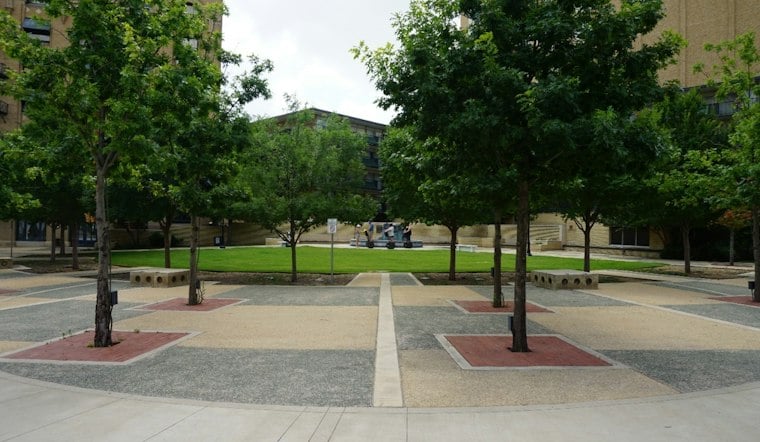
Three small downtown Fort Worth parks are in line for a different kind of attention. Downtown Fort Worth Inc. and the city’s Park and Recreation Department have announced a shared push to bring amenities to Lanham Plaza, John Peter Smith Park and Hyde Park.
The organization already manages Burnett Park and General Worth Square, and it plans to apply that system to the three other spaces, Fort Worth Report reported. Residents have asked for lights, furniture and cleaner landscaping. A construction schedule and a finished list of what gets built are not part of the announcement.
The Management System Comes First
Matt Beard, Downtown Fort Worth Inc.’s public improvement districts director, said the shift could “enhance the level of maintenance as well as any amenities that we could do in those parks.” He has also said the parks should serve as inviting spaces in urban Fort Worth and should do more than they have so far.
That is a care-and-programming argument before it is a design reveal. The same organization that already tends Burnett Park and General Worth Square would fold Lanham Plaza, John Peter Smith Park and Hyde Park into that routine, instead of leaving each one as a separate downtown leftover.
The language is still conditional. Beard tied the management system to maintenance and to amenities the organization could add. He did not name a contractor, a groundbreaking or a piece of furniture.
What The Monday Meeting Produced
Downtown Fort Worth Inc. hosted a Monday public input meeting with residents, business owners and other members of the public. The requests were ordinary and specific: more lighting, park furnishings, more trash receptacles, and a cohesive system of landscaping and planting.
The organization is analyzing that input. A wish list from a meeting is not an adopted plan, and the announcement does not say which of those features will be carried forward.
Councilmember Elizabeth Beck, whose district includes downtown, pressed the same point on Nov. 3. She urged people to recommend park enhancements and said community members should help shape future improvements, with public feedback used to build welcoming, functional spaces that reflect the city.
A $500,000 Pool, With A Wide Job
Parks officials and Downtown Fort Worth Inc. can draw on a $500,000 pool of park dedication funds for downtown parks and pedestrian spaces. The money comes from fees charged to developers constructing new housing.
The city’s Neighborhood and Community Park Dedication Policy is intended to keep parks and recreational facilities available as Fort Worth grows. Downtown is already feeling that pressure. A Nov. 3 news release tied heavier park use to a growing downtown population and to nearby projects that include the convention center expansion, Texas A&M School of Law and more housing.
The pool is for downtown parks and pedestrian spaces as a class. The announcement does not divide the $500,000 among Lanham Plaza, John Peter Smith Park and Hyde Park, or say that all of it will land on those three sites. Set against other downtown park ambitions, it is a modest pot: useful for lights and cans, not a riverfront rebuild.
Burnett Park Is The Working Example
Burnett Park is the clearest picture of what Downtown Fort Worth Inc.’s management has already produced. The organization says it replaced two recreational-area surfaces with artificial turf and padding, added a second deck on the south side to expand room for programming and park furniture, and installed perimeter tree lighting to brighten the sidewalks around the park.
Those improvements used grant funds from the Burnett Foundation and the City of Fort Worth, with funding assistance from Burnett Plaza, according to Downtown Fort Worth Inc. The Fort Worth Report has also described work at Burnett Park as ongoing. The turf, deck and tree lights are a sample of the playbook, not a pledge that Hyde Park gets the same deck.
Three Plazas Inside A Larger Map
The three parks also sit inside GREENprint, Fort Worth’s parks master plan. City staff held public meetings and focus groups while developing it. One focus group called for more investment in downtown parks and for converting surface parking lots into green space. The plan lists a central park as a department priority, connecting natural areas at the Trinity River confluence, downtown and future Panther Island. The city’s executive summary identifies the document as the Parks, Recreation, Open Space, and Public Realm Master Plan and carries a May 7, 2025 date.
A Nov. 3 news release said redevelopment of Heritage and Paddock parks was nearing 60% design completion. In separate reporting, the Fort Worth Star-Telegram described a $50 million funding goal for that redevelopment. It also reported that the Regional Transportation Council authorized $8 million, making the project eligible for Texas Department of Transportation review of its architectural plans, and that Fort Worth would provide $2 million in matching funds. That combined $10 million was tied to a pedestrian ramp from Paddock Park down to Heritage Park.
NBC DFW earlier described a roughly $40 million proposal to reopen Heritage Plaza, closed in 2007 over safety concerns. The proposal included upgraded landscaping, safety-related wall changes and waterproof LED lighting. City officials said the city would pay $19 million, with $12.5 million from a planned 2022 bond program, and the plan projected a June 2024 reopening if approvals went forward.
For Lanham Plaza, John Peter Smith Park and Hyde Park, the next documented step is narrower. Downtown Fort Worth Inc. is still sorting the meeting comments, and the dedication-fund pool remains a resource for downtown parks and pedestrian spaces rather than a check already written to these three sites.





