

























































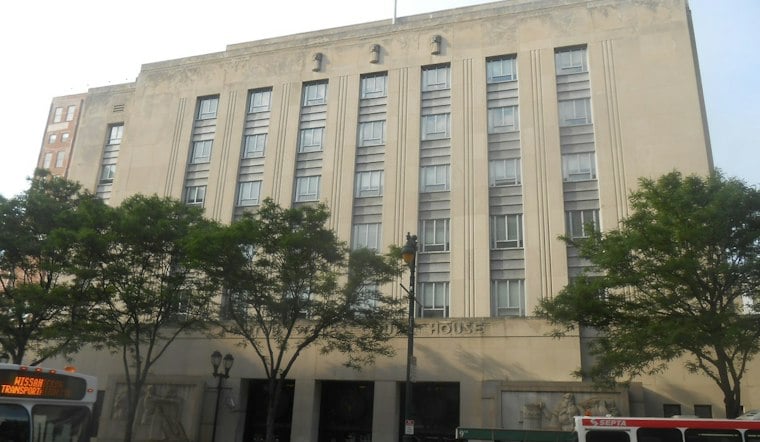
Dozens of people with pending immigration cases in Philadelphia were ordered over the last two weeks to appear for hearings inside ICE headquarters, some of them months or a year ahead of the court dates they had expected.
Family and friends could not come in. People called to the Center City office at Eighth and Cherry Streets waited on the third floor, then went one by one into a back room where a judge appeared on a video screen, The Philadelphia Inquirer reported Wednesday.
A Few Blocks, and a Different Building
Philadelphia's immigration court is at Market and Ninth Streets. The summonses sent people instead to the ICE office on North Eighth Street. Some were notified by mail. Others got a text telling them to report to ICE rather than the courthouse.
The timing was as abrupt as the address. Some people who were not due in court for a year were told they now had to appear next month. Others were ordered to appear immediately even though their hearings had been set a year out. Some received only days' notice. At least one person was notified the day before.
Philadelphia immigration lawyer Danilo Chavarro met his client at the Nix building, then dealt with an appearance at ICE. "My client was very nervous about it," he told the Inquirer. After a brief hearing, the judge granted a continuation.
The Department of Homeland Security, which supervises ICE, referred questions about the matter to the Justice Department, which had not immediately responded.
Panic, and No Pattern Advocates Can See
Asian Americans United leaders Elena Emelchin Brunner and Vivian Chang estimated that at least 50 community members were summoned this week and last. That is the organization's count, not an official tally. AAU said the people differed in age, ethnicity, and occupation, and that it had found no common pattern among them.
The summonses are causing a lot of panic.
AAU said the reason for the location change was unclear.
The practical cost of an earlier date is easier to describe than the motive. AAU said moving appearances up curtails the time people have to work and save money for attorneys. Shortened notice also limits how fully they can prepare a case.
The First Hearing Is Not the Last Word
Most of the people summoned to ICE during the previous two weeks were called for master calendar hearings. That is the first administrative court appearance for someone in removal proceedings. It does not produce a final ruling. Decisions made there can still affect how a case comes out.
The Immigrant Legal Resource Center says attorneys should be well prepared and should have a detailed advocacy plan for those hearings. A date that collapses from next year into next month, or into tomorrow, leaves little time to build one. A continuation, like the one Chavarro's client received, buys time. It does not restore the notice that was already lost.
On the books, notice of an initial removal hearing is supposed to be more orderly than a day-before text. Under 8 C.F.R. § 1003.18, in removal proceedings under section 240, the Service shall provide the time, place, and date of the initial hearing in the Notice to Appear where practicable. If that information is not in the notice, the Immigration Court is responsible for supplying it. The regulation does not, by itself, say who moved these Philadelphia hearings or what procedure was used in each case.
Fewer Grants, and Fewer Judges
The Inquirer, citing the Transactional Records Access Clearinghouse, reported that the grant rate was 32% at the end of President Joe Biden's term and has fallen to 5.5% under President Donald Trump.
TRAC put the national figures more precisely for June 2026: a 5.5% grant rate and a 94.1% denial rate. Citing Executive Office for Immigration Review records, TRAC also reported that 279 immigration judges were fired or resigned during fiscal years 2025 and 2026. Those are not the same measure as a separate NPR count from February, which found that 202 judges working in early 2025 were no longer on the bench by the time of that report.
AAU has described the immigration court system as increasingly stacked against immigrants.
Short Notice Is Not Only a Philly Story
Philadelphia has already had a version of the unexplained summons. In June 2025, dozens of immigrants received text and app messages on a Friday evening telling them to report to the ICE office on Father's Day, between 8 a.m. and 4 p.m., the Inquirer reported. The messages warned, "Failure to report as instructed will be considered a violation." They did not say why the recipients had been called.
Attorneys elsewhere are describing sudden dates and unfamiliar rooms. NPR reported in September that people scheduled for hearings in Maryland and Virginia were rescheduled to buildings in Washington, D.C., and Falls Church, Virginia. Neither building, NPR reported, had an immigration court set up for in-person hearings. In at least two cases NPR identified, immigrants were told of the new location within days of the appointment, or were not notified at all.
The Guardian reported this week that a New Orleans attorney had four days to prepare a family of six after officials moved an asylum hearing forward from July 2028, called it a priority case, and said it had to be completed by the end of November. NBC4 reported that attorneys across the country, including in Ohio, are seeing abrupt changes to hearing dates or locations.
In Philadelphia, the next step for many of the people called to Eighth and Cherry is still a master calendar appearance, not a final order. What has not arrived is a Justice Department explanation for why those hearings were moved inside ICE in the first place.





