

























































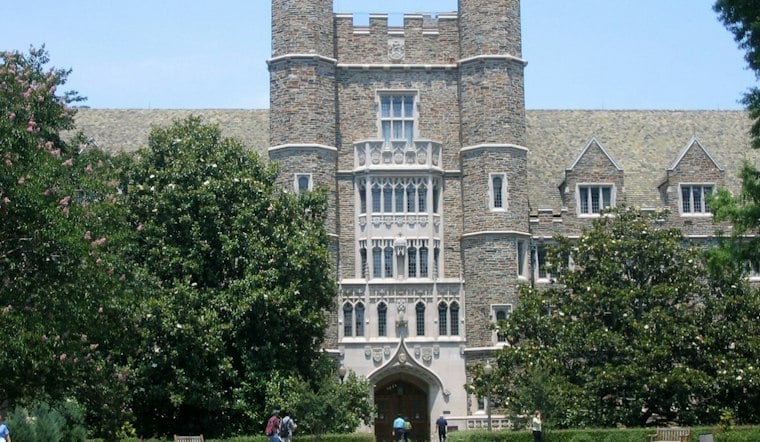
Duke University's School of Medicine has been referred to the Justice Department after federal health officials concluded the Durham, North Carolina school used coded language to track applicants' race in violation of civil rights law. The U.S. Department of Health and Human Services notified Duke of the referral on Thursday, escalating a seven-week dispute over how the medical school picks its incoming classes.
HHS's Office for Civil Rights announced the referral in a social media post, according to Raleigh News & Observer. The agency had first accused Duke's medical school back on September 8 of using racial proxies that let admissions reviewers consider race even after the Supreme Court's 2023 ruling struck down affirmative action in college admissions. HHS regulations permit referring matters to the Justice Department when Title VI compliance cannot be obtained voluntarily. In the separate Duke Law matter, the Justice Department has said it will sue Duke if negotiations fail.
At the center of the allegations are internal admissions standards that HHS says functioned as stand-ins for race. According to The Duke Chronicle, HHS's Office for Civil Rights said internal documents showed admissions officials using criteria such as “overcoming hardship” and “Social Justice Advocacy” to discern applicants' race during the review process.
What the Numbers Allegedly Show
HHS said that among incoming classes from 2020 to 2025, Black and Hispanic applicants were admitted at rates two to three times higher than white and Asian applicants, per the same Duke Chronicle report. The agency also said admitted Black students had statistically lower MCAT scores and GPAs than admitted white and Asian students, an attribution the News & Observer traces directly to the HHS letter. HHS further said Duke failed to explain the deviations when asked.
Not everyone is convinced the numbers prove discrimination. Higher education experts have questioned the legitimacy of HHS's findings based on standardized test performance alone, the News & Observer reports, noting that test-score gaps alone are a contested basis for establishing bias.
Duke's Response
Duke has pushed back on the characterization that it is stonewalling federal investigators. The university said it cooperated with HHS inquiries and submitted information demonstrating ongoing compliance, according to the Duke Chronicle. “Duke is committed to complying with the law in a manner that is consistent with our academic mission,” the university said.
UNC's Deal Looms Large
The Duke case lands 10 days after a neighboring Research Triangle school took a very different path. The University of North Carolina at Chapel Hill signed a deal with the federal government to close Trump administration investigations into the university, and UNC says that agreement, reached October 19, resolves 18 federal civil-rights investigations along with a Justice Department compliance review of admissions practices under Title VI. UNC has stated the agreement closes those investigations without an adverse action or adverse finding and does not amount to an admission of wrongdoing or liability.
As part of that resolution, UNC ended its study-abroad program with Fudan University in Shanghai in response to the same probe. The agreement UNC signed prohibits admissions and recruitment preferences based on race, color or national origin, including racial proxies, runs through December 31, 2028, and requires UNC to submit quarterly compliance reports.
Duke's Other Federal Entanglements
The medical school referral is not Duke's only brush with federal scrutiny this year. The Department of Education and Department of State have an open investigation into Duke's relationship with Wuhan University, accusing the school of submitting incomplete, inaccurate and untimely disclosures of foreign funding. Separately, the Pentagon closed its own audit of foreign funding sources at Duke, clearing the school of suspicion despite Duke not terminating a foreign relationship that had drawn scrutiny.
Duke's law school is facing a parallel but distinct fight. The Justice Department has said it found evidence of racially biased admissions practices at Duke Law School, alleging discrimination involving the incoming classes of 2023, 2024 and 2025. Per the News & Observer's earlier reporting, the Justice Department alleged Duke flagged whether essay answers mentioned diversity and whether applicants were Pell Grant recipients as admissions factors it characterized as racial proxies.
A Broader Federal Push
Duke's medical school is not an isolated target. The administration has launched at least 29 investigations into admissions practices at universities nationwide, with 27 of those investigations focused specifically on medical school admissions, according to Inside Higher Ed. The Duke School of Medicine investigation marks the first of its kind completed by HHS itself, with the Departments of Justice and Education having handled the other 27 cases, Inside Higher Ed reported.
Whether Duke follows UNC's path toward a negotiated settlement or ends up in federal court remains an open question. For now, the case sits with the Justice Department; the department did not respond to a question about a timeline for enforcement action in the medical-school referral.




