

























































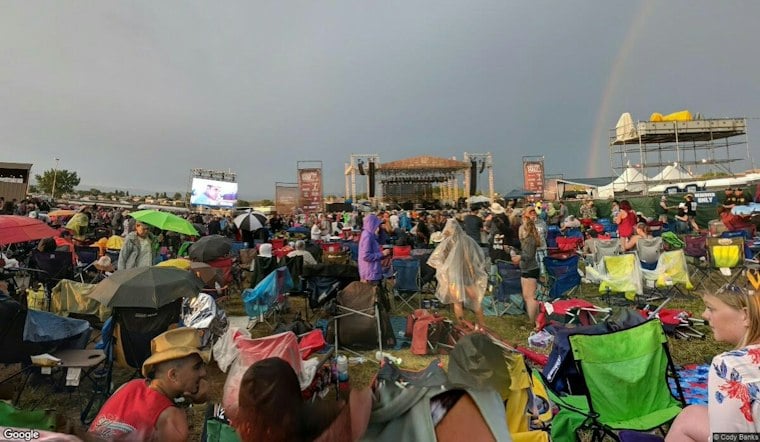
Skye King and about three dozen other sewers gathered two days ago at the Native American Cultural Center's classrooms at the former Metz Elementary in East Austin, stitching ribbon skirts and beadwork ahead of this weekend's Austin Powwow. King said she will dance for a close friend's missing daughter, a dedication that speaks to why the weekly sewing sessions have become something bigger than a craft circle for the people who show up.
The gathering was part of Sew Indigenous, the center's weekly workshop that brings together beginners and experienced makers working on ribbon skirts, beadwork, and other projects, according to CultureMap Austin. The center keeps a few sewing machines on hand for people to share, and the program meets weekly at whatever space the center currently calls home. That home has shifted over the past year: Austin Vida reported the center moved into portable classroom buildings at the former Metz Elementary campus in early April, describing the setup as two classrooms connected by a hallway, while the Austin Chronicle's reporting described the center moving into the empty Brooke Elementary. Accounts differ on exactly where the center sits today, but both describe a nonprofit squeezed into leftover school space.
Wherever the current address, the center is already bursting at the seams. Attendance at the public Wednesday workshop grew from about 20 people at an early session to roughly 40 by summer, Austin Vida reported, while a separate Austin Vida account put Sew Indigenous attendance above 30 people by the previous fall. The Austin Chronicle similarly reported that the workshops continued to outgrow even the Brooke campus space. The center now hosts regular elders' luncheons in a portable classroom that has no kitchen, and organizers say they are actively seeking additional space to meet demand.
A Move Powered By Community and AISD
Austin Vida reported that community members and Austin ISD did the heavy lifting on the center's relocation this year, helping the organization shift into its current classrooms. The Austin Chronicle reported separately that the center is still working with Austin City Council and Travis County to designate it a fully resourced cultural center, a process that remains unresolved. The center traces back to 1991, when it was founded after Austin's Native American community organized to establish a permanent presence in the city, according to the Austin Powwow organization, which the center sponsors and conducts annually alongside the Native American Heritage Festival.
City government has taken some formal notice of these pressures. The Austin City Council voted 9-0 in May 2026 to create the Native American and Indigenous Quality of Life Commission, an effort José Velásquez led, according to Austin Vida's reporting. The commission serves as an advisory body to the council on cultural preservation, economic development, education, health, and wellness, and it also advises on the cultural center's own operations and development, per the City of Austin.
Powwow Draws Thousands, Dollars to Austin
The Austin Powwow and Native American Heritage Festival, which the center has organized since 1991, draws more than 15,000 attendees and includes more than 300 dancers from different tribes and regions along with more than 100 Native food vendors, artists, and craftspeople, per CultureMap Austin's reporting. The Austin Chronicle has reported that the event attracts about 15,000 people and generates an estimated $300,000 in tourism and hospitality revenue for the city, according to executive director Skye Howell, with the Chronicle describing the Powwow as approaching its 33rd year.
This year's Powwow runs from 9 a.m. to 9 p.m. on Saturday at the Travis County Exposition Center, 7311 Decker Lane, according to CultureMap Austin's reporting, though an Austin Vida listing gives the date as November 22 without specifying a year — a discrepancy that remains unresolved in available reporting. The market opens at 9 a.m., the gourd dance begins at 10:30 a.m., and Grand Entry starts at noon. The potato dance competition kicks off at 11 a.m., and the host drum groups are the Wild Band of Comanches and Meskwaki Nation. Competitions include jingle, grass, and fancy dancing, with dancer divisions for ages 6 and older and a golden age division for ages 50 and older.
Heritage Stage Lineup and Ground Rules
Outside the dance arena, the outdoor Heritage Stage in the vendor market opens at 10 a.m. with Maxochitl's children's stories and poetry, followed by Jackie Salgado's jingle dress showcase at 1:30 p.m. Phnx.wav performs music at 2:30 p.m., the Hula Kalau Kaeepa Polynesian dancers take the stage at 3:30 p.m., Kalpulli Ayolopaktzin leads danza at 4:30 p.m., and Ryan Harjo closes out the stage with flute and storytelling at 6 p.m.
Organizers ask visitors to stand and remove hats during the Grand Entry, flag songs, and honor songs, and they describe the dance arena as sacred space that visitors should enter only if invited. Organizers also tell visitors to ask dancers' permission before photographing them or touching regalia, beadwork, or feathers. Families can check strollers at the gate, though strollers are barred from upper-level seating.
Admission is free for children 12 and under, while online tickets run $13.91 for ages 13 and up and $11.85 for military veterans, including fees. Parking is free, with accessible parking located near the Expo Center entrance, according to the Austin Powwow organization's ticketing page.
The gathering also carries weight beyond the dancing and sewing. The Bureau of Indian Affairs has reported that Native American and Alaska Native communities have faced high rates of abduction and other violence for decades, a backdrop that shaped King's decision to dance this weekend for a friend's missing daughter. For a community still negotiating permanent space for its cultural center, the Powwow remains the moment each year when that history, and the work of preserving it, becomes visible to the rest of Austin.




