

























































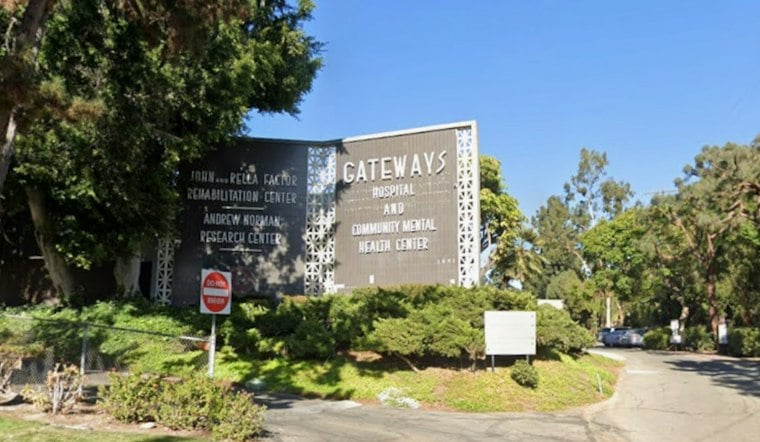
Construction crews are reshaping the campus of Gateways Hospital and Mental Health Center in Echo Park, where a new 37-bed adolescent psychiatric center is rising next to the hospital's longtime flagship building. The project, which broke ground in February 2025, is the centerpiece of a broader expansion effort by Gateways, which has served the region for more than 70 years, to add psychiatric, substance-use and residential treatment capacity across much of Los Angeles County.
According to HMC Architects, which led design on the project, Gateways broke ground on the two-story, 37-bed adolescent inpatient building in February 2025. Clayco is serving as general contractor, and the new beds will replace Gateways' current 27 adolescent beds, which will shift to adult inpatient care once the new facility opens, according to Gateways Hospital and Mental Health Center. The expansion is backed by a $19.2 million grant from the California Department of Health Care Services' Behavioral Health Continuum Infrastructure Program, per the same hospital account.
Completion timing for the Echo Park building remains unsettled. Gateways says on its own site that construction is expected to wrap by spring 2027, while HMC Architects, the project's design firm, has put the completion date at December 2026 — a discrepancy neither account resolves.
Addiction Treatment Facility Planned for Hoover Street
Beyond Echo Park, Gateways is also building a 125-bed community-based residential facility at its Hoover Street campus to serve people with substance-use disorders, funded by a $38,335,670 state grant through the Community Care Expansion Program, according to Gateways. That site is expected to offer crisis services, short-term stays and outpatient treatment, and the hospital anticipates it becoming operational in 2028. A related development plan for the Hoover Restorative Health Campus describes a 100-bed substance-use/outpatient intensive program paired with a 25-bed crisis residential treatment program, per PracticeLA.
Gateways has pointed to county data showing that 20% to 35% of Los Angeles County's unhoused population experiences substance-use disorder, underscoring the demand it says the Hoover Street project is meant to address. A third project is planned in Glendale, where Gateways plans a residential treatment program and an outpatient clinic supported by $35 million in Bond-BHCIP funding, the hospital says.
A County Still Short on Treatment Beds
The build-out comes as Los Angeles County continues to confront a well-documented shortage of subacute and residential mental-health beds. A county-hired consulting agency's February 2024 report identified subacute beds as the county's single most urgent behavioral-health resource need, according to LAist, and experts cited by the outlet said the county needs hundreds more beds at that treatment level. The Los Angeles County Board of Supervisors has since approved a plan to project future bed-capacity needs across acute, subacute and residential settings, per a statement from Supervisor Kathryn Barger's office.
The shortage intersects with the county's homelessness crisis. The finalized 2025 Greater Los Angeles Homeless Count estimated 72,195 homeless individuals countywide, and the revised figures recorded a 137-person increase in the sheltered population identified as having serious mental illness, according to the Los Angeles Homeless Services Authority.
Jail System Carries the Weight of Untreated Illness
The Vera Institute of Justice has described the county jail system as the largest mental-health institution in the United States.
Vera's accounting also found that the county spent roughly $548 a day to incarcerate a single person in a mental-health unit, compared with just $207 a day for community-based housing and treatment.
Elsewhere in the county, officials have moved on a separate project: the Restorative Care Village in Boyle Heights is slated to add 96 treatment beds for people with serious mental illness, at an estimated cost of $143 million, according to the same LAist reporting. That project illustrates the scale of investment county and nonprofit providers alike are making to chip away at the bed deficit, even as new facilities take years to materialize.
Wong has spoken about the mental-health and substance-use crises. Gateways has operated since 1953 and now operates inpatient and outpatient programs across nine service locations in Southern California, according to Becker's Behavioral Health.





