

























































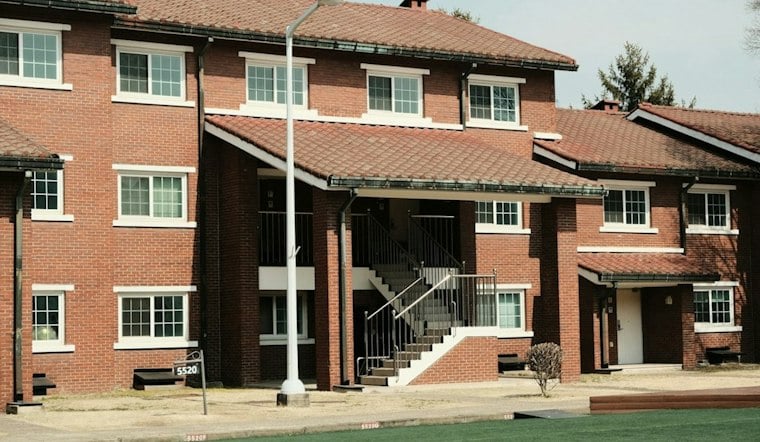
A new 48-apartment complex built for student parents in Hardin County opened this week already full, with a waitlist of families hoping to get in. Family Scholar House, the Louisville-based nonprofit behind the project, held a ribbon-cutting ceremony welcoming dozens of residents to their new home at the Elizabethtown Community and Technical College campus.
The complex includes a food pantry, a community center and a state-of-the-art playground, according to WLKY. The station reported the new housing was already at full capacity with a waitlist shortly after opening. The expansion extends Family Scholar House's reach 50 miles south of Louisville, where the organization has built its reputation supporting student parents working toward degrees.
Among the new residents is Kayla Braden, a nursing student at ECTC and single mother to 3-year-old Eliza. According to Spectrum News 1, Braden spent 10 days moving into the new housing with her daughter. Braden said having a stable home helps her make decisions to improve both her and Eliza's future, per WLKY's reporting.
Four Years in the Making
The Elizabethtown campus was the product of a four-year project undertaken in partnership with ECTC, the station's report notes. Accounts of exactly how many families first moved in have varied: The News-Enterprise reported that six families moved into the newly constructed campus, while a Hardin Local report on the Etown City Council from August 3 said the first seven families moved in that Saturday. The discrepancy between those early counts remains unresolved in public reporting.
The project drew on a $1 million Community Development Block Grant through the U.S. Department of Housing and Urban Development, with Hardin County Fiscal Court serving as applicant and grantee on behalf of Family Scholar House and ECTC, according to the Lincoln Trail Area Development District. ECTC's own program page lists two- and three-bedroom units available to 48 families, with rent set at $350 per month with utilities included, per Elizabethtown Community and Technical College.
Addressing a Statewide Housing Gap
Wendy Smith, with the Kentucky Housing Corporation, said stable housing provides security and predictability for low-income families, according to the same WLKY report. Smith added that residents need not worry about eviction, rent increases or utility costs eating into grocery money. WLKY described Kentucky as short 200,000 housing units, while a 2024 analysis from the Kentucky Housing Corporation and Bowen National Research, cited by the National Council of State Housing Agencies, put the statewide gap at a more precise 206,207 units. It is not clear from available reporting whether that difference reflects rounding or separate estimates.
The Kentucky Housing Corporation says all 120 counties in the state face a housing gap affecting both rental and for-sale housing, and that units affordable to households at or below 30% of area median income make up more than half of the rental gap in both 2024 and 2029 projections. The agency notes the shortage touches households across the income spectrum, though it hits lower-income Kentuckians hardest.
A Pathway Through Education
Juston Pate, chancellor of Elizabethtown Community and Technical College, said the buildings provide a pathway and education provides an opportunity, per WLKY's report. Pate also said community work remains and that he would ask for time rather than money going forward. Family Scholar House's mission, per its own materials, is to provide coordinated wrap-around services for students and their families, removing roadblocks to education and providing stability for student parents.
Family Scholar House already operates five residential campuses in Louisville, home to 247 student-parent families and 32 foster alumni pursuing post-secondary education, according to Family Scholar House. The organization was one of just five mature programs nationally recognized with the 2020 Rise Prize for its success supporting student parents. It also operates one campus in Houston, Texas, and plans another in Sellersburg, Indiana, extending a model built on fostering self-sufficiency and breaking cycles of poverty into new communities beyond Louisville.



