

























































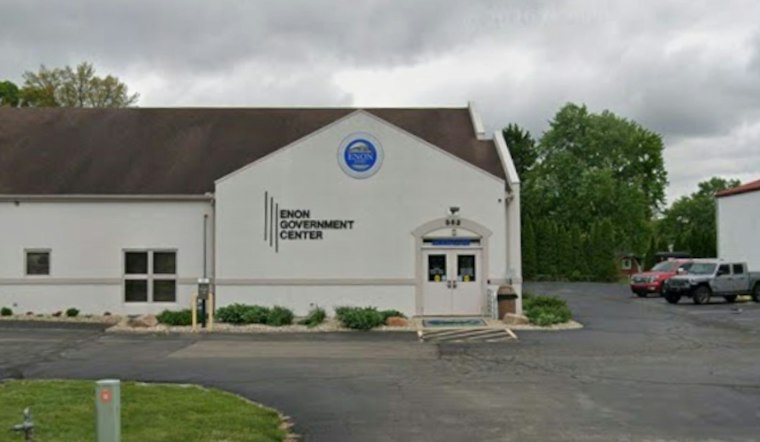
Residents packed an Enon Village Council meeting Thursday demanding answers about who holds police accountable when Flock Safety surveillance cameras are misused, and Sheriff Christopher Clark said penalties would depend on the crime. The council took no action on the future of the cameras, even as concerns about oversight, auditing and punishment for law-enforcement staff who abuse the system dominated the discussion.
According to the Springfield News-Sun, Enon resident Michael Collins, who lives on South Harrison Street, suggested local and county officials shut down camera access until policies are in place to address potential abuse by police staff. Collins asked a pointed question that went largely unanswered: how can officials discipline staff for misuse if no formal policy exists to define what misuse even is? Officials at the meeting responded that they lack the authority to shut down camera access themselves, the newspaper reported.
Randy Gearhart, who lives on Hunter Road, pressed further, asking what penalty police would face for misusing camera information. Clark County Sheriff Christopher Clark said penalties would depend on the crime, per the same report, but Gearhart said he worries the safeguards in place may be insufficient to prevent unnecessary intrusion into residents' lives. Notably, the training language currently used for Flock camera operators does not include punitive actions for misuse.
How the Cameras Work and Who's Watching
Flock cameras are small units generally attached to poles, running on solar power or long-term evolution wireless technology — a high-speed wireless standard — rather than tapping into public electricity. They're deployed on both public and private properties and capture photographs and details of passing vehicles, including license plates, make, model and color, according to the News-Sun's reporting. The cameras are manufactured and operated by Flock Safety, and the company has said its readers are motion-triggered rather than running continuous footage, capturing still images instead, as Signal Ohio has reported.
Enon Police Chief Jeffery Wise said the cameras in use locally do not operate in real time and do not take video, echoing Clark County's own system, which Sheriff Clark has said captures still photos only. Before canceling its program on Sept. 10, 2026, the Clark County Sheriff's Office had 33 Flock cameras, while Enon had five, the News-Sun reported. County officials signed a five-year contract with Flock Safety in 2024 and pay roughly $100,000 per year under that deal.
Sheriff Points to Arrests, Residents Point to Risk
Sheriff Clark told the meeting that the technology helped apprehend two homicide suspects and identify a recent shoplifting scam, and he said the benefits far outweigh the detriments of the technology. He added that Clark County requires Flock-record access to be tied to an active investigation or a specific law-enforcement reason. Local and county law-enforcement officials at the meeting defended the cameras as a tool for finding information on Amber Alerts, potential kidnappers, thieves and serious scofflaws — while critics in attendance called the system intrusive and an unnecessary infringement on personal liberties. Supporters, meanwhile, described it as a crime-fighting tool capable of using details as small as a bumper sticker to identify potential law-breakers.
Law-enforcement leaders at the meeting agreed that the potential for human abuse exists, but they argued that proper training and auditing should eliminate most threats of abuse. Attendees also raised concerns about whether Flock Safety sells personal information to outside interests — a question that went unresolved at the meeting. Law-enforcement leaders said they hope the Ohio legislature will eventually codify Flock-camera use and set broader standards for municipalities statewide.
Enon's Winding Path on Cameras
Enon's relationship with Flock has been anything but settled. The village council voted unanimously in August 2025 to return its trial cameras and decline to purchase the system outright, according to Citizen Portal. But by September, a separate report from the outlet said Flock had extended the village's camera trial through the November election, with the Clark County Sheriff's Department set to assume responsibility for the cameras if a local police levy failed.
The debate over oversight isn't unique to Clark County. In Dayton, city leaders suspended their Flock program in May after the police chief said the department had misused the technology, and the city soon covered all of its more than 70 cameras, which remain bagged today, according to WHIO. An internal review there found that a network-sharing feature had been enabled, allowing broader data access than intended, after the department identified higher-than-expected data sharing in October 2025. More than 7,100 instances of federal immigration officials accessing data from Dayton's 72 cameras were attributed to a permissions error, though police said they could not confirm whether any data was returned or acted upon. On Nov. 11, City Commissioner Daryl Fairchild told the station that Dayton had signed a contract to hire an outside law firm to investigate.
A Pattern Playing Out Nationally
Clark County isn't the only Ohio sheriff's office rethinking Flock. The Clark County Sheriff's Office announced in September that it had canceled its own Flock Safety contract and discontinued the program altogether, with the sheriff stating that discontinuing the system was the appropriate course for the community, according to esonline.news. Meanwhile, other Ohio state agencies — overseeing workers' compensation, fire investigations and state prisons — have contracted with Flock, the Signal Ohio report notes, and the company says more than 120,000 of its cameras now operate across 49 states, per Carolina Public Press.
Misuse concerns have surfaced elsewhere too. In San Diego, police used their license-plate reader program in six internal investigations, one of which substantiated misconduct and led to an officer's discipline, KPBS reported Nov. 12, adding that activists nationwide have mobilized opposition to the technology. In North Carolina, Carolina Public Press reported that a former Macon County sheriff's deputy searched the county's Flock network more than 3,500 times during a two-year contract period before being fired, and he now faces investigation by the North Carolina State Bureau of Investigation; the county's published audit logs show 13,698 network searches between January 2024 and October 2026.
As of September, proposed statewide restrictions on retention, warrants, data sharing and surveillance tied to license-plate readers were not yet Ohio law, according to cleveland.com. Under Ohio's public-records statute, images and data captured by an automated license plate recognition system and maintained in a law-enforcement database are exempt from public release, according to the Ohio Revised Code. Until state lawmakers act, it appears local communities like Enon and Clark County will keep wrestling with the same questions on their own.




