

























































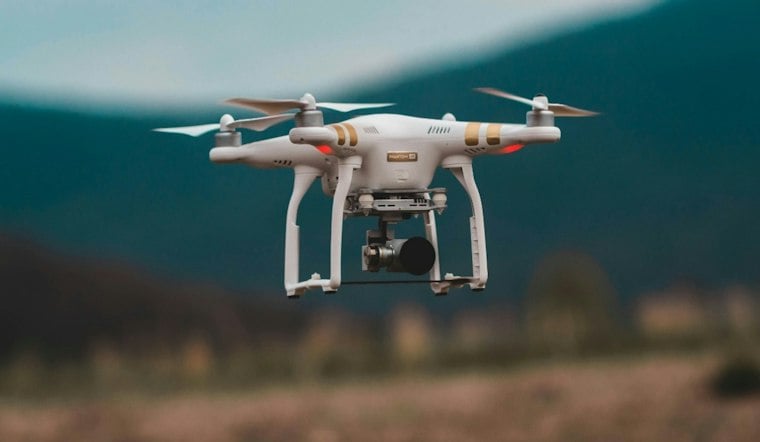
Fayetteville police expect drones to start answering 911 calls within the first three months of 2027, launching from five stations around the city as part of a technology overhaul that has already stirred debate on the city council. The drones will not patrol neighborhoods or conduct general surveillance, according to the department — they will be dispatched only to specific calls for service, flying ahead of officers to give them a view of a scene before they arrive.
The program, known as Drone as First Responder or DFR, stems from a contract the Fayetteville City Council approved with Axon Enterprise, according to WRAL. The deal bundles body cameras, Tasers and other technology into a single six-year package. Reported figures for the contract differ: The Fayetteville Observer and ABC11 both put the price at $17.3 million over a roughly six-year, 75-month term, while WRAL's reporting lists the figure at $17.4 million.
Fayetteville Police Chief Roberto Bryan Jr. has called the technology the future, telling ABC11 that bundling the contracts saves $12.6 million for citizens and the community compared with buying the systems separately. The council itself was split on the deal: The Fayetteville Observer reports members voted 6-4 to approve the roughly six-year public safety technology contract.
A Council Member Pushes Back
Not every vote came easily. Fayetteville council member Shaun McMillan expressed concern in September about the amount of power the Axon contract authorizes, per WRAL's reporting. The department says it will adjust its policies and procedures with transparency in mind as the drone program comes online, and Bryan has said the department plans a forward-facing platform that any citizen can look at and have access to, so they can see how the drones are being utilized — a tool ABC11 reports would show deployments, the purpose of each call, and response times.
The Fayetteville Observer also reports that drone-collected data will be made public and included in quarterly reports presented to the city council. Department officials are still determining where to set up the five planned drone dock stations, and Fayetteville is looking to hire six new staff members for its Crime Information Center to help manage deployments and process real-time data, according to ABC11.
Why Drones Are Catching On
The appeal, according to experts, is speed. DFR drones can avoid traffic and reach a scene in seconds rather than minutes, and they can help responders determine the priority level of a call before officers ever arrive, per WRAL's reporting. Brian Stults, director of the Real Time Crime Center Research and Policy Institute at Florida State University, said drone intelligence may enhance both public and officer safety.
WRAL Investigates first reported on DFR technology in Burlington back in 2024. Burlington Police Department's drone gives officers real-time information and video from a birds-eye view, and WRAL has reported the department's drone can reach an emergency scene in three minutes or less. Master Police Officer Matthew Cook said in 2024 that drones increase safety by giving officers information before they walk into a scene.
Durham and Raleigh Still Weighing Options
Fayetteville is not the only Triangle-area department moving on drones. Durham Police Department approved its own DFR program in 2026 and can purchase up to four drones, though the department currently has two drones that are not yet in use and is, per WRAL, still in the early research and planning stages with no estimated deployment timeline. Durham is also still determining where to set up its drone dock stations. During a Durham City Council meeting in June, a resident voiced opposition to police surveillance technologies that could harm Durham residents.
Raleigh Police Department, meanwhile, is still gathering information about the technology and has not committed to a program. In nearby Apex, town spokesperson Victorian Simmons said the Apex Police Department has no proposal before the public safety committee or town council to adopt a DFR program as it is currently defined — though language in the town budget indicates the department is working toward one.
Forsyth County's Head Start
North Carolina already has a working example. The Forsyth County Sheriff's Office has used its DFR program since 2022, making it, according to AeroX, the first in the state. The program initially operated within a one-mile radius of the Lewisville-Clemmons Road and Interstate 40 intersection, and specially trained deputies — all sworn law enforcement officers — use gaming controllers to deploy and fly the drones, which can stream live video to both responding deputies and the command center.
Major James Rae oversees the Forsyth County program, which WRAL reports is monitored by lieutenants, a captain, a sergeant and a corporal who track flight logs, equipment checks, propeller checks and battery checks to keep the drones safe and ready to fly. The sheriff's office also maintains a flight log updated daily. Through a separate partnership with Duke Health, the office can use drones to deliver defibrillators to emergency scenes.
What North Carolina Law Says — and Doesn't
The legal framework around police drone use remains loosely defined. According to the North Carolina Criminal Law Blog at the UNC School of Government, state law generally prohibits using drones to conduct surveillance of people or private property, but the statute does not define what counts as surveillance. The same blog notes there is an exception allowing law enforcement to conduct drone surveillance pursuant to a warrant, though the statute offers no detail about how such warrants would actually work. The blog's author said they were not aware of comprehensive current data but suspected hundreds of North Carolina law enforcement agencies already have active drone programs.
The trend extends well beyond North Carolina. The Electronic Frontier Foundation reported that more than 1,000 public safety agencies nationwide had received the FAA waivers needed to automate drone operations and launch DFR programs as of February 2026 — and that the FAA issued more of those waivers between April 2025 and February 2026 than in the previous seven years combined. In San Francisco, the EFF found police drone deployments climbed from roughly 350 in 2024 to more than 3,500 in just the first five months of 2026, illustrating how quickly the technology can scale once a department adopts it.





