

























































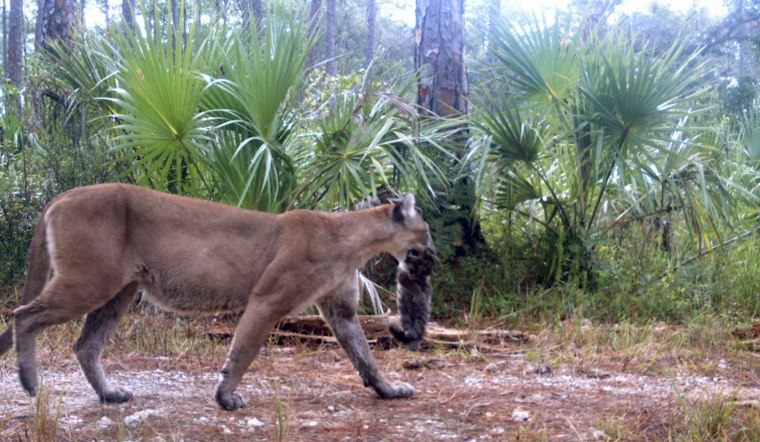
A Florida panther chasing a rabbit tore through a Naples yard, passing so close to the man standing there that he says he froze in place rather than risk moving. The rabbit darted beneath a fallen log for cover, and the panther, one of North America's rarest apex predators, briefly lost its footing on pine straw in the chase — just enough of a stumble to let its prey escape.
An older video captured in Naples and detailed by Whiskey Riff shows the panther prowling in the background before the chase begins. The rabbit and the panther reportedly passed within inches of the man recording, who summed up the moment bluntly: “A Florida panther nearly steps on my feet. I pretend I'm a tree. Thought it might turn out differently there for a second.” After the rabbit vanished, the panther stood for a moment on a wooden walkway before turning back toward the wooded area it came from.
A Rare Encounter With an Endangered Cat
Florida panthers are known scientifically as Puma concolor, and the Naples population carries the only remaining breeding group of mountain lions east of the Mississippi River. They're also called cougars or mountain lions elsewhere in the country, but Florida's version has a notably tan coat, a leaner build, and shorter fur than its western relatives. Adult males typically weigh 100 to 160 pounds and can claim roughly 200 square miles of territory, while females run smaller, around 70 to 100 pounds.
The cats are concentrated in southwest Florida's swamps, pinelands, and hardwood hammocks, largely confined to Big Cypress and the Everglades south of the Caloosahatchee River. Their diet leans heavily on whitetail deer, feral hogs, raccoons, and occasionally small alligators, hunted mostly at night. Florida panthers generally avoid people, which is why wildlife officials and outlets covering these sightings emphasize how unusual it is to see one up close — the state has recorded no verified fatal panther attack on a human.
The panther and rabbit in the Naples footage both ran within inches of the videographer. Separately, a Naples woman named Vendela Harold shared video of a panther peeking through her backyard window on 12th Avenue Southeast in the Golden Gate Estates neighborhood, where, according to NBC 6 South Florida, the cat watched her family and their three dogs for a few minutes before moving on, with no injuries or altercations reported. The station noted that such sightings remain rare because panthers are reclusive and stick to underdeveloped areas.
From the Brink of Extinction to a Fragile Comeback
The species' history explains why any sighting draws attention. Unregulated hunting and habitat loss pushed the Florida panther population down to just 20 to 30 animals by the early 1990s, and inbreeding within that shrinking gene pool produced kinked tails, cowlicks, and fatal heart defects. In 1995, wildlife biologists relocated eight female cougars from Texas to South Florida in an effort to widen the genetic pool and pull the subspecies back from collapse.
That intervention helped, but the species remains federally classified as endangered and now occupies less than 5% of its historic range. The Florida Fish and Wildlife Conservation Commission estimates there are 120 to 230 adult and subadult panthers left in the wild. Beyond genetics, the cats now contend with habitat loss driven by suburban sprawl and highway traffic, along with feline leukomyelopathy, a neurological disorder that weakens their hind legs.
Roads Remain the Biggest Threat
Vehicle collisions are the leading killer of Florida panthers today, claiming 15 to 25 or more of the animals every year. Recovery efforts depend partly on safely getting breeding females across the Caloosahatchee River and into Central Florida, where more room to roam could help the population expand beyond its current southwest Florida stronghold.
Roadkill numbers tell their own story about how growth and traffic have reshaped the risk. Before 2000, yearly panther roadkills numbered four or fewer, but since then annual totals have ranged from six to 34, according to the Florida Fish and Wildlife Conservation Commission. The agency attributes part of that rise to the panther population itself growing, even as it works to offset the danger: 60 wildlife crossings or bridges modified for panther use now exist on Florida roads, including 24 crossings and 12 modified bridges built along a 40-mile stretch of I-75 in the early 1990s. In stretches where crossings and fencing are in place, the commission reports that vehicle-related panther deaths have dropped sharply.
Encounters like the one in the Naples footage remain the exception rather than the rule, but they aren't unheard of in the region. At Corkscrew Swamp Sanctuary in Naples, a woman named Tina Dorschel had a panther charge right past her on a boardwalk trail, an encounter also chronicled by whiskeyriff.com, in which the animal briefly lost its footing while rounding a corner of the walkway — echoing the same close-call stumble caught in the Naples video.





