

























































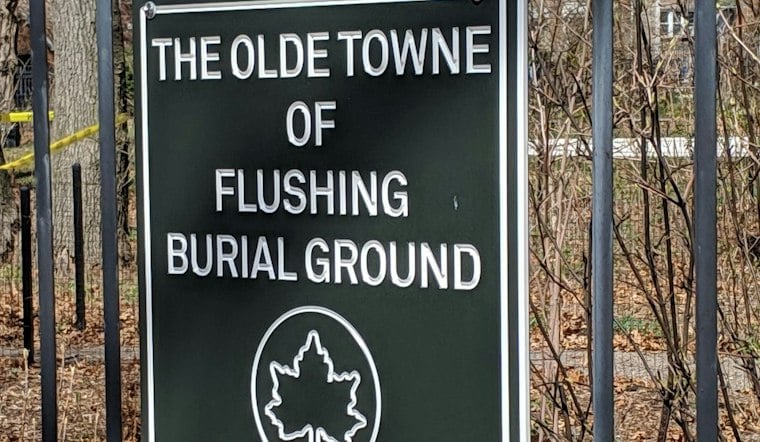
A historic Queens burial ground that Robert Moses once ordered paved over for a children's playground is getting another round of city money, this time to fix its fencing, bricks and stone monument and to fund ongoing maintenance, including its paths. The Olde Towne of Flushing Burial Ground, tucked across from Flushing Cemetery, is the resting place of as many as 1,000 people, most of them African-American or Native American New Yorkers, many buried during 19th-century cholera and smallpox outbreaks.
According to Gothamist, the makeover will cover repairs to the fencing, bricks and stone monument as well as money for upkeep of the paths. The outlet reports the cemetery's final burial took place in 1898, and the city's Parks Department took over the site in 1914. More than 20 years after that, Moses, then the parks commissioner, ordered the cemetery paved over and replaced with a children's playground.
From Pauper's Graveyard to Paved-Over Park
The site was purchased by the Town of Flushing as a public burial ground in 1840, according to the Olde Towne of Flushing Burial Ground Conservancy. The conservancy says more than 1,000 individuals were buried there over the years, the majority African-American or Native American, with some interred during cholera and smallpox epidemics in 1840, 1844, 1857 and 1867. A separate 1996 archaeological study cited by the Queens Chronicle put the number lower, estimating between 500 and 1,000 people were laid to rest at the graveyard.
The burial ground has carried other names over time, including Pauper's Burial Ground, Colored Cemetery of Olde Towne of Flushing and Town Ground, before being officially named in 2010. It spans 3.5 acres on 46th Avenue between 164th and 165th Streets in Flushing. The federal government and New York State registered it as a historic place as of February 2, 2018, per the conservancy.
A Monument Reborn After Decades of Neglect
The site's transformation into a memorial began with nearly $2.7 million in city funding in 2006, the station's report notes, which paid for a central stone and a wall listing the names of the recorded dead. That memorial wall bears an incomplete list of 320 names. The site received another round of funding in 2021, about $1.3 million, specifically for its monument.
NYC Parks' own capital project tracker lists a monument project at The Olde Towne of Flushing Burial Ground as 100% complete, with a completion date of August 2021. The project address is 46th Avenue between 164th Street and 165th Street.
Voices Behind the Decades-Long Fight
Robbie Garrison, the 91-year-old co-chair of the Olde Towne of Flushing Burial Ground Conservancy, has described the cemetery as a peaceful place created in the 1840s by Quakers who cared about people, per the same account. Garrison said the new funding is meant for a broader makeover of the grounds, and recalled that Moses paved over the cemetery after viewing it as a community blight. The conservancy, Garrison said, received a dilapidated playground decades ago and set out to restore the site's history, with thousands of daffodil bulbs now blooming there each spring.
City Councilmember Sandra Ung, who represents Flushing, called the site a peaceful place for reflection and said it has historical and cultural significance that should be preserved. Community activist Mandingo Osceola Tshaka first called attention to the cemetery's history after learning that members of Macedonia African Methodist Episcopal Church of Flushing were buried there, and his advocacy helped prompt archaeological studies using ground radar as well as the site's push for inclusion on the state and national registers of historic places.
Decades of City Investment
The city's financial commitment to the burial ground has included multiple allocations. The city allocated $2.667 million and about $1.3 million for work at the site. In 2006, about $2.7 million in city funding went toward the memorial park project.





