

























































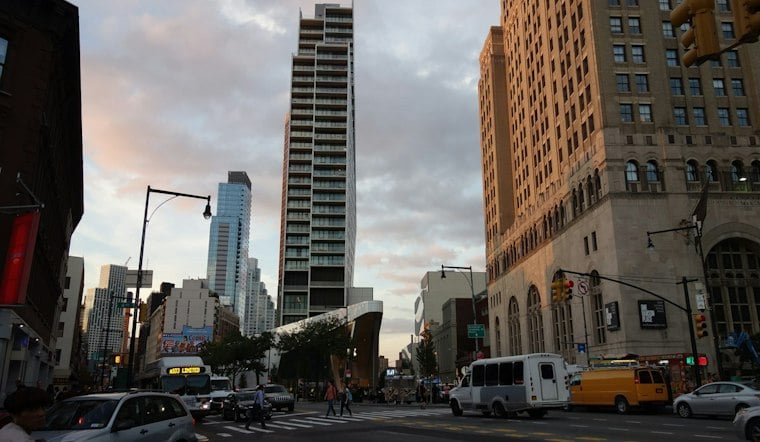
A class-action lawsuit filed against developer Two Trees accuses the company of skirting 421-a tax break rules and illegally raising rents at its 379-unit complex at 300 Ashland Place in Fort Greene. The complaint alleges the developer applied renewal increases to tenants' full legal rents rather than their discounted preferential rents, a tactic that could have added more than $30 million to rents over five years.
How the Alleged Scheme Worked
According to Gothamist, the lawsuit says Two Trees applied increases to the full “legal rent” on stabilized units instead of the lower preferential rent many tenants actually pay — a move the complaint says produced a potential 20% rent hike on one unit. A 20th-floor apartment in the building reportedly carried a legal rent of $3,990 under the complaint's accounting, even though Two Trees had advertised that same unit with two months free, bringing its effective monthly price down to $3,325. The lawsuit was filed by the law firm Newman Ferrara in coordination with Housing Rights Initiative, a nonprofit that has previously targeted the leasing practices of major landlords and developers.
Aaron Carr, the nonprofit's executive director, said the alleged increase on that unit and six others violated state law, since the New York City Rent Guidelines Board has not approved an increase higher than 3.25% since 2021. Carr has said property owners often advertise concessions and then raise rents at renewal — and argued that landlords collecting public subsidies while overcharging tenants effectively cheat the public twice.
Rents Climbing Inside the Tower
The scale of the alleged gap shows up in recent listings at the building. A two-bedroom apartment at 300 Ashland Place leased for $7,455 in July, the report notes, while a 26th-floor one-bedroom was listed on the building's website for $4,925 earlier this month. The 379-unit complex opened in 2016 and received the 421-a property tax break, which bases property taxes on a site's assessed value before a development adds apartments, amenities, and improvements — a benefit that can provide millions of dollars in savings for at least 25 years in exchange for keeping units rent-stabilized and following state rent regulations that cap renewal increases at a percentage set by the city panel.
Two Trees is a multibillion-dollar real estate firm that owns and manages more than 4,000 apartments in a portfolio worth $4 billion, according to its company website. Managing Director David Lombino said the company was reviewing the lawsuit and declined to comment further.
A Councilmember's Criticism, and Industry Pushback
Brooklyn Councilmember Crystal Hudson, who represents the district that includes Fort Greene, helped notify 300 Ashland Place tenants about Housing Rights Initiative's investigation by sending mailers. Hudson said concessions can mislead tenants and later hurt them financially, and argued that everyone must be held to the same standard. She also criticized the state housing agency for leaving enforcement of tax-break rules to a nonprofit and a private law firm rather than handling it directly.
A Division of Homes and Community Renewal spokesperson, Charni Sochet, declined to comment on the ongoing litigation but said the agency is committed to protecting rent-regulated tenants by enforcing and administering state law. Not everyone views the complaint the same way: real estate firms and their allies say Housing Rights Initiative and its attorneys focus on a technicality to pressure landlords. Seth Glasser, a partner at real estate investment firm Marcus & Millichap who hosts an industry-focused podcast, compared the overcharge complaint to a foot-fault penalty in tennis, saying the penalty is much worse than the infraction.
Bigger Stakes for Two Trees' Pipeline
The lawsuit lands as New York's tax-incentive fight over 421-a keeps resurfacing. Lawmakers allowed the original 421-a program to expire in 2022 amid disputes over whether it produced genuinely affordable housing, and Gov. Kathy Hochul and state legislators approved a replacement tax break in 2024 with deeper affordability and higher wage requirements. In May, state lawmakers extended 421-a coverage specifically to cover Two Trees' River Ring project, a 1,200-unit development on the Williamsburg waterfront; the developers will not finish construction by the program's 2031 tax-break deadline.
The 300 Ashland Place complaint isn't an isolated case in the city's rental market. In Long Island City, tenants at three buildings — Eagle Lofts, the Linc and Hayden LIC — filed a separate class-action suit this month alleging landlord Rockrose Development Corporation overcharged renters by more than $50 million while simultaneously claiming 421-a tax benefits, according to QNS. Housing Rights Initiative and the office of state Sen. Kristen Gonzalez allege Rockrose illegally claimed more than $194 million in 421-a tax exemptions, and a New York court ruled in May that Rockrose had violated the Housing Stability and Tenant Protection Act in a separate case.
When 300 Ashland Place first opened, it carried a mix meant to serve both subsidized and market-rate renters: a housing lottery offered 76 affordable units at the building, advertised at $889 a month for studios, $949 for one-bedrooms and $1,087 for two-bedrooms, according to 6sqft. The other 300 market-rate units were advertised at roughly $2,850 for studios, $3,600 for one-bedrooms and $5,750 for two-bedrooms — figures that now sit well below some of the current listings cited in the lawsuit.





