

























































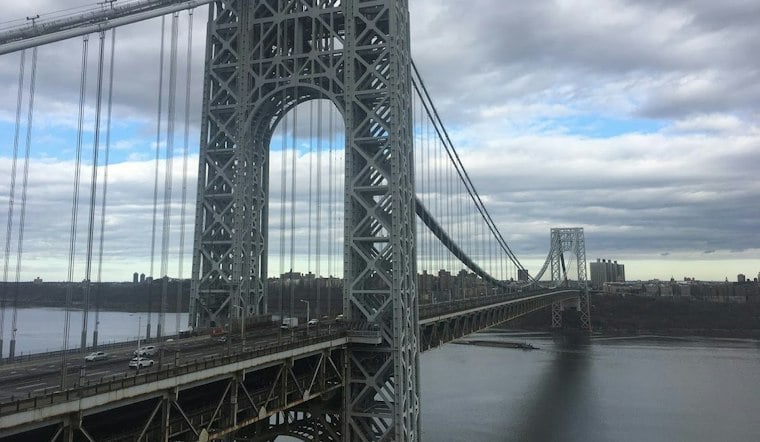
The George Washington Bridge's pedestrian-only Southwalk reopened Oct. 15 after a multi-year renovation, giving walkers, runners and tourists their own dedicated path across the Hudson River for the first time since the span's north side reopened in 2023. The upgraded route now includes new approach ramps, fresh signage and a viewing platform with panoramic views of the New York City skyline, sitting more than 200 feet above the water — roughly the height of a 16-story building.
Rob Jennings, a five-time New York City Marathon finisher, crossed the Southwalk on Oct. 19 and Oct. 25 and reported on the reopening for NJ.com. The path connects Fort Lee with West 178th Street and Cabrini Boulevard in Manhattan. The Port Authority of New York and New Jersey describes the crossing as 1.5 miles; Jennings’s Garmin recorded 1.28 miles between the entrance signs. The NJ.com report said the difference may reflect different starting and ending points, and that zigzagging can affect the measured distance.
Separating Walkers From Cyclists
The two walkways now have separate intended users. Walkers, runners, wheelchair users and people pushing baby carriages are directed to the Southwalk; cyclists, tricycles, low-speed e-bikes and human-powered electric scooters under 100 pounds belong on the Northwalk. Low-speed devices are those whose motors cannot exceed 20 mph. Motorcycles, mopeds, dirt bikes, all-terrain vehicles, electric skateboards, hoverboards and electric unicycles remain prohibited on both paths. According to the dossier’s reporting, Port Authority police will redirect people using the wrong walkway but take no other action.
Dogs are allowed on the Southwalk, a Port Authority spokesperson said, and the posted speed limit for the path is 15 mph. The walkway can take 12 minutes or less to cross at an 8-minute-mile running pace, or roughly half an hour or less walking at 3 mph. As CBS News New York reported, officials also installed 11-foot-high security fencing aimed at preventing people from climbing over the bridge's edge — though the NJ.com account notes a thin gap under the fence through which a dropped cellphone could still fall into the Hudson River.
Cleaning Closures and a Busier Weekend
The walkways are generally open around the clock, but maintenance brings overnight closures. The Southwalk shuts from 12:01 a.m. to 4:45 a.m. Mondays and Thursdays, and the Northwalk on the same schedule Tuesdays and Fridays, according to ROI-NJ. During a Southwalk closure, pedestrians are directed to the Northwalk; cyclists and scooter riders can use the Southwalk when the Northwalk is closed. The paths may also close for bad weather or an emergency, NJ.com reported.
Jennings observed the Southwalk was noticeably busier on a sunny Sunday afternoon in the mid-60s than it had been on an earlier weekday visit, though that's a single reporter's snapshot rather than evidence of a broader trend. For comparison, more than 637,000 trips were made across the Northwalk in 2025 while pedestrians and cyclists still shared that single path, per ROI-NJ's report. During the south-side work, both groups made do with the Northwalk, according to the New Jersey Bike & Walk Coalition. The project is part of the Port Authority's $2 billion Restoring the George program, CBS News New York reported.
Why the walkways were separated
Separating cyclists and pedestrians was part of the plan before the Southwalk reopened. The Port Authority’s 2017 Bicycle Master Plan called for cyclists to use the Northwalk and pedestrians the Southwalk, saying separation would eliminate conflicts between the groups. According to the Port Authority, as reported by Construction Equipment Guide, the Northwalk recorded more than 637,000 trips in 2025, about 55 percent by cyclists and 45 percent by pedestrians, before the paths were separated.
No Bathrooms, Limited Parking
Restroom access is a practical limitation for visitors: two porta potties near the Fort Lee entrance are locked, and a Port Authority spokesperson said there are no plans to add working portable toilets. The entrance is on Hudson Terrace near Bruce Reynolds Boulevard, about a half-mile from the last I-95 northbound exit before the bridge. Fort Lee Historic Park is less than a tenth of a mile away.
Fort Lee Historic Park has more than 100 parking spaces, though its lot sometimes fills, NJ.com reported. Weekday parking costs $1.50 an hour for the first four hours and $1 for each additional hour, with a $12 daily maximum. Weekend rates are $2.50 an hour for the first four hours, capped at $20. The Southwalk also gives New Jersey residents a way to reach Manhattan without paying the bridge toll or parking there; Jennings said he previously paid the toll plus $29 to park in Washington Heights.
What Officials and Walkers Are Saying
Former New York City Sanitation Commissioner Kathryn Garcia said New York City Marathon runners might use the Southwalk for training.
On the Manhattan side, the 175th Street subway station serves the A train, which runs along Manhattan's west side and into Brooklyn and Queens, giving walkers an easy connection after crossing. Nearby attractions include the Cloisters, a Metropolitan Museum of Art branch featuring nearly 5,000 medieval works, and the Armory Track and Field Center, which has an Olympics-caliber running track surrounded by 4,000 seats. A few miles south, High Bridge — New York City's oldest bridge, which opened in 1848 — still lets pedestrians and cyclists cross the Harlem River into the Bronx.
The George Washington Bridge itself remains the world's busiest vehicular bridge, with 604-foot towers that absorb wind, traffic and other forces through the normal swaying typical of suspension bridges. For now, the renovated Southwalk gives the region's walkers and runners a dedicated, if imperfect, route across the Hudson — one with sweeping views, tighter security fencing, and, for better or worse, still no place to use the restroom.




