

























































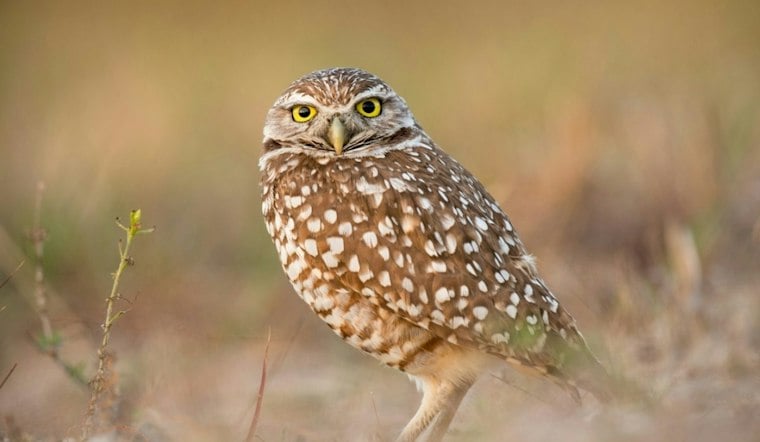
An adult burrowing owl found stuck across its entire body to a glue trap in Fort Myers got a second chance at life this fall, after wildlife rehabilitators spent more than a week peeling, soaping and dusting the bird back to health. The owl arrived trapped in adhesive and was eventually released back near where it was found, its recovery now being held up as a cautionary tale about a common pest-control product.
A Sticky Situation Gets Worse With Every Struggle
The owl had glue on its feet, wings and chest when it was discovered, and its own attempts to break free only caused further entanglement, according to Cape Coral Breeze. The bird was brought to the Clinic for the Rehabilitation of Wildlife on Sanibel Island, arriving on Sept. 16 still caught in the adhesive, according to Beach Talk Radio News. CROW itself described the scene in blunt terms, noting that “the powerful glue coated the owl's wings, feet, and feathers, completely restricting the bird's movement.”
Dr. Hunter Ferchaw, a DVM intern at CROW, said the owl was found quickly and brought in before it suffered serious injuries, per the Cape Coral Breeze report. That timing mattered: animals caught on glue traps can become exhausted and dehydrated while trying to escape, a danger highlighted by WINK News.
Peanut Butter, Dish Soap and a Dusting of Chinchilla Powder
Freeing the owl took more than a gentle tug. The CROW team sedated the bird and used an adhesive-removal spray to separate it from the trap, the station's report notes. From there, staff bathed the owl in warm water mixed with dish soap and peanut butter to work the remaining glue out of its feathers, according to the Cape Coral Breeze article.
Once the glue was gone, the recovery process still wasn't finished. CROW staff applied chinchilla dust to prevent the bird's affected feathers from sticking back together, the same account explains. The treatment worked fast: just three days after arriving at CROW, the owl was strong enough to move into an outdoor enclosure, per the same report.
Back Home in Fort Myers
A rehabilitation team evaluated the owl's recovery and readiness for release in the days that followed. On Sept. 25, the owl was cleared for release and returned to the wild near the location where it was originally found in Fort Myers, WINK News reported. The WINK account adds that the bird did not sustain any serious injuries despite being glued down to its chest, wings and feet.
Dr. Ferchaw called successfully releasing an animal back into the wild a major achievement, according to the Cape Coral Breeze report. Florida's burrowing owl is classified as a state-threatened species by the Florida Fish and Wildlife Conservation Commission, which also prohibits taking, possessing or selling the birds, their burrows or their eggs without a permit, and notes they are additionally protected under the federal Migratory Bird Treaty Act.
What To Do If You Find a Trapped Animal
Amber Strassler, a certified veterinary technician and floor manager at CROW, advised the public not to try removing an animal from a glue trap themselves. People who find wild animals stuck to adhesive traps should instead contact a licensed wildlife rehabilitator for guidance, the Cape Coral Breeze report states. Strassler recommended covering any exposed glue with paper and keeping the animal in a quiet, dark box until it can be transported to a rehabilitation center.
Glue traps are meant to catch pests, but they can just as easily endanger wildlife that was never the target, including the insects and small animals burrowing owls themselves prey on. CROW encourages wildlife-safe alternatives to the traps, pointing to options like peppermint oil, cayenne, ultrasonic repellents and live traps. A similar scenario played out in Irvine, California, where a barn owl got caught in two glue traps set out for pests while trying to grab a mouse that had already been snared, according to The Cool Down; officers there brought the bird to the Irvine Animal Care Center for treatment.
Anyone in Southwest Florida who comes across sick, injured or orphaned wildlife can contact CROW's wildlife hospital at 239-322-5068.




