

























































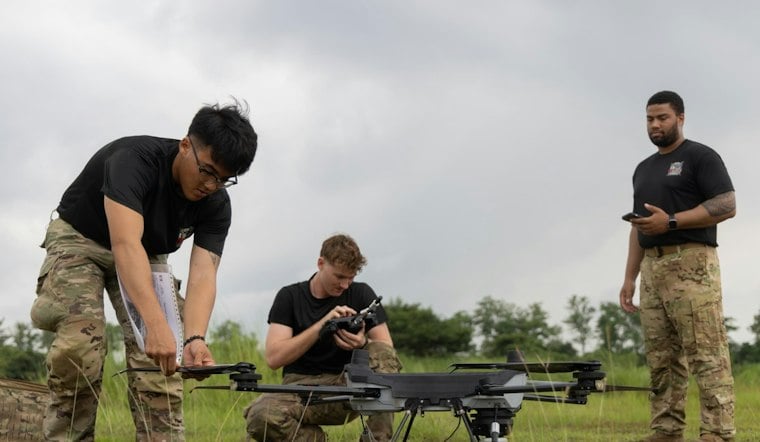
A senior U.S. Army aviation warrant officer who teaches a drone course at Fort Rucker, Alabama, spent months shuttling in and out of Ukraine to study how the embattled country trains its drone operators — and he's now rebuilding American training around what he saw. James Andreasen, an AH-64 Apache helicopter pilot who helped launch the Army's Unmanned Advanced Lethality Course, visited Ukraine's Killhouse Academy roughly two dozen times between November 2025 and March 2026, according to Andreasen.
Andreasen's observations, as reported by Business Insider, center on the Killhouse Academy, a training program run by Ukraine's elite 3rd Army Corps that teaches soldiers, foreign fighters, civilians, and defense industry workers to fly small drones. The program trains people on basic equipment that Andreasen described as a patchwork — “some of it they got donated — some of it they got secondhand, some of it the US paid for to support them, or some stuff they just purchased themselves.” Andreasen said understanding how the drones actually work matters because it lets operators iterate and adapt in the field.
Training Built on Degraded Signals and Expected Crashes
Killhouse instructors intentionally degrade drone signals during exercises, Andreasen said, to create more realistic training environments for students who may later fly under electronic jamming on the battlefield. Ukrainian trainees are expected to repair and program their own drones, understand their basic systems, and swap parts when needed — a hands-on standard that contrasts with an American training culture that typically seeks reliable, safe, and controllable exercises, the report notes.
A separate account published by the Modern War Institute, co-authored by Jordan Bower, Nico Martire and Andreasen himself, described the mechanics of that hands-on approach in detail. Observing Killhouse's six-day First-Person-View Pro Course, which enrolled sixteen students, the authors wrote that crashes were treated as expected rather than exceptional. Students managed batteries, tightened components, identified faults, and remained accountable for the condition of their own aircraft, according to the Modern War Institute account.
From Simulator to Live Flight, Pilot and Navigator Together
Before touching a live aircraft, Killhouse students had to demonstrate stable hovering, controlled yaw without drift, and precision landings on the Liftoff simulator, the Modern War Institute account states. Only after clearing that bar did students move into repeated live flights built around crew coordination, degraded video, cluttered terrain, payload effects, maintenance, and increasingly complex tactical tasks. Students trained in pilot-navigator pairs, with the navigator helping plot grids, coordinate launch and recovery, and support target search.
Andreasen also pointed to a cultural difference in how Ukrainian operators think about their own safety. Ukrainian operators, he said, prioritize survivability and appear to take greater care to protect the positions from which they operate — an instinct he said Ukrainian trainees seemed to grasp more naturally than their American counterparts, along with a feel for their aircraft and the electromagnetic spectrum.
Fort Rucker's Course Takes Shape
Andreasen said he applied what he saw directly to the Unmanned Advanced Lethality Course at Fort Rucker, adopting training objectives that include initial liftoff training, steady hovering for extended periods, flying low, and operating inside buildings and around corners without losing altitude. “All of those training objectives, we copied directly from what we were seeing in Ukraine and applied them directly to UALC,” Andreasen said. The course also updated its training altitude and methods for striking targets based on the Killhouse lessons.
The course itself launched at Fort Rucker in August 2025, when 28 students from various job specialties were selected for the three-week inaugural run, according to Army Times. Those first students logged 20 to 25 hours of simulator time before moving to live-flight exercises, and at the time, instructors framed the course as catch-up work: “We're behind globally, and this is our aggressive attempt to close that gap.” A new drone training facility at Fort Rucker, featuring an indoor flying course, classrooms, and labs, opened in April 2026, and by July 2026 the program's live kinetic engagements had increased from five to twelve, per the Modern War Institute dispatch.
Still Playing Catch-Up
Despite the expansion, Andreasen said the Army still cannot get enough soldiers through its drone courses fast enough. “We can't get enough of our soldiers through these courses fast enough,” he said. He added that the Army has never moved faster in his 16 years of service than in its effort to catch up to Ukraine on drones, and said the service has responded quickly to the changing role of drones and been receptive to proposals for improving the course.





