

























































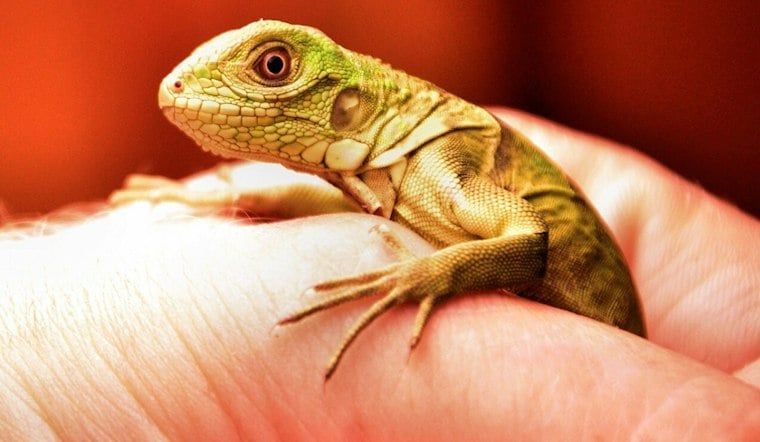
Four critically endangered Jamaican iguanas recently hatched behind the scenes at Disney's Animal Kingdom, a quiet addition to a species-wide breeding effort for one of the rarest reptiles on Earth. The hatchlings emerged with distinctive mottled gray-green scaling, and photos show one perched on a handler's hand while another peeks out from its egg on a bed of sand.
The successful births took place backstage at the park, according to wdwmagic, which published a photo gallery of the newborn reptiles. As wdwnt.com reports, the hatchings contribute to the AZA Jamaican Iguana Species Survival Plan, with Animals at Disney saying the births help maintain a healthy, genetically diverse population of one of the rarest iguana species in the world. The outlet also notes that Disney has not said whether these particular hatchlings will ever be viewable by park guests.
A Species Clawing Back From the Brink
The Jamaican iguana, scientifically known as Cyclura collei, is endemic to Jamaica and remains classified as critically endangered on the IUCN Red List, per the same wdwnt.com report and corroborated by science.sandiegozoo.org. The species' recovery has depended on decades of fieldwork on the island itself, including headstarting programs that raise hatchlings in captivity before release, along with predator control and reintroduction efforts in the wild.
A total of 315 headstarted iguanas have been released back into Jamaica's Hellshire Hills, according to science.sandiegozoo.org. That same source states that after 20 years of intensive predator control and reintroductions, researchers observed a greater than eight-fold increase in nesting females and hatchlings in the wild. The International Iguana Foundation separately reported that by September 2023, 483 iguanas had hatched that season, surpassing the previous annual record of 467, and that its program reintroduced 100 individuals to the Hellshire Hills during 2023.
How Many Are Actually Left in the Wild
Just how many Jamaican iguanas survive in the wild depends on which account you read. The 2013 IUCN Jamaican Iguana Species Recovery Plan cited estimates that only 100 to 200 adults remained, possibly fewer. National Geographic has put the wild population at roughly 200, confined to under four square miles of habitat. Fort Worth Zoo, meanwhile, states on its conservation blog that there are now 500 to 600 adults in the wild thanks to extreme conservation efforts, though it cautions the species remains critically endangered regardless of which figure is accurate.
The breeding program that produced Disney's four new hatchlings isn't a solo effort. The AZA Species Survival Plan is among the efforts focused on Jamaican iguanas, according to the San Diego Zoo Wildlife Alliance. Disney's Animal Kingdom joins a list of institutions that have reported similar milestones over the years.
Other Zoos Have Celebrated Similar Hatchings
In 2006, the Indianapolis Zoo reported the first Jamaican iguana hatching to ever occur outside Jamaica, a milestone for the captive breeding effort. A second clutch at that zoo began hatching that September, with 19 of 20 viable eggs successfully hatching out of a clutch of 21 that included one infertile egg.
More than a decade later, the San Diego Zoo Safari Park's Reptile Conservation Center reported four Jamaican iguanas hatching from eggs laid by two different pairs of adult iguanas, per the San Diego Zoo Wildlife Alliance. That account states one egg from the first clutch hatched on September 4, while three eggs from a second clutch hatched on October 6, 7 and 11, though it does not specify the year. The 2013 recovery plan also noted the species carries formal legal protection, listed as protected under Jamaica's Wildlife Protection Act and considered Endangered under the U.S. Endangered Species Act at the time the plan was written.
For now, Disney's backstage hatchlings remain out of public view, with no word yet on whether that will change. What is clear is that each new clutch, wherever it hatches, adds another data point to a slow, decades-long effort to pull Cyclura collei back from the edge.





