

























































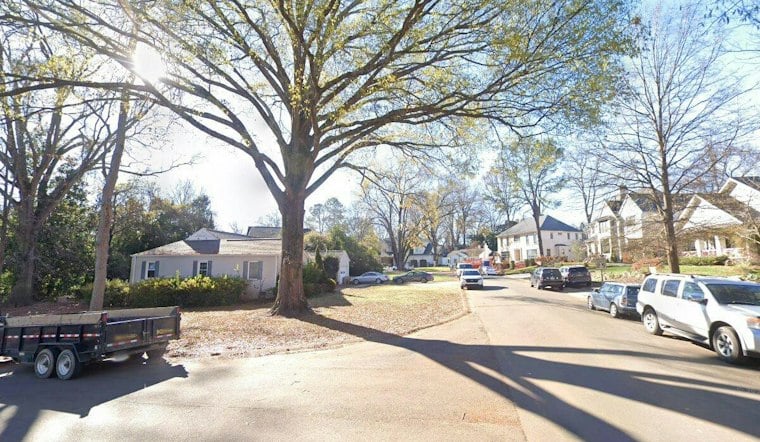
A house near Charlotte's Freedom Park neighborhood came down on Nov. 9, and by the next day, two heritage trees that once stood over the property were gone too. For Meigan Alexander, who lives across the street from where a 100-year-old oak stood at Salem Drive and Idlewood Circle, it was the ending she had spent weeks trying to prevent.
Alexander had tried to contact both the city and the developer, Amin Ventures, hoping to find a compromise that would save the corner tree, according to the Charlotte Observer. In October, she said she and her neighbors had done everything within their power to work with the developer to save it. The oak and a second heritage tree stood in the way of a planned redevelopment, and city records show Amin Ventures purchased the house across from Alexander for $1 million in April.
Those records describe a two-story, 6,442-square-foot house slated to replace what had been a one-story home of 2,474 square feet, the Observer reports. Amin Ventures did not respond to emails and direct messages from the paper seeking comment on the removals or its plans for the site.
A $3,000 Fee and a Pair of Saplings
According to city records cited by the Observer, Amin Ventures paid $3,000 to cut down the two trees and plans to plant two replacements on the property. Alexander argues that kind of fee does little to change developer behavior. She said a fee will not stop developers from cutting down trees, and she has criticized the city for not requiring creative approaches or stronger consequences when healthy tree canopy is removed.
Charlotte's Unified Development Ordinance, adopted in 2023, requires a permit before any heritage tree can be removed, and the city's rules allow removal when a tree's trunk or root zone occupies buildable space or when preserving it would restrict how a property can be used. Permits cost $1,500 per tree for development projects and $500 per tree for non-development removals, per the Observer's reporting. City officials say Charlotte has issued almost 2,400 heritage-tree removal permits since the ordinance took effect, collecting roughly $4.5 million in mitigation fees along the way.
That permit volume doesn't tell the whole story, though. The Observer notes that if each of the 2,390 permits represented a single tree, the mitigation total would come to about $2.5 million — well short of the $4.5 million actually collected — and the city has not clarified how many individual trees were actually cut down under those permits. A separate Observer report on the Freedom Park fight similarly noted that a permit doesn't necessarily correspond to one tree.
Defining a Heritage Tree
Just what counts as a heritage tree carries its own uncertainty in local reporting. The Observer's description of the city's definition covers trees native to North Carolina that measure at least 30 inches in diameter, a reading that matches language in the city's own 2024 text amendment, which defines a heritage tree as one native to North Carolina under the USDA Natural Resources Conservation Service Plants Database with a diameter at breast height of 30 inches or greater. But WBTV has described the standard differently, reporting that a heritage tree must be at least 100 years old in addition to meeting the 30-inch diameter threshold. The city's adopted tree ordinance states that removal activities cannot begin until a tree work permit is issued and applicable mitigation is addressed.
Charlotte's Shrinking Canopy
The fight over two trees in Freedom Park sits inside a much larger citywide struggle. Charlotte has set a goal of reaching 50% tree-canopy coverage by 2050, but a 2022 estimate put coverage at just 47.3% of the city's land area, according to WFAE. A more recent analysis cited by the station found that under business-as-usual conditions, the canopy could fall to just 41% by 2050 in the best-case scenario.
WFAE also reported that as of Aug. 19, the city had logged 1,085 non-developmental and 1,305 developmental heritage-tree removal permits since the ordinance took effect, and that Charlotte has collected $53,760 in fines from 25 violations involving trees disturbed without permits since January 2025. Sustain Charlotte founder Shannon Binns pointed to Washington, D.C., Portland and Austin as cities with comparatively stronger heritage-tree protections that Charlotte might look to as a model, per the station's reporting. In May, the city said it planned to launch a tree-canopy policy initiative over the summer to reevaluate its practices, but it has not provided an update since.
Alexander's Call to Action
For Alexander, the loss of the Salem Drive oak has become a rallying point rather than a closed case. She hopes others will speak up as development continues to remove more of Charlotte's tree canopy, and she's urging residents to band together to hold developers accountable rather than waiting on City Hall to toughen its rules. Her message, as relayed in the Observer's reporting, is that neighbors who want to protect what canopy remains may need to organize before the next demolition crew arrives, not after.





