

























































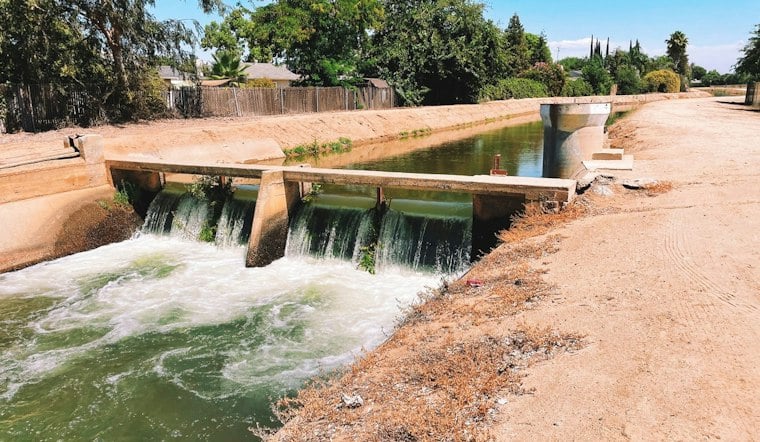
A stretch of fabric and steel nearly 90 feet long is doing the job that once would have taken dump trucks, an excavator and a bulldozer. Fresno Irrigation District is in the middle of an $800,000 upgrade to the main Kings River headgate on the Fresno Canal, a structure dating back to 1905, and instead of building a temporary cobble dam to hold back the water, crews brought in a portable barrier from a New Jersey company to get the job done.
The district contracted with Portadam, according to SJV Water, which deploys portable dams in waterways as needed. The company describes its system on its own site as a freestanding structure that does not require penetrating the ground, built from engineered modular steel frames paired with a nylon-reinforced, impervious PVC fabric liner that the company says can retain up to 12 feet of water. At the Fresno Canal site, the barrier takes the form of a row of metal A-frames about 10 feet tall, covered by a tarp and secured with sandbags, stretching roughly 90 feet across the canal, according to Adam Claes, FID's assistant general manager of operations, as reported by SJV Water.
Why Not Just Build a Cobble Dam
The district does keep a stockpile of cobble on hand for projects like this, but per SJV Water, officials weren't certain it held enough material for the headgate job. Building a temporary cobble dam the old-fashioned way would have meant several dump trucks of material, plus an excavator and a bulldozer to put it all in place. The Portadam method skips all of that heavy equipment entirely.
That matters beyond just convenience. FID Chief Engineer Felix Vaquilar told SJV Water that avoiding the cobble-dam approach freed up staff time for other projects, including getting ready for potentially heavy winter storms. Claes added that the district wanted to be ready for flood control or flood releases during the current El Niño year and did not want the main canal out of commission when that moment came.
A Headgate Almost as Old as the District Itself
The Fresno Canal and Irrigation Company originally built the headgate in 1905, well before Fresno Irrigation District existed. The district itself traces its roots to a June 1920 vote, when, according to Fresno Irrigation District, more than 88 percent of voters — 1,290 of 1,438 ballots cast — approved forming the district. By the following month, the district had acquired the Fresno Canal and Land Corporation, as the old canal company had been renamed, picking up 260 miles of canals for $1.75 million. That purchase, per SJV Water, is how the district came to own the headgate itself in 1920.
The canal's origins stretch back even further. Fresno Irrigation District's history page notes that Moses J. Church was commissioned in 1870 to develop the Fresno Canal and divert Kings River water, decades before the headgate that stands there today was built. The structure has since become something of a symbol for the district — the Fresno Canal headgate appears in FID's own logo, per SJV Water.
From Cast Iron to Motors to Individual Control
The original headgate used custom cast iron gates, which the district later swapped out for epoxy-coated steel. Those steel gates rusted over time and occasionally jammed when a tree got stuck underneath, according to SJV Water's reporting. Before electric motors ever entered the picture, a water wheel system powered the gates, and a resident employee living in the headgate house manually adjusted the flow rate — a building FID still rents out today, with current residents checking the headgate in case its communication system goes down.
More than 80 years before this project, the district added two motors to the system, but those motors controlled the gates in two separate groups rather than individually. FID began dismantling that old setup about a week before an Oct. 27 site tour, and the new upgrade will finally give every gate its own motor so each can be controlled independently. Claes told SJV Water the project was expected to wrap up Wednesday, Nov. 25, 2026.
How Other Districts Have Tackled Similar Jobs
Other irrigation districts have taken a different route entirely for aging infrastructure. New Sweden Irrigation District in eastern Idaho launched a $900,000 headgate modernization in 2019 to replace a 127-year-old structure, according to Capital Press. That project called for three 15-foot-square, partially automated panels lifted by electric motors — a full gate replacement rather than the temporary-barrier approach Fresno used to work around its existing structure.





