

























































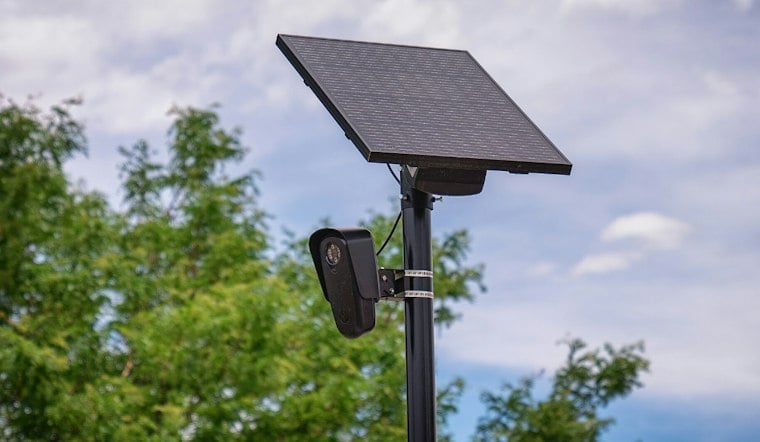
Minutes before a man called 911 to report he'd been shot in a drive-by, a Flock gunshot-detection sensor near his neighborhood had already picked up the gunfire and sent an alert to Gastonia police. That alert, investigators say, helped them figure out what actually happened: a homeowner told officers he shot Cedric Ford while Ford was trying to break into his house, not the version Ford had reported. The case became one of the clearest local examples yet of how deeply Flock's camera network has embedded itself in Gastonia policing, even as the city commits taxpayers to a 10-year, multimillion-dollar contract with the company.
Gastonia Police Assistant Chief Nancy Brogdon walked WSOC-TV reporter Hunter Sáenz through the department's Real Time Crime Center, where feeds from Flock cameras stream live and officers pull up nearby footage after nearly every call for service. The department currently runs 27 live Flock cameras and 75 license plate readers, and it began using the technology in 2023. Brogdon said Flock has empowered the department to solve crimes more quickly, and that it has saved investigators hours, and sometimes days, of legwork.
The department attributes more than 200 successful outcomes to the cameras, according to WSOC-TV's reporting, including cases where the technology helped locate a missing 16-year-old with special needs. Those numbers are set to grow. In July, Gastonia entered a 10-year “Safe City” contract with Flock that, per the city's agreement, brings the total to 130 license plate readers, 70 live cameras and 158 gunshot-detection devices. The department also plans to install dozens more Flock devices. WSOC-TV reports the full contract will cost Gastonia taxpayers more than $10 million over its decade-long term.
How the Gunshot Alert Led Police to a Different Story
The July case began when one of the city's gunshot-detection sensors picked up gunfire near a residence and routed the alert straight into the Real Time Crime Center, according to Police1. The alert led officers to a nearby house, where a homeowner said he had shot Ford while Ford tried to break in — a different account than the drive-by shooting Ford had reported to 911. Police said the Flock alert helped identify the true source of the shooting and led to two arrests. Police1 also reported that the gunshot-detection system had only been running for two weeks at the time, making the case the technology's first solved outcome in Gastonia.
Flock itself points to much larger numbers to make the case for its tools. The company estimates its cameras helped with more than 1 million law enforcement investigations in 2025, according to the Pew Research Center. Flock's vice president of policy, Jalen Johnson, told WSOC-TV that Flock products helped bring home more than 10,000 missing people in 2025 and helped solve more than a million cases that year, framing the technology as a tool that helps police piece together puzzles to solve heinous crimes.
Misuse Concerns Spread Beyond Gastonia
Johnson acknowledged to WSOC-TV that some law enforcement officers have misused Flock cameras and systems, calling any misuse horrible and something that should never happen. He said Flock captures only a point-in-time image of a car's rear from a public roadway, without facial recognition, personal identifying information, or GPS-style continuous tracking of a person's movements. Flock and the Gastonia Police Department conduct routine weekly audits for camera misuse, and the company created a transparency portal in response to misuse concerns; Gastonia's version of that portal shows data and search counts from the previous 30 days and states that information collected is used for law enforcement purposes only and is never sold to third parties.
Elsewhere in the region, WSOC-TV reported allegations with more serious consequences. A former Mooresville officer, Elizabeth Snowman, used Flock to track her boyfriend's ex-wife, according to Ron Campurciani. And the Charlotte-Mecklenburg Police Department said Seth Elliot used the Flock system to share information about an undercover officer with a suspected drug dealer. Those incidents echo a broader pattern documented nationally: USA TODAY found that at least 19 police and sheriff's office employees in five states were arrested, fired, placed on administrative leave or put under investigation over alleged improper Flock use in just the two months before its late-August report. That investigation, which analyzed more than 75 million Flock license-plate-reader searches across more than 6,300 agencies over three and a half years, identified 240 users with unusually frequent searches; of the 67 agencies USA TODAY contacted about those users, roughly half confirmed misuse or ongoing investigations, or opened new ones.
Privacy Advocates and Shifting Local Contracts
Daniel Oria raised a broader concern to WSOC-TV: that surveillance systems collect information on everyone at a national level, including people never suspected of a crime. Johnson responded that people have a right to raise privacy concerns, and said the real debate is about strengthening safeguards rather than whether the product works. In Monroe, demonstrators gathered at city hall in September to call for a moratorium on the technology, and resident Abigail Pepper said the city should hold a dedicated public-comment meeting to hear concerns alongside the pros and cons.
Flock has responded to that pressure with new company-wide policy changes. The company says it will require all law enforcement customers to adopt its Audit Assistance feature, which flags abnormal search activity for administrator review, by the end of the year, according to Flock Safety. It also plans to require case codes for all law enforcement searches, with emergency bypasses flagged for review, and is shifting its recommended default data-retention period from 30 days down to seven, though existing customers keep whatever retention period they already have.
Not every town has stuck with the company. The Town of Catawba decided not to renew its subscription after a 60-day trial in September 2026; Catawba Police Chief Brian Bixby told WBTV that limited funding and other competing local needs drove the decision not to renew. Nationally, at least 10 local governments and police departments have moved since summer to curb, restrict or end their Flock use, according to TechCrunch, including Asheville, which lost access after the city voted to terminate its contract in August, and Monroe, Ohio; Newburgh, New York; Richmond, Virginia; Hopkinton and New Bedford, Massachusetts; and Lansing, Michigan. Cleveland took a middle path, extending its Flock contract while restricting immigration-related searches and limiting database access to its own police department.
What Local Contracts Actually Say About Leaving
WSOC-TV reporter Erika Jackson submitted public-records requests to cities and towns across the region for their Flock contract terms, revealing wide variation in cost and exit clauses. Mooresville has a five-year agreement worth more than $850,000 that includes an agency satisfaction guarantee, letting the town terminate at any time with removal fees up to $500 per camera and a prorated refund. Monroe's three-year, $153,000 contract requires the city to pay the remaining balance if it removes cameras early, while Huntersville's two-year, $133,000 agreement allows termination only if either party breaches the deal, giving the violating agency 30 days to fix the issue.
Gastonia's contract sits apart from those smaller deals both in size and in its termination terms. The agreement allows either side to exit if a party goes out of business or runs into serious financial trouble, but it explicitly does not allow termination simply because a party is unhappy or changes its mind. Johnson told WSOC-TV that ending a Flock relationship is ultimately each community's own decision, though he said he feels regret whenever a community chooses to do so.
National camera counts vary depending on who's counting. Pew's own OpenStreetMap analysis identified 109,577 Flock license-plate-reader nodes as of mid-September, which Pew describes as a lower-bound sample rather than a complete total, and found that roughly 80% of all Flock cameras sit in urban areas. TechCrunch has separately reported more than 100,000 Flock cameras in use nationwide, while Flock told The Washington Post in August that it had surpassed 120,000 cameras across 6,000 communities — figures from different sources that the available reporting does not reconcile into one settled number.



