

























































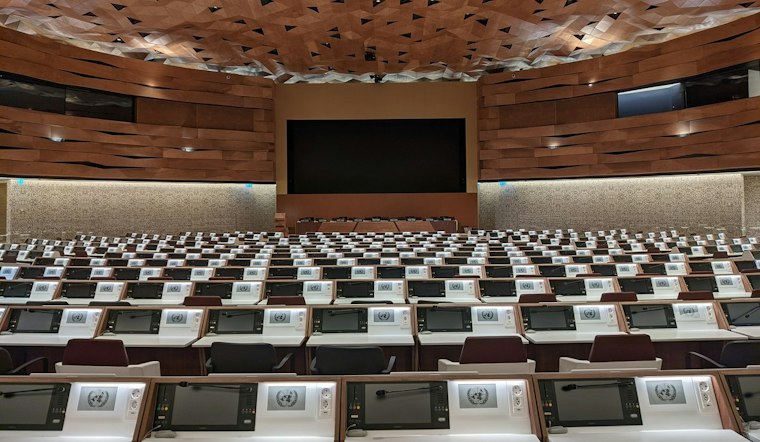
Delegates convened Monday at the Palais des Nations on whether lethal autonomous weapons should come under a new international instrument, but proceedings ground to a halt within minutes over an agenda dispute and the conference remained suspended; informal consultations on autonomous weapons were to begin Tuesday. The Seventh Review Conference of the Convention on Certain Conventional Weapons is scheduled in Geneva for Nov. 16 to 20, a five-day span. The weapons under discussion are already being treated as a present problem, not a lab concept.
U.N. Secretary-General António Guterres urged delegates from more than 120 member states to move toward negotiating a legally binding instrument, U.N. News reported. That account said there is currently no agreement on the nature of a possible new instrument, or on its timeframe. The New York Times counted delegates from 128 states at Monday's meeting. Geneva Solutions reported more than 128 countries at the opening.
What Delegates Are Being Asked to Do
The United Nations Office for Disarmament Affairs places the conference at the Palais des Nations from Nov. 16 to 20. The agenda includes a proposal on the mandate and modalities of future work by the Group of Governmental Experts on lethal autonomous weapons systems.
Those are drab words for a real fork. A mandate can keep experts studying a problem. It can also be the threshold for negotiations. Guterres asked the hall to move toward an instrument that would bind. The item in print asks what the expert group does next, and on what terms.
U.N. News has already named the choice the meeting has not made: no agreement on whether a possible new instrument should be legally binding, and none on the timeframe. A guideline a government may set aside and a treaty it would have to implement are not the same text. An open calendar is not a deadline.
Already Past the Hypothetical
The conference is focused on weapons systems with increasing levels of autonomy.
The New York Times reported that Russia and Ukraine have already deployed fully autonomous drones to carry out attacks. Disarmament experts cited by the paper fear the low cost and easy availability of such technology could lead to its rapid spread, including to law enforcement, nonstate armed groups and organized crime. A capability that begins in a state arsenal does not have to stay there.
Swissinfo described the technical pressure behind that fear. Rapid advances in sensors, algorithms and artificial intelligence are dramatically expanding what autonomous weapons can do, and fueling a development race. A rule written for last year's system is aimed at a moving target.
Experts cited by CBC News warned about a failure that does not require removing the person from the procedure. Human approval of an AI-assisted strike, they said, could effectively serve as a rubber stamp, partly because people over-trust AI systems. A retained human role that nobody is prepared to overrule is a role on paper.
A Consensus Brief That Will Not Choose
The examination did not start in Geneva this week. Since 2017, parties to the Convention on Certain Conventional Weapons have been looking at challenges posed by emerging technologies in lethal autonomous weapons systems through the Group of Governmental Experts, the U.N. Office for Disarmament Affairs says. Nine years of that work is the backdrop to a review conference that still has not agreed what kind of document should come out of it.
The group's 2026 mandate was to formulate, by consensus, elements of an instrument and other possible measures, without prejudging the instrument's nature. Consensus sets a high bar for the sentences. The refusal to prejudge leaves their legal status open even if the sentences are agreed. Governments can settle on paragraphs and still disagree about whether anyone must follow them.
The debate remains over what form any instrument should take.
October's Majority and This Week's Split
Outside this convention's expert track, the politics have looked less stuck. The New York Times reported that a General Assembly resolution supporting negotiations on a binding agreement was backed by 163 states in October.
It does record a large group of governments, only last month, lining up behind talks aimed at a binding agreement. The Geneva opening, in the U.N. News account, has not turned that lineup into an agreed legal form or an agreed clock.
Both facts can be true because they describe different procedures. A majority can be assembled in the General Assembly. The expert group, by contrast, was told to work by consensus and not to decide in advance what kind of instrument it was building. Delegates can leave Friday with a renewed mandate and no treaty path, and the process will still have continued.
When Earlier Talks Moved Elsewhere
The New York Times has reported fully autonomous drone attacks by Russia and Ukraine.
The Arms Control Association describes the Ottawa Process as the work of like-minded states and nongovernmental organizations, outside the United Nations and without the major powers. A ban written that way can bind the governments that join. It cannot claim the major powers were in the room when it was made. Geneva Solutions notes a later version of the move: Norway hosted negotiations in 2006 after efforts to launch cluster-munitions talks at the weapons convention failed.
Delegates have until Friday. The published agenda still centers on the mandate and modalities of the expert group's future work. Ottawa and the 2006 Norway talks are precedents for what some states have done after this convention would not start the negotiation. They are not a result this conference has reached.



