

























































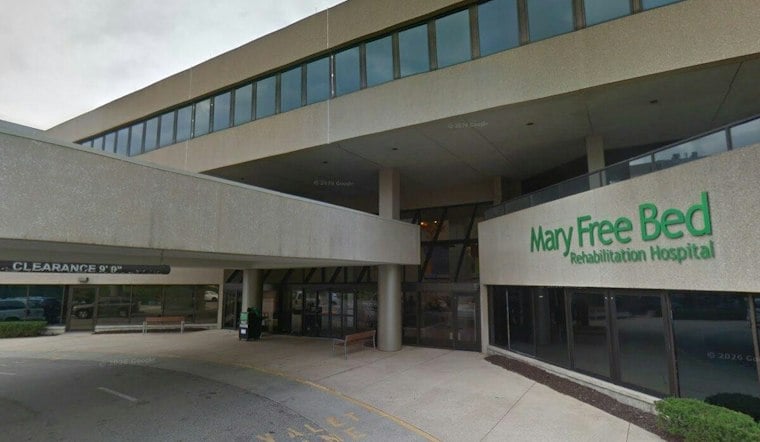
A child-sized orange door built low to the ground, shaped like something out of the Shire, sits beside the standard sliding-glass entrance at Mary Free Bed's new Joan Secchia Children's Rehabilitation Hospital in Grand Rapids. Inside the lobby, a towering artificial tree named the Tree of Hope and Freedom rises toward the ceiling. The $72.5 million facility, described as Michigan's first freestanding children's rehabilitation hospital, is set to open following a ribbon-cutting ceremony on December 4.
The three-story, 67,000-square-foot building sits across from Mary Free Bed's main campus at 235 Wealthy St. SE, and it is a joint venture between Mary Free Bed and Corewell Health Helen DeVos Children's Hospital, according to Pure Architects. A pedestrian skybridge is designed to connect the new building with the Mary Free Bed Grand Rapids campus, according to Healthcare Design. The hospital's tree references Mary Free Bed's mission of restoring hope and freedom after injury or illness, and hospital officials say the overall design aims to make rehabilitation feel less clinical and intimidating for children, as reported by MLive.
Mary Free Bed announced the project in 2022, planning it in response to growing demand for children's rehabilitation services. The organization says it is now serving record numbers of pediatric inpatients and outpatients, with outpatient volume already exceeding earlier projections, per the same MLive report. Carly Ridderbusch, quoted in that coverage, said she hopes children feel excitement and calm when they arrive.
A Doubling of Beds and a 20 Percent Capacity Boost
The new hospital has 24 pediatric inpatient beds, twice as many as Mary Free Bed's main building, and is expected to increase outpatient capacity by 20 percent. Mary Free Bed expects the hospital to serve more than 2,500 children annually, the outlet reported. Reports have varied on the project's overall price tag: Healthcare Design described it as a $70 million, 67,000-square-foot facility, while Crain's Grand Rapids Business referred to it as a $72 million pediatric center scheduled to open Dec. 7.
Funding came from both public and private sources. Joan Secchia, widow of businessman, philanthropist and former U.S. ambassador to Italy Peter Secchia, provided the lead donation, according to MLive's reporting. The State of Michigan contributed $15 million and the federal government added $3 million, while the DeVos family separately announced a $5 million gift toward construction, according to Mary Free Bed. Sara Mooney, the organization's vice president of development, said the community raised $72.5 million total, including gifts as small as 50 cents, and said Mary Free Bed has simply outgrown its current space.
Designed Around Families Who Stay
Mary Free Bed pediatric inpatients come from west Michigan, elsewhere in the state and the Midwest, while outpatients primarily come from the Grand Rapids area. The organization says it treated 1,313 children from outside Michigan between 2016 and 2023, and hopes the new hospital will eventually draw patients from across the nation. Each inpatient room was built with families in mind: two recliners convert into beds for overnight caregivers, and refrigerators let parents store food without leaving their child's side. Officials added the refrigerators after a family said they needed somewhere to keep food during a stay, per the same report.
The hospital also includes dedicated work rooms where parents can use laptops, take calls or join virtual meetings, along with an activity center built for parties, celebrations and family gatherings. That space features arcade-style basketball, air hockey and art areas, with separate zones for teenagers and younger children. Outpatient treatment rooms are designed to resemble rustic cabins, and child-sized waiting nooks include twinkling lights meant to resemble a night sky.
Therapy Gym Built Around Mobility and Fall Prevention
Pediatric inpatients typically receive three hours of therapy a day, five days a week, and will have access to physical, occupational and speech-language therapy from care teams that include nurses, physicians, psychologists, dietitians, recreational therapists, child life specialists, a full-time teacher, and pediatric orthotics and prosthetics specialists. The main therapy gym contains five treatment tables and four overhead lifts, plus a ZeroG body-weight support system mounted on a ceiling track that lets patients move throughout the gym rather than staying stationary over a treadmill, as Mary Free Bed's older system required. The ZeroG system supports part of a child's weight while they practice standing or walking and is meant to protect them from falls during therapy. Therapists can also use floor hurdles and a movable staircase, while floor markings spaced 10 feet apart help them measure walking distance and track progress.
Lighting plays its own role in treatment. Outpatient treatment rooms have selectable, color-changing ceiling lights that let therapists create either playful or lower-stimulation environments depending on a child's needs. Steven Jaeger said gentle lighting can serve as a therapeutic tool for children who need it. Each inpatient room also has an overhead mechanical lift along with voice-controlled lights, curtains, television and nurse-call functions — a feature Ridderbusch said removes a mobility barrier for children who cannot reach buttons on their own. Before opening, Mary Free Bed converted several planned conference and staff consultation rooms into additional treatment spaces, and the organization describes the hospital as one of nine such facilities in the country.




