

























































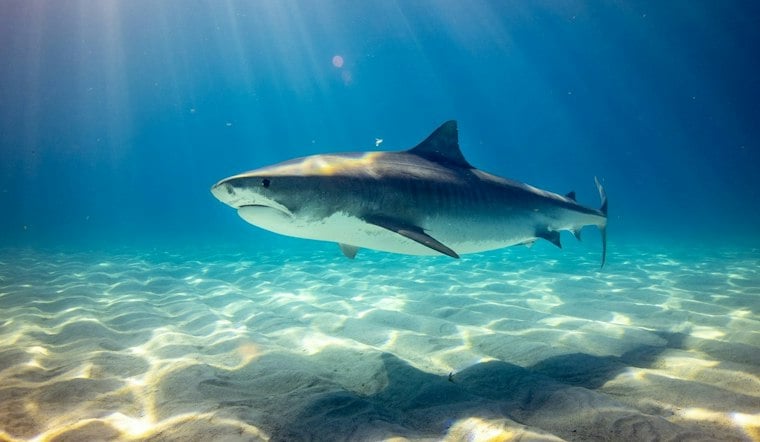
Nine great white sharks have turned up at Flower Garden Banks National Marine Sanctuary over the past three years, marking the first time the protected reef system roughly 100 miles off the Texas and Louisiana coasts has ever recorded the species. Researchers tracked the animals using an underwater acoustic array, with at least one shark detected having traveled nearly 3,800 kilometers from where it was originally tagged.
The discovery comes from a paper led by Michael Dance, an associate professor in LSU's Department of Oceanography & Coastal Sciences, published in September 2026 alongside collaborators from other universities, according to The Reveille, LSU's student newspaper. Dance runs the university's Fisheries and Movement Ecology Lab, which partnered with Texas A&M University researchers to establish a large-scale acoustic receiver array across the sanctuary and surrounding outer shelf in July and August 2022. The array, consisting of 32 receivers spread across sanctuary banks, surrounding reefs and adjacent artificial structures, allowed the team to document shark visits that had never before been recorded in the sanctuary, according to frontiersin.org.
Sharks Tagged Along the Atlantic Coast Showed Up Deep in the Gulf
The nine sharks detected between 2022 and 2025 had originally been tagged along the Atlantic coast between South Carolina and Massachusetts, per the student newspaper's reporting. Detections occurred between January and August at seven natural banks within the sanctuary, along with surrounding natural and artificial reefs, the Frontiers paper notes. Two of the animals, one male and one female, returned to the region in multiple years, suggesting the Gulf outpost may hold some repeat appeal even as researchers debate exactly why.
Flower Garden Banks National Marine Sanctuary spans 17 banks across more than 300 kilometers of the continental shelf edge, sitting at a location Dance described as supporting both reef-associated species and mobile pelagic, or open-ocean, visitors, according to the Reveille's account of his comments. Marine protected areas like this one restrict fishing, anchoring and other human activities to shield underwater ecosystems, and the sanctuary's own website confirms that anchoring is not permitted within its boundaries, with visitors directed instead to use a mooring buoy, per the Flower Garden Banks National Marine Sanctuary.
Researchers Call the Sanctuary a Yellowstone in the Gulf
Brondum Krebs, a doctoral student in Dance's lab focused on the sanctuary, compared the protected reef system to Yellowstone in the Gulf, according to the Reveille, and said the ecosystem and the species that depend on it require careful stewardship to retain ecological resilience. Dance has said that passive monitoring of remote ocean areas and electronic tagging have both improved significantly in recent decades, giving scientists tools to detect animal movements that would have gone unnoticed in the past.
Great white sharks remain a protected species, and the population along the western North Atlantic has been recovering since 1997, when commercial and recreational harvest of the species was prohibited, according to Texas Monthly. Frontiers reporting on the sanctuary findings echoes that recent data suggests the species is reoccupying both the northern and southern ends of its historical range. White sharks are also protected internationally under CITES Appendix II, CMS Appendix II, UNCLOS and other regional fisheries agreements, per NOAA Fisheries.
Why the Sharks Are Showing Up Remains an Open Question
Dance explained that the sharks' presence in the sanctuary raises questions about whether prey availability will be enough to keep them there, or whether they will eventually be pushed back toward the Atlantic, the student newspaper reported. Artificial reefs and oil and gas infrastructure scattered throughout the sanctuary support significant biomass that could serve as a food source for the sharks, which may help explain the visits even as the underlying cause stays unresolved.
Some researchers studying the broader pattern describe the Gulf reefs as functioning less like a final destination and more like stepping stones along a seasonal migration route, according to Forbes. That outlet's reporting frames the detections as possible evidence of a seasonal migration corridor stretching across the western North Atlantic, though the interpretation remains conditional. A separate Frontiers paper on Gulf white shark sightings similarly suggested that recent reports in the northern Gulf may reflect early range-edge expansion rather than simply more tagging or citizen observations, as populations rebuild after three decades of management measures.
More Sightings Are Piling Up Across the Northern Gulf
The Flower Garden Banks detections are not an isolated data point. Researchers also documented two white sharks on remotely operated vehicle video off coastal Alabama in 2024, after none had appeared in camera surveys stretching from 2010 through 2023, per the Frontiers paper on Alabama observations. The first was a female estimated at 239 centimeters, recorded on April 24, 2024, and the second was a male estimated at 191 centimeters, recorded on May 7, 2024.
Farther west, tracked sharks have pushed even deeper into Gulf waters historically considered off-limits to the species. A great white named LeeBeth was tracked past the Mississippi River into Texas waters and near Mexico before turning back east along the Gulf Coast, according to nola.com. A juvenile named Keji, tagged in Nova Scotia, was later pinged off Mississippi, and another shark named Crystal became only the sixth white shark OCEARCH had ever tracked that far west, the outlet reported. Great white shark migrations themselves are relatively common, but discoveries west of the Mississippi River have historically been rare, which is part of what makes the Flower Garden Banks detections and these western Gulf pings notable together.
What More Research Could Reveal
According to the Reveille's reporting on Dance's findings, additional long-term datasets and monitoring across a wider range of habitats will be needed to answer the open questions the discovery has raised, including why the sharks are visiting and how the ecosystem might be managed to support them. The research data gathered so far was backed by university partners, federal agencies and sanctuary staff, and is already raising awareness about the protected reef system even as it remains essential to understanding the broader marine ecosystem the sharks now appear to be using.





