

























































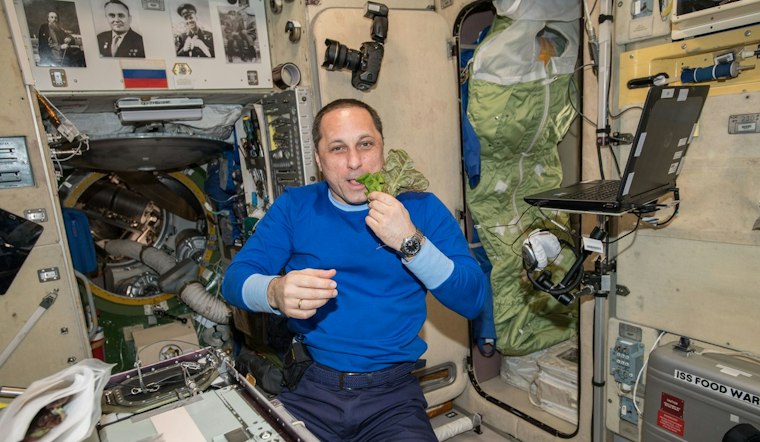
Six students at the S.C. Governor’s School for the Arts and Humanities spent the past month tending mizuna greens and Australian yellowleaf lettuce under grow lights in their Greenville classroom, playing a small but real role in NASA’s hunt for food that astronauts could one day grow on the moon. The environmental science class measured its edible plants on October 30, after four weeks of growth and washing left the greens and lettuce ready for evaluation.
The class joined NASA’s Growing Beyond Earth program, a partnership with Fairchild Tropical Botanic Garden in which middle and high school students run plant experiments that feed directly into the space agency’s decisions about what crops astronauts will eventually grow, according to the Post and Courier. The program describes itself as putting real plant science into classrooms, noting that “Middle and high school students run real plant experiments in their classrooms, and the results help NASA decide which crops astronauts will grow in space,” according to Fairchild Tropical Botanic Garden. Every participating classroom, including the one in Greenville, adds to a shared dataset that NASA’s Space Crop Production team uses to vet new crops for space.
Teacher Anne Byford, who brought the project to her students, said the stakes go beyond a science-fair exercise. Byford said the students are trying to help NASA determine which crops grow best, taste best and provide the highest nutrition, per the Post and Courier’s report. Byford, who has 21 years of teaching experience at a private school in Cherokee County and two years at Limestone University, planned to submit her class’s results to NASA over the weekend. Students in her class have partnered with the space agency since 2016.
A Growth Chamber Modeled on the Space Station
The equipment doing the heavy lifting in Byford’s classroom was supplied by Fairchild Tropical Botanic Garden, which builds what it calls a PlantLab — a plant habitat modeled after NASA’s plant-growing system on the International Space Station, the garden says. That system, known as Veggie, has operated aboard the ISS since May 2014 and gained a second growth chamber in 2017, according to a study published in tandfonline.com. NASA has used Veggie to test crops like mizuna mustard, running two flight tests with ground-based controls in 2019 under different lighting setups; that research found yield and chemistry differed between the space-grown and ground samples, as well as between light treatments.
NASA is pursuing this kind of research, the study notes, because fresh salad crops could supplement the packaged food that astronauts currently rely on during long missions. The idea of Greenville teenagers standing in as proxies for future lunar astronauts fits squarely into that goal — NASA hopes the program leads to a broad menu of fresh foods that astronauts can grow and eat raw, since future crews will need plants for sustenance and possibly for oxygen production.
Students From Across South Carolina, Mostly Pursuing the Arts
The six students working on the project include Suai Stephenson, a senior animation student from Orangeburg; Paolina Loubiere, a 16-year-old French drama student whose family lives in Greenville; and Eden Threlfall, a junior visual arts student also from Greenville. Another student, Gabriella Stocker, and her classmates have previously found E. coli in the Reedy River Falls, according to the Post and Courier’s reporting. The mix underscores that the Governor’s School, despite its arts focus, has folded hands-on science into its curriculum.
The Governor’s School for the Arts and Humanities is a cost-free public residential school that opened in 1999 and currently enrolls 230 students. It also posts an 85 percent AP exam pass rate, the fifth highest in South Carolina. Jennifer Thomas, speaking to the Post and Courier, said students’ commitment and passion translate to academic success — a point the school’s space-crop experiment seems to illustrate in miniature.
Part of a Wider, If Inconsistently Counted, Program
Growing Beyond Earth isn’t limited to Greenville. NASA has partnered with hundreds of schools worldwide on the project since 2015, including C.E. Williams-South Middle in Charleston, and the broader partnership provides varied plant-growing environments stretching from Alaska to Australia. Participating schools receive crops to grow as part of the arrangement, turning ordinary classrooms into small nodes in a much larger research network.
Exactly how large that network has become depends on who’s counting. Fairchild says the program has reached 500 middle and high schools in 48 states and 10 countries, and more than 80,000 students since 2015. Refresh Miami, however, reports the program now reaches more than 10,000 students in more than 500 schools across the United States, Puerto Rico and 13 other countries, according to Refresh Miami. Mirage News offers yet another figure, putting participation at more than 120,000 students across more than 800 classrooms who have tested over 250 plant cultivars, per Mirage News.
The same discrepancy shows up in how many student-tested crops have actually made it to space. Refresh Miami reports that four of the cultivars students tested through the program have been grown on the ISS, while Mirage News puts that number at five. Refresh Miami separately notes that students have tested more than 275 edible plant varieties overall, with around 40 of those down-selected by NASA for further testing at Kennedy Space Center. In 2026, Fairchild says more than 80 schools and 300 participants took part in the program’s student research presentations, and Mirage News reports that nearly 1,250 middle and high school students from 71 schools around the world joined a separate Growing Beyond Earth event with NASA scientists.
For now, the Greenville students’ contribution is more modest: four weeks of greens and lettuce, carefully measured, washed and readied for a weekend submission to NASA. Whether their mizuna or yellowleaf lettuce ever makes it into the agency’s broader dataset of space-worthy crops remains to be seen, but the exercise has already given a group of arts-focused teenagers a direct line into real astronaut food research.




