

























































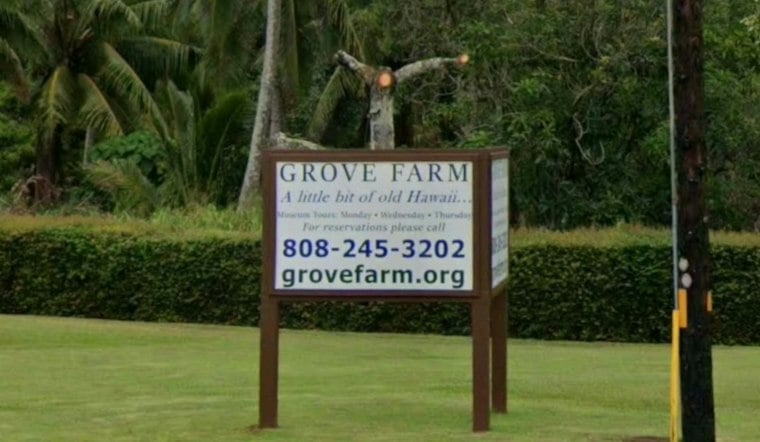
Grove Farm is floating early plans to turn a more than 100-year-old former sugar plantation camp in Kōloa into dozens of new homes, with a preliminary target of 40 to 60 lots on the roughly 24-acre property. The company has not settled on a final home count, and company leaders say the project, known as Waihohonu, is still in its exploratory phase with no engineering or technical designs finished.
The property sits behind the county's Anne Knudsen Park and borders part of the Waihohonu Stream, according to Honolulu Civil Beat. Kōloa Camp was once part of Japanese Camp C, a plantation-era workers' settlement, before Grove Farm evicted its last tenants in 2012 to make way for an earlier 50-unit Waihohonu subdivision. That version of the project, which the Honolulu Star-Advertiser reported at the time would have priced homes between $260,000 and $485,000, never got off the ground, and no homes were built under that plan.
This time, Grove Farm Chairman and CEO Don Horner told residents at a Kōloa Community Association meeting between November 16 and 22, 2026, that the company is still working through the basics. “We don't have engineering done. We don't have technical plans done, etc. So we're exploratory,” Horner said, according to Civil Beat's report. Horner invited Kōloa residents to share ideas at that same gathering, where the company introduced its new project manager to keep community engagement going. Grove Farm expects to present a more developed plan sometime in 2027.
Flooding and Wastewater Top Residents' Concerns
Part of the Waihohonu site sits in a flood zone, and Grove Farm says it still needs to analyze how best to mitigate flooding there, the report notes. Community members have pointed to 2024 heavy rains and flooding that damaged Kōloa homes and the Kōloa Early School as a reason for caution, and residents at the recent meeting pressed the company on both flooding and wastewater plans for the site, as well as whether the homes would actually go to local residents.
On wastewater, the company is weighing several options rather than committing to one. One idea floated by Horner is a shared septic system serving every two homes; another is tying into existing sewer lines already in Kōloa. Grove Farm is also looking at reviving its own 2009 environmental impact statement for a sewage treatment facility planned for part of the former Kōloa Mill site. Kōloa's lava rock terrain makes cesspool conversions especially costly, and Hawaiʻi Act 125 requires cesspools statewide to be upgraded, converted, or connected to sewers by 2050.
That statewide cesspool mandate is part of a broader push for alternative wastewater technology. A solar-powered, off-grid system called the Honu Hub, designed for single-family homes and capable of treating up to 600 gallons of wastewater per day, is currently being piloted through a partnership involving the University of South Florida, the University of Hawaiʻi, the City and County of Honolulu and WAI, funded by a National Science Foundation grant, according to Hawaii News Now. That outlet reports Hawaiʻi has more than 80,000 cesspools statewide, and converting just one can cost a homeowner between $30,000 and $50,000 — a cost backdrop that helps explain why Kōloa's terrain and sewer options are drawing such close scrutiny.
Who Would Actually Get the Homes
Grove Farm says Waihohonu is meant for gap housing — residents who earn too much to qualify for affordable housing but not enough to comfortably afford market-rate homes. Horner has cited police officers and teachers as examples of the kind of buyers the project is aimed at, per the Civil Beat account. The company is weighing deed restrictions that would limit lot sales to Hawaiʻi residents, and the Waihohonu homes would be barred from use as transient vacation rentals and would need to comply with the South Kauaʻi building code. The development itself sits outside the visitor destination area.
Governor Josh Green signed a law in July 2026 requiring perpetual deed restrictions on affordable housing projects that want fast-tracked permitting, though regulations implementing that law have not yet been drafted, the report states. Horner has also noted uncertainty over whether first mortgages would even be available to buyers of deed-restricted homes — a question that remains open. Separately, Horner said he wants to give property owners on neighboring Wailani Road the first option to buy the lot directly behind their homes.
One approach under consideration would have Grove Farm sell individual lots and offer buyers plans for two-bedroom, two-bathroom model homes to build themselves — the same model the company has used at its Pīkake and Puakea subdivisions in Līhuʻe. Some Kōloa residents have asked the company to consider larger homes suited to multigenerational families, and Horner has said he would like to see community garden space and access to Anne Knudsen Park built into the Waihohonu site, along with development access routes that avoid burdening the existing neighborhood.
Part of a Much Bigger Kauaʻi Housing Push
Waihohonu is one piece of Grove Farm's goal to build 2,500 new homes on Kauaʻi over the next five years, adding to a history that includes more than 2,194 homes built over 160 years. The scale of that ambition lines up with the island's documented housing shortfall: the 2024 Hawaiʻi Housing Planning Study found Kauaʻi needs 4,900 more homes by 2027.
For now, Grove Farm says it is gathering community input during this early planning stage and will keep engaging south shore residents as the Waihohonu concept takes shape. Horner told residents the company is listening and will modify its plans when needed, though with engineering work still unfinished, many of the specifics — from flood mitigation to final lot counts — remain unresolved until the more developed plan arrives in 2027.




