

























































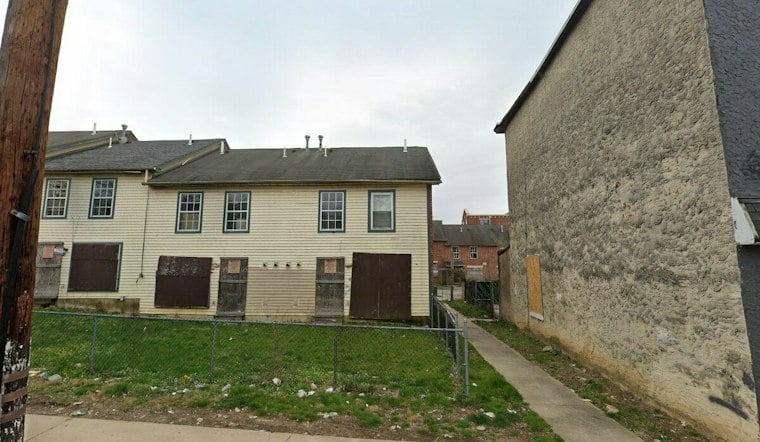
A stretch of East Collom Street in Germantown that sat empty for two decades, drawing squatters, illegal dumping and a steady stream of neighbor complaints, is being rebuilt into 16 affordable homeownership units. The $3 million project, called Lena Commons, marks the first phase of a much larger push to deal with blighted and neglected properties scattered across the neighborhood.
Habitat for Humanity Philadelphia is leading the transformation of the long-vacant apartment complex, according to WHYY, which reported that the Philadelphia Housing Authority donated the properties to the nonprofit after taking control of the complex in October 2026. The site had been fenced off through a partnership between Habitat and the housing authority while plans came together, and the nonprofit expects to complete the project within three years, per the same report.
Corinne O’Connell, who spoke at Monday’s groundbreaking ceremony, said the goal is simple: turning empty shells into real homes. “The houses will become homes where families can grow and thrive in Germantown,” she said, as WHYY reported. For a block that’s been shaped by gun violence and blight for years, that promise carries real weight for the people who live nearby.
A Complicated Ownership History
The East Collom Street properties have a tangled past tied to Germantown Settlement, a nonprofit that Emanuel Freeman ran for more than two decades. Federal loans were awarded to Germantown Settlement to develop low-income housing in the neighborhood, but Freeman did not repay those loans, according to WHYY’s reporting. A bankruptcy judge eventually ordered Germantown Settlement to liquidate, and the Philadelphia Redevelopment Authority seized the properties after what WHYY described as a protracted legal battle with Freeman.
Neighbors played a role in documenting the deterioration. Yvonne Haskins and other neighbors photographed the properties to document what WHYY characterized as Freeman’s negligence, and Haskins later presented her findings to the Philadelphia Redevelopment Authority. Habitat for Humanity Philadelphia’s own request for proposals confirms that the Philadelphia Redevelopment Authority owned 60–74 E. Collom Street when Habitat sought professional services for a land-development plan study, with a proposal deadline of 3 p.m. on February 13, 2024.
Rehab or New Construction? Reports Diverge
Exactly what form the 16 units will take isn’t entirely settled across public accounts. Habitat for Humanity Philadelphia’s request for proposals describes acquiring the site and rehabilitating existing structures, stating that “HFHP aims to acquire the site and rehab the units to sell to low-income first-time homebuyers,” and describing the existing buildings as three-bedroom, 1.5-bath, two-story units. A Philadelphia Housing Authority announcement snippet likewise refers to the effort as a 16-home rehabilitation project.
But Resolve Philly described the same Collom Street project differently in an October 15 report, reporting that “the Habitat for Humanity project on Collum Street includes 16 new-construction homeownership units.” Resolve Philly also reported that work was already underway at that point, with completion expected within three years.
WHYY’s reporting on the groundbreaking adds a concrete figure to that income threshold, noting that 80% of area median income in Philadelphia equals $88,350 for a family of three. Applicants hoping to buy one of the homes must also complete educational workshops and homeowner counseling, contribute money toward closing costs, and put in 125 hours of sweat equity, which can include helping build and repair other Habitat properties, according to WHYY. Habitat’s three-bedroom homes will be renovated with help from volunteers, the outlet reported.
One Piece of a Larger Germantown Push
Lena Commons is the opening chapter in a wider campaign to address the 28 neglected properties the Philadelphia Housing Authority acquired from the Philadelphia Land Bank in October 2026, most of them located in Germantown. The Philadelphia Housing Authority's broader plan is expected to yield 153 affordable rental units scattered across Northwest Philadelphia, with a proposal calling for building 40 new units and renovating 113 others, work the agency hopes to start by spring 2027.
The former Germantown Settlement properties sit in pockets of dense vacancy near Church Lane and Lena Street and on the 40th blocks of Wister and Garfield Streets, according to the Philadelphia Inquirer. The newspaper has also reported that the housing authority's plan for those properties calls for spending $84 million to gut and rehabilitate 113 units and build 40 apartments for seniors.
Neighbors Weigh Hope Against Gentrification Fears
Germantown has seen a wave of new residential development after decades of disinvestment, per WHYY, and that growth has raised concerns among longtime neighbors about rapid gentrification. Still, many residents see the Habitat project as a chance to add affordable housing in a place where it's badly needed, rather than market-rate units that could push them out.
Robert Johnson, a block captain on nearby Lena Street, told WHYY the neighborhood has a bright future ahead. Developer Ken Weinstein, meanwhile, said people had been waiting for this project for a long time. Neighborhood stakeholders broadly want the vacant and neglected properties returned to productive use, with Lena Commons framed as just the beginning of that effort, according to WHYY's reporting.
Habitat for Humanity Philadelphia is tackling similar work elsewhere in the city. The nonprofit is also planning to rehabilitate and build 26 affordable homes in Sharswood and Brewerytown as part of what's known as Pope Leo Village, a project described by WHYY's separate reporting, with 21 of those homes built new and five rehabilitated. Applicants there face the same requirements as those proposed for Lena Commons: educational workshops, homeowner counseling, a contribution toward closing costs and 125 hours of sweat equity.
Elsewhere in Germantown, a developer is making a third attempt to redevelop the neighborhood's historic YWCA building, proposing affordable senior apartments there, though key funding for that project remains uncertain, the Philadelphia Inquirer has reported. Together, the projects suggest a neighborhood in the early stages of reckoning with its vacant properties, one development at a time.





