

























































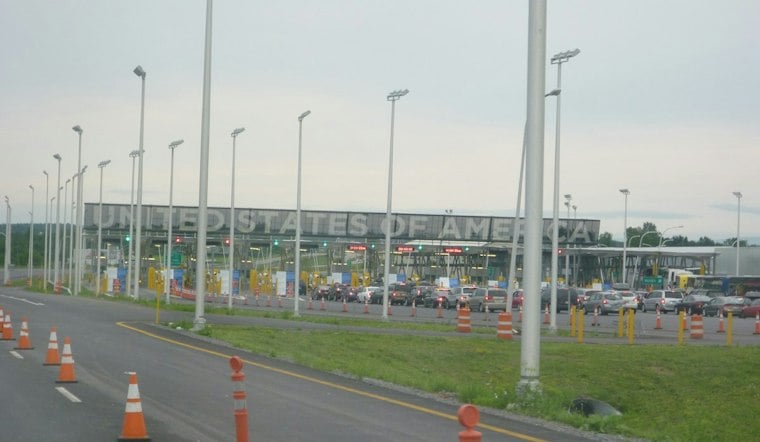
Keyla François and Noelson Pierre packed up their lives in Springfield, Ohio, in August and drove 700 miles toward the Canadian border, hoping to keep their family together after losing their legal protections in the United States. Instead, they were torn apart at the crossing near Champlain, New York — Pierre and their two toddlers were allowed into Canada, while François was turned back and detained by U.S. border authorities.
Their case is one of dozens that lawyers say they have encountered since the Trump administration ended Temporary Protected Status for Haitians, according to The New York Times, whose reporting was carried by The Seattle Times. François and Pierre, both 30, had lived and worked in the United States for more than three years, having crossed the southern border in March 2023 using an appointment secured through a Biden-era program. They settled in Springfield, worked at an Amazon distribution center in West Jefferson, Ohio, bought a used car for $10,000, and moved into a three-bedroom duplex with a patio and a grassy front lawn — their landlord, Levenson Laguerre, said the couple paid $1,200 in rent on time every month. They had their first child, Jackson, in 2024, and their second, Micaela, in 2025.
A Treaty That Can Split a Family in Half
The reason François was turned away while her husband and children were not comes down to the Canada-U.S. Safe Third Country Agreement, which generally bars people from claiming asylum in Canada if they first arrived in the United States — unless they qualify for an exception, according to the Library of Parliament. One such exception applies to people who have a spouse, parent, or other close relative who is already a Canadian citizen or permanent resident; notably, the exception excludes in-laws, and couples who both filed for asylum in the U.S. each need their own qualifying relative in Canada for the whole family to be admitted. Pierre and the children were admitted because they had proof of his two brothers living in Montreal, along with Haitian passports and the children's U.S. passports. François had no such relative of her own, and the New York Times reported she was barred from entering because she lacked immediate relatives in Canada.
The Canada Border Services Agency has said it does not separate families who arrive together at the border, but acknowledged that eligible relatives may choose to proceed into Canada knowing it will result in separation from an ineligible family member. Rebecca Purdy, speaking for the agency, said as much directly, per the Times' reporting. More than 1,300 people, many of them Haitian, were turned away at the northern border between Jan. 1 and Nov. 16 after being found ineligible under the agreement, according to the same report.
Detained 2,000 Miles From Her Family
After being turned back at the border, François and Pierre declined to sign a voluntary departure form for deportation to Haiti. They said U.S. officers threatened to transfer them to ICE detention and remove their children if they refused. François is now in U.S. custody.
François has since passed through four detention facilities in four states and now sits in an immigration detention center in New Mexico, roughly 2,000 miles from Pierre and their children in Montreal. The family was separated, with François detained and Pierre and the children in Montreal. François is held at a New Mexico facility. She also received a one-year exclusion order barring her from entering Canada. “We were terrified of being taken from our children,” François said, describing why the family fled Springfield in the first place.
Other Families, Same Impossible Choice
Jules, a 47-year-old Haitian man with a Canadian-citizen brother, traveled two days by taxi from Florida to the New York-Quebec border in August with his wife and their daughters, ages 3 and 4, seeking refuge in Canada. Canadian officers fingerprinted and photographed the couple before telling them, hours later, that his wife did not qualify for entry. She spent more than 40 days bouncing between four detention centers before being deported to Haiti on Sept. 24, after an asylum hearing; her family’s home was outside Port-au-Prince.
Lawyers describe a range of similar scenarios playing out at the border: one parent entering with children while the other is left behind, a denied single parent sending children into Canada alone, or parents sending children to the border by themselves. Anne Cécile Khouri-Raphael, an attorney in Montreal, has advised dozens of separated families, according to the Times. Jenn McIntyre, who coordinates the Canada-U.S. Border Rights Clinic, said families approaching the border are often unaware of the risk of separation until they are already standing in front of officers.
No Official Tally, but a Growing Pattern
There is no official count of how many families have been split apart while seeking refuge in Canada, though the Times says it interviewed lawyers aware of dozens of such cases. Quebec child welfare officials, speaking anonymously, described a spike in unaccompanied minors crossing the border — many of them fleeing killings, kidnappings, and systemic violence back in Haiti. Canadian officials say some of these children have been moved among caregivers, often relatives they had never met before.
The numbers point to a broader surge. Canadian authorities also rejected asylum seekers at official U.S. crossings in August, according to The Atlantic. As of an August 23 report, nearly 900 asylum claimants had been sent back to the United States since the start of the year after being deemed ineligible, per CNN. Even so, applications processed at the Canada-U.S. border had fallen by more than 60 percent that year compared with the same period a year earlier, CNN reported — a sign that the crackdown may be deterring people from attempting the crossing at all, even as those who try face steep odds.
Why So Many Are Running Now
The wave of departures traces back to the Trump administration's move to eliminate Temporary Protected Status for Haiti, a decision the Supreme Court ruled in late June the administration had the authority to make; the protection formally ended in July, terminating deportation protections for more than 300,000 Haitians. The administration has also suspended access to asylum at the border, canceled humanitarian parole programs, and largely shut down the U.S. refugee program, with exceptions that include white South Africans and a small number of people from other countries, according to the Times. The administration has said it is pursuing deportation of 1 million immigrants a year.
Even as it turns families away, Canada has halted its own removals to Haiti because of the country's perilous conditions — the same violence that drove families like Cassous's and Jules's to leave in the first place. A legal challenge is underway in Canada questioning whether the United States still qualifies as a safe third country under the bilateral treaty, though the outcome of that case has not been determined. The Supreme Court of Canada previously ruled that the regulations designating the United States as a safe third country do not violate refugee claimants' Charter rights to liberty and security of the person, though it sent a related equality-rights claim back to the Federal Court for further review, according to the Supreme Court of Canada. For now, families like François and Pierre's remain caught between two countries, waiting to find out whether the law will ever let them live under the same roof again.




