

























































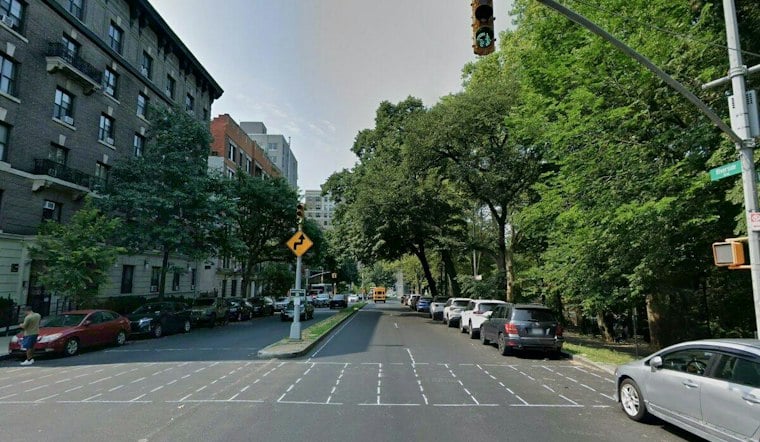
A man and woman were arrested outside a Harlem apartment building after authorities said they watched the pair push a cart loaded with shopping bags stuffed with $1.5 million in cash down the street. The bust, described by officials, led investigators to a nearby apartment where they say they found another $1.5 million in cash, eight pounds of narcotics and four firearms hidden inside a hollow speaker.
According to New York Daily News, agents with the Office of the Special Narcotics Prosecutor had been conducting surveillance on the pair as they pushed a cart of reusable shopping bags toward a car that was double-parked along Riverside Drive near West 144th Street. Investigators said the bags contained nearly $1.5 million in cash bundled inside the supermarket totes.
Agents obtained a search warrant Monday afternoon, and then a second warrant for the Riverside Drive apartment tied to the pair, the outlet reported. Inside the apartment's front closet, agents reportedly found bundles of cash, numerous plastic bags of narcotics, a money counter and a scale.
Guns Found Stashed Inside a Speaker
The search also turned up four firearms concealed inside a hollow speaker in the apartment's front closet, per the same account: a 9-mm. pistol, a .22-caliber pistol, a .45-caliber pistol and a .38-caliber revolver. Agents also found ammunition for three of the four guns, the report said.
John Morales, 39, and Amya Douglas, 21, were arrested and charged with criminal possession of a controlled substance, criminal possession of a weapon and criminal possession of a firearm, according to the outlet's report. A Manhattan Criminal Court judge set cash bail at $300,000 for Morales and $100,000 for Douglas.
Officials Describe Roughly $3 Million Seizure
Officials Describe Roughly $3 Million Seizure Towanda Thorne-James, the DEA’s New Jersey Field Division special agent in charge, described the overall haul as approximately $3 million in suspected narcotics proceeds, four firearms and dangerous narcotics, the report noted. Special Narcotics Prosecutor Bridget G. Brennan said the alleged traffickers showed disregard for the law and neighborhood safety while moving millions in illicit cash in a pushcart in broad daylight, with no fear of getting caught.
Brennan added that the investigative work removed illegal firearms, dangerous narcotics and criminal proceeds from the streets, the outlet reported. Towanda Thorne-James said the seizure disrupted the criminal operation and its ability to fuel the drug trade, according to the same account.
A separate New York City case showed a similar combination of large cash holdings and drugs hidden in a residence: in March 2024, authorities said they found nearly 30 pounds of cocaine and $3 million in secret compartments in a Bronx apartment used by an alleged cocaine distributor. The case described by the Associated Press followed a two-month investigation involving city and state police and federal DEA officials. The comparison illustrates another way investigators have found alleged drug proceeds concealed inside homes; it does not establish a trend in Harlem.
The scale of the cash seizure stands out against broader enforcement figures: the DEA reported nearly $280 million in U.S. currency seized nationwide in 2024. Those figures track law-enforcement seizures, not the total amount of drug proceeds in circulation. The DEA’s 2025 National Drug Threat Assessment also says cash is often found alongside drugs and weapons, while noting that virtual-currency seizures exceeded currency seizures over 2020–2024.
The city’s Office of the Special Narcotics Prosecutor focuses on high-level drug-trafficking organizations and illicit prescription-drug networks, rather than handling only street-level cases. Its work includes investigating persistent drug activity and coordinating with the city’s five district attorneys, as described in the office’s mission statement. The Harlem seizure involved the office alongside the DEA’s New Jersey division, illustrating how investigations in New York can involve agencies with responsibilities that cross city and state lines.




