

























































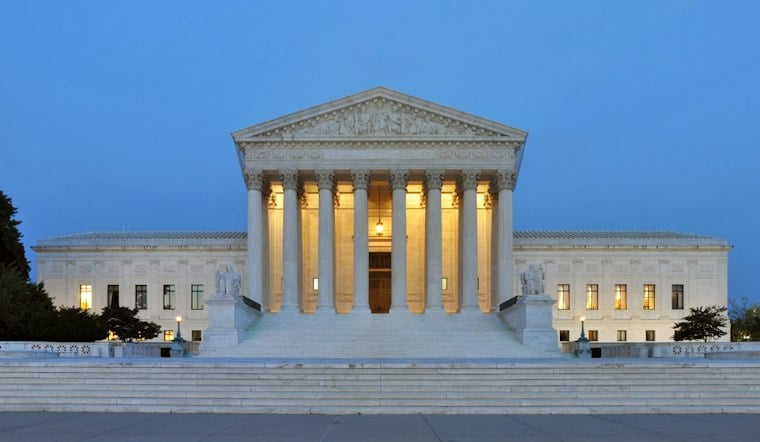
The Supreme Court is weighing whether Kekai Watanabe can seek damages from a federal prison medical worker over care he says he was denied after a 2021 beating. Watanabe was 40 and recovering inside a federal prison in Hawaii when, he says, a nurse told him to stop being a cry baby. An X-ray seven months later showed a fractured tailbone.
The Claim At The Court’s Center
Watanabe was injured in a 2021 gang riot at the federal prison, attacked with a makeshift weapon known as a lock in a sock, according to NPR. He reported serious back pain afterward, but the prison nurse dismissed his complaints, the report says. His pain was recorded as a 10 on a scale of 1 to 10, yet he received only over-the-counter medication, according to SCOTUSblog.
An X-ray taken seven months after the injury showed a fractured coccyx, with bone chips that had penetrated nearby soft tissue, SCOTUSblog reports. Doctors had separately diagnosed him with a fractured tailbone in 2021, according to NPR. Watanabe filed suit in federal court in Honolulu in February 2022, invoking the Supreme Court’s Bivens precedent and its 1980 decision in Carlson v. Green to allege an Eighth Amendment violation, SCOTUSblog reports.
Nurse Or Paramedic? Lower Courts Split, Then Reversed
Sources differ on the defendant's exact role: NPR and USA Today describe Francis Nielsen as a federal prison nurse, while SCOTUSblog refers to him as a prison paramedic who allegedly failed to provide medical treatment. A district court initially dismissed Watanabe's claim, but the U.S. Court of Appeals for the 9th Circuit reversed that ruling, allowing the case to proceed, SCOTUSblog reports.
Nielsen’s attorneys argue that the case should be dismissed, in part because Watanabe survived the 2021 attack, according to NPR. They also ask the justices to foreclose future damages suits against federal officials for constitutional violations. The federal government supports dismissal of Watanabe’s claim but has urged the Court not to use the case to reconsider Bivens more broadly, per SCOTUSblog.
A 1971 Precedent Rarely Expanded Since
The Supreme Court established a damages remedy for certain constitutional claims against federal officers in its 1971 Bivens decision, according to NPR. The justices have extended that remedy only twice since—in Davis v. Passman and Carlson v. Green, SCOTUSblog reports. Carlson involved a federal prisoner who died from untreated asthma. The Court held that a Bivens remedy was available even though the facts could also support a claim under the Federal Tort Claims Act, according to the Supreme Court opinion reproduced by Justia.
The Court has since become more reluctant to recognize Bivens claims. In Egbert v. Boule, the justices said they had declined 11 times to create similar causes of action for other constitutional claims, SCOTUSblog notes. The case involved a Border Patrol agent’s alleged use of force and retaliation against a bed-and-breakfast owner. The Supreme Court’s opinion states that Boule’s separate tort claim was ultimately denied and Border Patrol took no action against the agent.
Experts Clash Over How Often Misconduct Claims Succeed
Georgetown law professor Steve Vladeck, who filed a friend-of-the-court brief in Watanabe’s case, told NPR the dispute concerns whether federal law enforcement officers can be held accountable for violating clearly established constitutional rights. He warned that eliminating Bivens could leave federal officers effectively immune from such suits. NPR also reports that the Supreme Court generally requires plaintiffs to show that their case is nearly identical to an existing precedent before a claim can proceed.
Mary Hampton Mason, who spent nearly 35 years evaluating legal claims at a Justice Department office, told NPR that officer misconduct is rare and that problems are typically systemic rather than attributable to individual officers. She argued that Bivens has been weakened and should be overruled. Mason said that, in the last 20 years, she knows of only one Bivens judgment for a plaintiff that was not reversed on appeal, despite thousands of cases being filed. Watanabe’s supporters counter that such counts do not include settlements reached outside court or capture any deterrent effect, NPR reports.
The Broader Stakes For Accountability
Gregory Cui, an attorney at the civil rights organization MacArthur Justice Center, said damages can help victims pay for medical care or rebuild their lives, according to NPR. Cui’s brief reported that federal prison grievance processes succeed only 1% of the time in changing conditions such as medical access. A separate study described by the MacArthur Justice Center found that 99% of medical grievances filed through the Bureau of Prisons’ administrative remedy program were rejected.
What Oversight Figures Show
A separate measure concerns the Justice Department inspector general’s oversight recommendations, not inmate complaints: as of February 2024, the office had closed approximately 80% of recommendations from prior reports and advisory memoranda, while numerous important recommendations remained open, according to the U.S. Department of Justice Office of the Inspector General. That figure does not measure how often medical-care grievances are accepted or resolved.
Legal experts said the Supreme Court is considering Watanabe's case amid heightened public attention to alleged abuses by federal immigration agents, including accusations that officers have beaten and run over migrants, NPR reports. Separately, the Immigration Policy Tracking Project has documented nearly 50 instances of immigration agents breaking vehicle windows during the second Trump administration, compared with eight such instances over the previous decade, with experts and former ICE officials saying they know of no formal policy change authorizing increased force. The DHS Office of Inspector General has said it is initiating an audit of whether ICE investigates excessive-force allegations and holds personnel accountable, though that audit's findings were not available.
Both sides in the Watanabe case agree that Congress could establish a clearer statutory path for holding federal officers accountable for rights violations, according to NPR. Lawmakers, however, have not advanced legislation to do so, leaving the question to the courts — and, for now, to the nine justices weighing Kekai Watanabe's case.





