

























































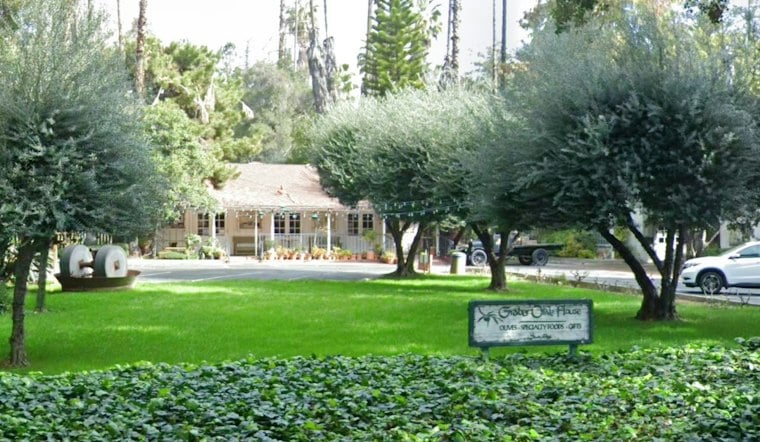
The historic commercial property that has housed Graber Olive House for generations is now on the market in Ontario, even as the family-run olive business insists its brand is far from finished. The site in the 300 block of East Fourth Street was listed for sale this past Monday, and while the for-sale sign marks a major turning point for the property, Graber family members say the company itself continues to operate.
A Century-Old Brand Weighs Its Next Move
Graber olives were established in 1894 and were among the first businesses founded in Ontario after the city's 1891 incorporation, according to the Daily Bulletin. For generations, the Graber family business cured and canned olives on the property, but that chapter of the operation has quieted considerably in recent years. The property last hosted sorting, canning and labeling work in 2022, per the same report.
On its own website, the Graber family confirms that its historic Ontario site is not currently open for tours or canning, saying “Our historic Ontario site is not open for tours or canning right now. Production of our tree-ripened canned olives is paused,” according to Graber Olive House. The family says it is instead focusing on extra virgin olive oil, along with jarred olives and merchandise, with some products processed and packaged in California's Central Valley and others imported from Spain and Italy, per the Daily Bulletin's reporting.
Pandemic, Lawsuit and a Deal That Fell Through
The road to this point has not been smooth. The Daily Bulletin reports the Graber family faced a family lawsuit, and that the COVID-19 pandemic disrupted operations, with social distancing requirements making it difficult to reopen the gift shop and affecting olive product output. A drought is reported to have caused the failure of that year's olive crop in 2023, and by 2024 the family reportedly lacked funds to purchase olives or hire seasonal staff.
Speaking to CBS Los Angeles, Robert Graber said the coronavirus pandemic “forced business to slow down to a crawl” in 2020, and that station described the operation as having gone roughly two years without production. Graber told the station the family had been working toward developing the two-acre lot into a wedding and wine-tasting venue while resuming canning, but that plan fell apart when an investor backed out weeks before the report. “The property is for sale, but we're at least hoping to partner with someone on the olive side of the business,” Robert Graber said.
What's Actually For Sale
According to the Daily Bulletin, the Graber Olive House commercial property covers nearly two acres with six buildings. The city project document lists individual site buildings of 11,232, 10,300, 909 and 2,919 square feet, totaling more than 25,000 square feet. The Daily Bulletin reports a listing price of $2,699,000.
A Facebook property post tied to the listing similarly describes a developed parking area and loading dock access, the Daily Bulletin reports. Robert Graber has said he hopes to find a partner for the olive side of the business, even as the real estate changes hands.
Preservation Pressures on a Historic Site
The city of Ontario has designated the property's buildings as contributors to the College Park Historic District, a status City Council applied on July 18, 2000, according to a city zoning agenda document. The Daily Bulletin reports that Ontario officials want the historically significant property preserved, and that under preservation restrictions, six structures on the site must be repurposed rather than demolished, while existing oak, camphor and redwood trees are considered untouchable.
The property sits in a residential area, and the Daily Bulletin reports that neighbors are sensitive to activities on the site — a dynamic that could shape whatever comes next. Property stakeholders may seek a zoning change by working with the city, according to the same report, though it remains unclear whether any such change will be pursued or approved.
Brokers See Both Challenges and Potential
Donavan Price, a representative of Price Real Estate in Upland, has shown the property to at least two interested parties: one buyer drawn by its historic nature, and another considering relocating a five-decade-old family business, according to the Daily Bulletin. Price said he believes the property will ultimately go to someone who wants to preserve it, adding that a future buyer has the opportunity to do something special there.
Jerry Tessier, who is with Arteco Partners, told the Daily Bulletin that the property has both challenges and potential, and that it is salvageable and a strong candidate for adaptive reuse. Tessier said the property and business hold a special place in the community, noting that significant deferred maintenance remains a hurdle. He presented a proposal last year, in 2025, to use part of the property for special events while retaining space for canning, but project funding for that plan fell through.
The Brand's Future, By the Family's Account
Even with the property up for sale and a financial institution having foreclosed on the commercial property, according to the Daily Bulletin, family members maintain that the Graber name isn't disappearing. Kelsey Graber told the outlet the family is still navigating the situation, while another Graber family member said the business and brand remain alive. The Daily Bulletin reports the family retains the Graber brand and business, having found ways to keep its products and brand in the marketplace while seeking to retain the property itself.
For now, customers can still purchase Graber olives, olive oils and specialty foods through the company's website, even as the fate of the Ontario property that started it all remains an open question.




