

























































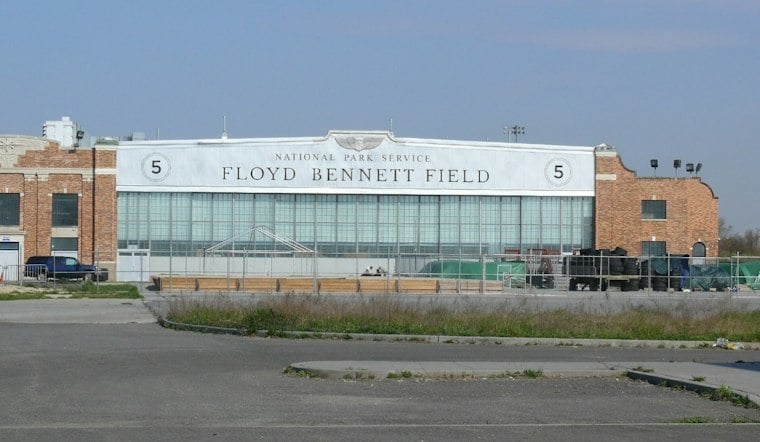
Two massive hangars at Floyd Bennett Field in Brooklyn have sat largely untouched since the airfield stopped flying planes decades ago, but that is about to change. Gov. Kathy Hochul has committed $10 million for the first phase of a two-part plan to reopen Hangars 3 and 4 to the public for the first time in nearly a century.
The funding marks a major step for a redevelopment effort years in the making, according to Gothamist, which reports the hangars are currently inaccessible to the public and unacceptable for use. The Jamaica Bay-Rockaway Parks Conservancy, which is fundraising for the project, plans to break ground in early 2028 once the National Park Service finishes exterior improvements to the buildings. That first construction phase is estimated to take about a year to complete.
Elizabeth Stoehr, deputy director of the Jamaica Bay-Rockaway Parks Conservancy, called the governor's funding a major boost to advance the project, per the same Gothamist report. Stoehr also said the hangars' materials bear witness to the site's aviation history and innovation. Anastasia Yankopoulos, the conservancy's director of development and capital projects, said the hangars have never been appropriately programmed or used to their full potential, and noted they have not been open to the public in nearly a century.
What the First Phase Will Actually Build
The initial phase will prepare nearly 50,000 square feet of interior space for public use, according to the Jamaica Bay-Rockaway Parks Conservancy, which describes the work as adding core building systems, clean-energy infrastructure and visitor amenities. That includes onsite renewable energy such as solar panels on the roof and geothermal wells beneath the lawn in front of the buildings, the group notes. Hangars 3 and 4 will also receive bathrooms and other upgrades that would let them function as a large events space for things like concerts.
A proposed second phase, which could begin shortly after the first wraps, would add an observation terrace and a spot to buy food and beverages. The conservancy's website states its first phase builds on a $26 million National Park Service rehabilitation of the hangars' exterior, while the National Park Service's own page on the project puts that rehabilitation at $25 million; the two agencies have not clarified the discrepancy.
Two Hangars, Two Different Futures
Once complete, the two structures will serve distinct purposes. Hangar 3 is slated to support park activities including kayaking and biking, while Hangar 4 will house labs, classrooms, meeting rooms and a workshop to host research projects with the Science and Resilience Center of Jamaica Bay, which is separately restoring the nearby West Pond. The redevelopment plan aims to transform the shuttered hangars into public space for educational programming and cultural events.
The Jamaica Bay-Rockaway Parks Conservancy and the National Park Service are partnering on the broader effort to revitalize the hangars and the surrounding green space. The conservancy's fundraising push follows a public arts festival the group held at Floyd Bennett Field last month, which, according to the Brooklyn Paper, featured fifteen newly commissioned artworks by 21 contemporary artists projected onto Hangars 3 and 4. That event also marked the official launch of the conservancy's Fifty for Floyd Bennett Field fundraising campaign.
A Site With a Storied Past
Floyd Bennett Field sits in the Marine Park section of southeast Brooklyn, on Jamaica Bay, and holds the distinction of being New York City's first commercial airport. Its airstrip opened in 1931 after roughly three years of construction at a cost of approximately $4.5 million, per Gothamist's reporting. By 1933, the field had more than double the flights of Newark Airport and was the second-busiest airport in America.
The site later served as a naval base during World War II until 1970, and the U.S. Coast Guard used the facility for helicopters until 1998. Famous aviators and historic flights took off from Floyd Bennett Field, including Amelia Earhart, John Glenn and Howard Hughes, according to the National Park Service. The field is named for Floyd Bennett, a Navy pilot who became the first person to fly over the North Pole and died at age 37 from pneumonia shortly after a World War I rescue mission.
The airstrip reopened as part of Gateway National Recreation Area in 1974, two years after the broader Floyd Bennett Field property became part of that recreation area in 1972, as the Brooklyn Paper has reported. The National Park Service continues to manage Gateway National Recreation Area today. The surviving original structures at Floyd Bennett Field are listed in the National Register of Historic Places, and the site currently includes a campground, hosts astronomy events, and features one runway reserved for radio-controlled craft enthusiasts, while the NYPD uses the runways as a helicopter base.
Hangars 3 and 4 have had little use since the airfield was decommissioned, leaving the structures largely dormant even as the rest of Floyd Bennett Field found new life as parkland. With state funding now in place and a 2028 groundbreaking on the horizon, the conservancy hopes the buildings' long stretch of disuse is nearing its end.




