

























































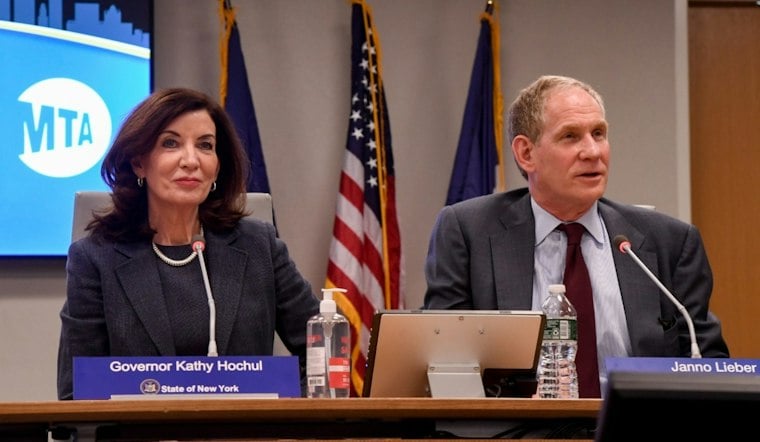
Gov. Kathy Hochul's office has demanded that John Samuelsen, the international president of the Transport Workers Union and a nonvoting member of the Metropolitan Transportation Authority board, provide proof he actually lives in New York State or give up his seat. The ultimatum lands amid a bitter, months-long feud between Hochul and the union leader, who has spent the year attacking her publicly and bankrolling efforts against her reelection.
A Letter, a Deadline, and a Denial
According to City & State New York, which first reported the dispute, the governor's appointments secretary, Cathleen McCadden-Benjamin, sent Samuelsen a letter asking him to confirm whether he remains a legal resident of New York State. The outlet, whose reporting by state bureau chief Rebecca C. Lewis forms the backbone of this account, reported that McCadden-Benjamin warned that if Samuelsen is no longer a New York resident, he vacates his appointment and can no longer serve as an alternate nonvoting member of the MTA board. Samuelsen told the outlet in a text that he had not received the letter as of about 5 p.m. Sunday.
It has been reported around town that Samuelsen purchased a home in Florida and registered to vote at that address in 2023, per the same City & State account. Samuelsen has previously said he was recentering his life after decades in Brooklyn's Gerritsen Beach neighborhood. The MTA's own biography of Samuelsen, however, states plainly that he “was born, raised, and still resides in Brooklyn, New York,” and separately describes him as international president of the Transport Workers Union and president of what it calls the 39,000-member Transport Workers Union Local 100, which represents subway workers.
What the Statute Does and Doesn't Say
McCadden-Benjamin's letter asserted that Public Officers Law Section 3 requires New York State residency for civil office holders, including MTA board positions, and that the law does not authorize nonresident appointees for Samuelsen's seat, according to City & State's reporting. The outlet also reported that under the Public Officers Law, a position becomes vacant if its holder moves out of state, and that the Transport Workers Union would need to recommend any replacement for Samuelsen on the board. Notably, the reporting indicates that a Metro-North representative on the board may live in any state where the railroad operates, under an exception to the law — while New York City Transit and Long Island Rail Road union representatives are not covered by that same carve-out.
Samuelsen pushed back, asserting that Public Officers Law Section 3 does not apply to him because his MTA board seat is uncompensated, the outlet reported. When asked to identify the law section supporting that claim, he sent a Google search link; he later shared a screenshot of an AI search overview citing Public Officers Law Sections 73 and 74, which the City & State report notes actually cover ethics and financial disclosure rules for different categories of public employees and officers, not residency requirements. A New York State Senate statute excerpt reviewed separately describes residency requirements for certain governor-appointed voting members of the MTA — three of whom must be New York City residents and two of whom must reside in the city or nearby counties — though that excerpt does not address whether such rules extend to a nonvoting seat like Samuelsen's.
A Spotty Attendance Record
Samuelsen has held the MTA board seat designated for organized labor since 2016, and the board includes other nonvoting members representing unions covering New York City Transit, Long Island Rail Road and Metro-North workers. He is currently serving in a holdover capacity after his term expired, according to McCadden-Benjamin's letter as described by City & State. MTA board attendance records cited in the reporting show that since July 2023 — roughly two months after Samuelsen purchased the Florida condo, per the outlet — he has missed all or part of most monthly board meetings. He attended only part of one MTA board meeting in July 2026 and missed every New York City Transit committee meeting that year, the report states.
A Yearlong Feud Over Union Contracts
The residency fight is the latest flashpoint in what has become an open war between Hochul and transit labor. Samuelsen, described in the City & State report as a frequent and staunch critic of the governor, has criticized her over her handling of nurses, Long Island Rail Road workers and New York State correction officers who have gone on strike. He also said he believes Hochul is angry with him because he was voted the 2027 grand marshal of the St. Patrick's Day Parade instead of her, according to the same reporting.
The tension has real financial stakes attached. Samuelsen spearheaded a TWU independent expenditure committee that spent hundreds of thousands of dollars this year urging voters not to support Hochul's reelection, per City & State. As Gothamist has reported, the governor is entering her reelection campaign without the backing of two major labor unions amid contract disputes, even as the MTA says it is working with 80 labor unions on contracts overall. TWU Local 100, which Gothamist describes as representing about 40,000 subway and bus workers, aired a scathing TV ad against Hochul on St. Patrick's Day, according to that outlet, and Samuelsen has said Hochul should direct MTA Chair Janno Lieber to reach a contract settlement quickly.
Samuelsen has also taken his criticism to social media. In a post on X, he wrote: “.@GovKathyHochul is a bit confused apparently. When she ran for congress, she said she was from a 'business family.' But yesterday, attempting some damage control after causing the @LIRR strike, she said she was from a 'trade union family.' Which one is it?” Whether the residency dispute resolves with documentation, a resignation, or a prolonged standoff remains to be seen.





