

























































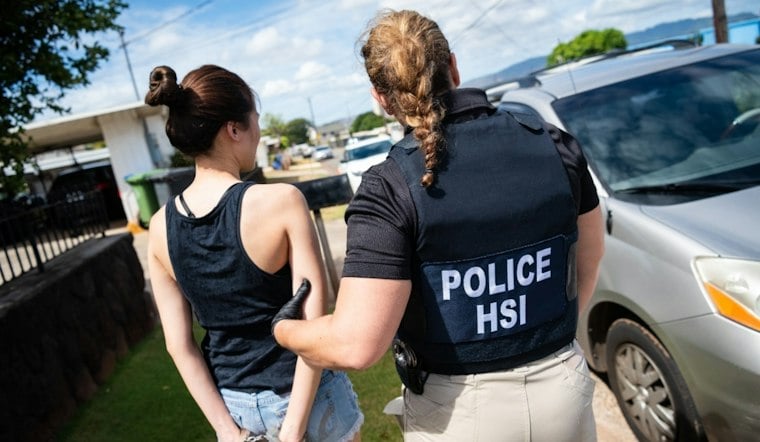
Federal agents in Honolulu say they have taken down a sprawling piece of scam infrastructure capable of blasting out more than 230,000 fraudulent messages every single minute. Homeland Security Investigations Honolulu announced the takedown of what authorities describe as a “SIM farm,” a tool increasingly favored by transnational criminal networks running large-scale fraud operations.
HSI Honolulu shared the news Tuesday in a post on X, writing that “transnational criminal networks use “SIM farms” to run large-scale fraud operations,” and that “Today, HSI Honolulu
and partners dismantled one capable of sending 230,000+ messages per minute.” The agency added that the investigation into the network is ongoing, meaning further details, including specifics on the equipment seized or any suspects involved, have not yet been released.
What Exactly Is a SIM Farm
For anyone unfamiliar with the term, a SIM farm is essentially a bulk-messaging machine built out of phone hardware. As ZDNET explains, it is “a network of hundreds, even thousands, of mobile SIM cards — backed by hardware such as modems and handsets — that operate simultaneously,” according to ZDNET. That setup lets operators automate spam texting and calling, firing off a barrage of messages to potential victims with little to no human oversight, the outlet notes.
These rigs aren't just used for annoying spam texts about unpaid tolls or missed packages. WIRED reports that SIM farms have been linked to everything from phishing scams to swatting, fake account creation, and fraudulent engagement schemes on social media and advertising platforms.
A Much Bigger New York Case For Comparison
The Honolulu case is notable, but it is far from the largest SIM farm uncovered in recent memory. Per WIRED's reporting, a SIM farm found in the New York area held more than 100,000 SIM cards packed into so-called “SIM servers,” and a law enforcement source told the outlet that network could be used to send approximately 30 million text messages per minute. The U.S. Secret Service said its investigation into that New York-area operation was ongoing, and WIRED reported that no arrests had been made at the time.
There is disagreement over whether the hardware itself crosses a legal line. Unit 221b's Ben Coon told WIRED that SIM boxes are illegal in the United States, while ZDNET describes the picture differently, stating that the equipment itself isn't illegal, but that SIM-farm applications and use fall into a legal gray area. The dossier of evidence reviewed for this story does not resolve that disagreement.
Part of a Wider Federal Crackdown
The Honolulu takedown lands amid a broader federal push against this kind of fraud infrastructure. According to the Highland County Press, HSI has executed more than 116 federal criminal search warrants since 2024, seizing more than 500,000 SIM cards, over 1,900 SIM boxes, and more than $700,000 in illicit proceeds nationwide. Those efforts have led to one criminal arrest, 11 administrative arrests, and the disruption of 68 SIM farms across 15 states, the outlet reported.
One major piece of that campaign was Operation Signal Break, a 2026 nationwide HSI effort targeting illegal SIM-box operations run by transnational criminal organizations between June 22 and July 10, per the same Highland County Press report. That operation deployed specialized teams to high-risk areas in California, Florida, Texas, Massachusetts, New York, and New Jersey, with more than 11 HSI field offices taking part. Whether the Honolulu case announced this week connects to that earlier nationwide sweep has not been established in the information released so far.
Similar busts have popped up elsewhere over the past year or so. ZDNET reported that in September 2025, the U.S. Secret Service dismantled a SIM farm operating near the United Nations that packed over 300 SIM-based servers and more than 100,000 SIM cards. And in October 2025, Europol supported an operation known as SIMCARTEL that led to the shutdown of a SIM farm linked to more than 1,700 cyber fraud cases in Austria and Latvia, according to ZDNET.
What Happens Next
For now, HSI Honolulu has not released additional information about who ran the dismantled network, how many devices were seized, or whether any arrests have followed. The agency describes its broader mission as protecting America through criminal investigations meant to preserve national security and public safety, and says this particular investigation remains active. Anyone following the case will likely need to wait for further updates, since none of the specifics beyond the 230,000-message-per-minute capability have been made public yet.



