

























































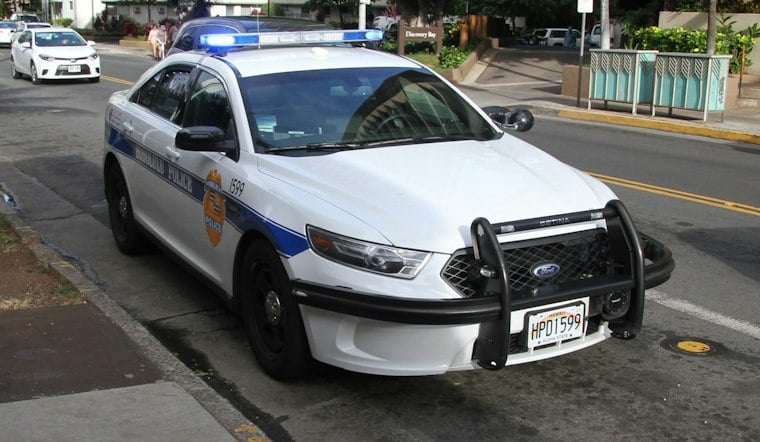
Honolulu police officers used force in more than 12,500 incidents across Oʻahu over the past five years, and while the overall number of those incidents has dropped, the share resulting in an injured person has climbed sharply. The area mauka of Ala Moana Boulevard in HPD District 1 logged more use-of-force incidents than anywhere else on the island, with 488 recorded from 2021 through 2025.
According to Honolulu Civil Beat, the total number of force incidents fell 13% between 2021 and 2025, yet the percentage of reports involving an injured person rose from 23% in 2021 to 30% last year. Central Waikīkī ranked second for sheer volume, with 372 incidents over the same five-year span, the outlet reports. Even so, less than 1% of reported injuries each year were classified as serious or substantial, and officers themselves reported being hurt in about 8% of cases during the five-year period.
Ambulance Calls Drop, But Mental Health Crises Dominate
Ambulance transports tied to use-of-force incidents fell from 85 in 2021 to 45 last year, per the same report. A third of all incidents that resulted in injury happened between 6 p.m. and midnight, the data shows.
Calls involving mental health evaluations represented the largest single category of call during which an officer needed to resort to force, accounting for roughly 15% of reported uses of force, the outlet's analysis found. Civil Beat reviewed 39 narrative reports tied to 2025 ambulance transports obtained through a public records request; two were withheld because of ongoing investigations and three because they involved juveniles. Eleven of those 39 cases involved someone either attempting or threatening suicide, while four involved subjects who suffered medical emergencies after fleeing officers.
Discipline Remains Rare Even As Injuries Rise
Despite the volume of incidents, only 14 officers were disciplined for their use of force while on duty between 2021 and 2025, according to HPD reports to the Legislature cited by the outlet's reporting. Mental health-related use-of-force incidents did decline substantially over the period, dropping about 30% from 460 in 2021 to 318 last year, the same analysis found.
Statewide, both the Honolulu Police Department and the separate Hawaiʻi Police Department, which covers the Big Island, operate under written use-of-force standards. HPD policy says officers may use only force that is objectively reasonable given the facts and circumstances as they perceived them at the time, and the policy directs officers to use de-escalation concepts when practicable and reasonable to reduce the need for force. Factors considered include the severity of the offense, the immediacy of any threat, and the level of resistance encountered, and the policy states force must never be used as punishment or be influenced by an officer's personal feelings.
A Different Agency's Rules, For Comparison
On the Big Island, the separate Hawaiʻi Police Department's General Order 804, revised January 2, 2025, similarly directs sworn personnel to use only the objectively reasonable force necessary to accomplish lawful objectives and to apply de-escalation techniques when possible. That agency's policy also requires a Blue Team Report whenever force results in, or is alleged to have resulted in, another person's injury, and calls for a documented annual analysis of use-of-force incidents identifying patterns tied to injuries and to subjects' race, age and gender.
Separately, the Public First Law Center has compiled its own use-of-force dataset using HPD Form 192E records extracted from the department's record management system for 2021, 2022 and 2023. The center cautions that each row of that data is not necessarily a separate use-of-force incident, since multiple reports can concern the same event, and that the dataset identifies only the relevant police beat rather than a specific location. The center also excluded narrative fields from its records request to avoid disclosing information that could identify the subject involved.
New Chief's Plan Targets Nonviolent Call Volume
Honolulu's newly unveiled five-year strategic plan under Chief David Lazar includes evaluating how 911 calls are screened and creating a process to route certain nonviolent calls to partner agencies better equipped to handle them, Civil Beat reported separately. The stated goal is to reduce police responses to certain types of calls by 20% by June 2030 — part of a broader push that, if realized, could reshape how often officers are dispatched to the kinds of mental health and crisis calls that have made up the largest category of force incidents.





