

























































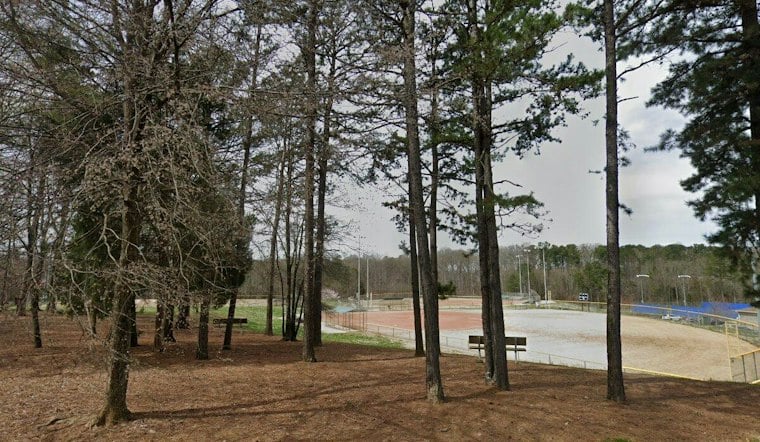
Huntersville Parks and Recreation has put a herd of goats on invasive plants at North Mecklenburg Park, including kudzu along the greenway and mountain bike trail. The assignment is temporary, fenced, and already drawing people who came to walk and stayed to watch.
The town expects the animals to remain about two weeks, depending on how quickly they clear the kudzu overgrowth, according to WSOC. Staff will check a temporary electric fence daily. Visitors are being asked not to step inside to feed or pet the goats.
What Visitors Are Being Asked to Do
The fence is the whole operating plan, at least from the trail side. Goats stay in the grazing area; people stay out. Department staff are checking the temporary electric line every day, which is the practical answer to a herd working next to a greenway and a mountain bike trail.
Dog rules are more specific than a general leash reminder. Officials asked owners to leash their pets and urged anyone whose dog reacts to livestock to consider avoiding that part of the park entirely while the goats are working. A curious dog and an electric fence are a bad combination, and the department is treating that as a visitor problem, not a photo opportunity.
WBTV reported that Parks and Recreation Director Michael Jaycocks learned about goat grazing at a conference in Raleigh and that his team welcomes ideas that serve the environment. Park leaders told the station the goats cleared unwanted vegetation faster than anticipated after their first full workday.
Why the Town Chose Grazing
The department has described the work as a way to encourage native plant growth and support a healthier long-term habitat for local wildlife and vegetation. That is the town's case for the herd: less kudzu, more room for what was already supposed to be growing there.
Visitors have framed it the same way. WBTV reported that Sean Garcia welcomed the goats as an alternative to chemicals and urged natural methods around children, dogs, and animals. Samantha Starnes, walking the park with her son Dalton, said the animals do not disturb the park and that they entertain children.
Elsewhere, grazing companies make a terrain argument that fits a greenway edge better than a riding mower does. A Raleigh provider told WUNC that goats thrive on broad-leaf plants such as English ivy and kudzu and can reach ground that is unsafe or difficult for people or machinery. Raleigh's invasive species program director said the animals can remove a lot of vegetation so crews can come back and treat the sprouts, rather than applying large amounts of herbicide at the start.
Huntersville has not publicly laid out a follow-up spray or cutting schedule for North Mecklenburg Park. What it has said is narrower: the goats are there to knock back overgrowth, and how long they stay depends on the kudzu.
Two Weeks Is Not Eradication
Kudzu does not surrender to one hungry visit. The University of Florida IFAS says young colonies can be eradicated in three to four years if plants are overgrazed or cut back repeatedly during the hottest summer temperatures. A November deployment on a greenway is a clearing pass, not that multi-year program.
Researchers have treated goats as the first tool, not the last one. In a Clemson University project covered by The Post and Courier, browsing reduced cover so people could get into dense thickets and follow up. In those browsing areas, almost every invasive species showed a significant reduction in cover, and three were eliminated entirely. That result came from a prescribed, studied site, not from a two-week park contract.
NPR has reported growing interest in goats as a way to fight kudzu in the South, and has quoted the view that grazing services can be more effective at taking out the vine than herbicides and machinery. The same reporting describes heavy growth in goat use in the arid West, where the job is often removing vegetation that could fuel wildfires. Different climate, same basic hire: animals that eat what people do not want to cut.
The Same Idea, Closer to Home
Huntersville is not the only local government testing the method. Country 103.7 reported that Mecklenburg County is using approximately 200 goats from Grateful Grazing Crew to clear invasive Chinese wisteria in a natural area, a project expected to take roughly one month. That is a different plant, a much larger herd, and a longer window than the town's kudzu job.
The division of labor on the county site is blunt. The Charlotte Observer reported that the goats strip leaves and vines from the forest floor while crews cut the thick wisteria vines climbing into trees. Goats handle the browse. People still have to deal with what a mouth cannot sever.
WUNC has also tracked the practice around the state. In one Raleigh backyard, 20 goats cleared English ivy and Elaeagnus in four days. The city's invasive species program has had two successful projects with Goats on the Go and has identified at least a dozen other places where goats could work. Asheville, Chimney Rock, and Belmont have used them for invasive-plant control as well. WUNC described Goats on the Go Raleigh-Durham as one of more than 70 such operations across the country.
While the Fence Is Up
For the next stretch at North Mecklenburg Park, the practical details are the ones that matter. The herd is working kudzu and other invasive growth along the greenway and bike trail, behind a temporary electric fence that staff plan to check daily. How long that lasts depends on the overgrowth, with about two weeks as the town's expectation.
Until the animals leave, the request is simple: do not enter the grazing area, do not feed or pet the goats, keep dogs leashed, and give the site a miss if a dog is likely to react to livestock. The entertainment, such as it is, is from the outside of the fence.



