

























































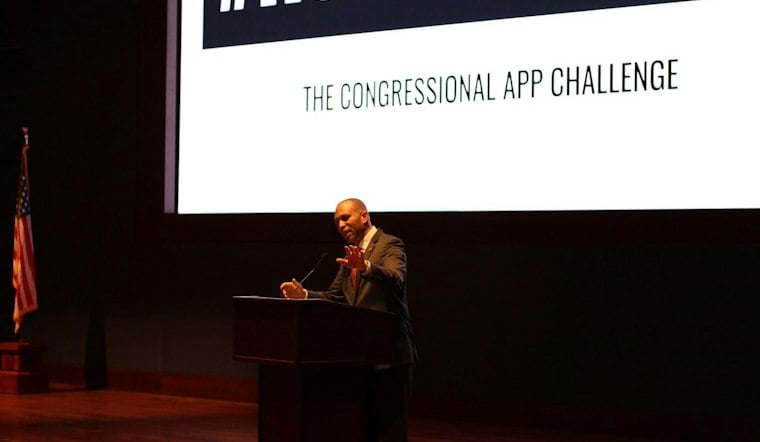
House Minority Leader Hakeem Jeffries said Thursday he would support reinstating proxy voting for new or expectant parents, breathing fresh life into a fight that has split Congress along party lines for years. Jeffries, who is likely to become House speaker if Democrats take control of the chamber in January, credited two of his colleagues for pushing the issue forward even as the practice remains banned in the House today.
According to punchbowl.news, Jeffries said, “I'm thankful for the leadership of Brittany Pettersen and Sara Jacobs and other members of the House Democratic Caucus in this regard.” Proxy voting allows an absent member of Congress to designate a present colleague to cast a vote in their name, a workaround that does not currently exist under House rules.
As reported by yahoo.com, House Democrats are coalescing around a narrower approach this time rather than a full-scale revival of the pandemic-era system. “Members are coalescing around narrower proposals that would allow only new parents or those undergoing medical treatment to have colleagues cast their votes,” the outlet reported, adding that “many Democrats aren't interested in going back” to the broader policy.
Pettersen's Push for 12 Weeks of Remote Voting
Pettersen has proposed allowing 12 weeks of remote voting for new parents, including adoptive parents, and wants the policy folded into the upcoming House rules package, the same report noted. Her 2025 bill attracted 175 co-sponsors, including nine Republicans, a sign that the idea has drawn at least some bipartisan interest even as GOP leadership has balked at bringing it to a vote.
Rep. Pete Aguilar framed the effort in practical terms, telling the outlet, “We want to be responsive to members and their growing families” while also accounting for the realities of voting in the House. The push isn't new: Brittany Pettersen and Sara Jacobs sought to restore proxy voting for expectant mothers and new parents in early 2025, and Republicans Anna Paulina Luna and Mike Lawler joined that effort at the time.
Republicans Have Called the Practice Unconstitutional
Despite that bipartisan interest, Mike Johnson and other Republicans have opposed restoring proxy voting, with Johnson calling the practice unconstitutional. Johnson said in 2025 that allowing proxy voting for one group of lawmakers could open the door to broader remote voting and ultimately harm the work of Congress.
Instead of proxy voting, Johnson and Luna agreed to allow vote pairing for lawmakers who can't be present because of family obligations — a system in which an absent member supporting a bill pairs with an opposing member who also agrees to be absent, canceling out both absences. Per Roll Call, the House rule that emerged in 2025 tabled a proxy-voting discharge motion and revived that pairing mechanism instead, after Pettersen and Luna had pushed for proxy voting lasting up to 12 weeks after a birth.
A Fight That Predates the Pandemic Ban
Proxy voting was heavily expanded during the COVID-19 pandemic, when lawmakers began using it in 2020 to cast votes without being physically present on the floor. Most lawmakers who used it that year were Democrats, though the practice was adopted widely across the aisle as the pandemic wore on — by a later point, Kevin McCarthy had unsuccessfully challenged the policy in court; lower courts dismissed the suit, and the Supreme Court rejected the GOP's request to review that action.
A study described by thehill.com found that 80 percent of House members ultimately used proxy voting, including nearly 70 percent of House Republicans, with the practice characterized as having become welcomed by both parties as a reform of traditional voting procedures. During the November 2021 vote on the Build Back Better legislation alone, 98 members cast proxy votes — 55 Republicans and 43 Democrats, the outlet reported.
Republicans campaigned against proxy voting in their successful 2022 effort to flip the House, and ended the practice in 2023 after taking the majority. Lawmakers from both parties pushed for its return after the ban, but a later effort by Pettersen and Luna to change House rules fell short after Luna struck a deal with Johnson to rely on vote pairing instead, according to a separate Roll Call report.
Jeffries's comments, first reported by the Denver Gazette, suggest the proxy-voting debate will resurface again if Democrats take the gavel in January — though the shape of any final policy, including its scope and timeline, remains unresolved.





