

























































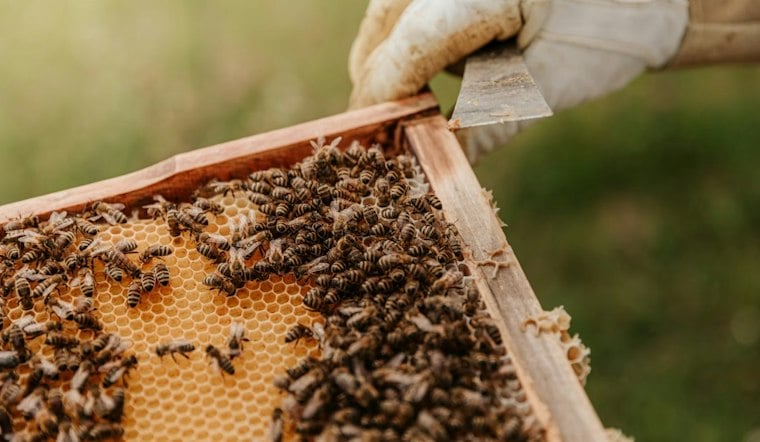
A Kauaʻi honey competition this fall put backyard beekeepers in the public eye as county officials considered whether residents should be allowed to keep hives at home—and under what limits. The inaugural Kauaʻi Honey Challenge included formal judging at Kauaʻi Community College and a public tasting in Līhuʻe.
On Oct. 17, five judges spent more than two hours evaluating locally produced liquid honey in light, medium and dark categories at Kauaʻi Community College, according to Kauai Now. The panel rated entries for aroma, taste and complexity, jotting down comments and suggestions as they tasted honey produced by bees foraging among the island's seasonal flowering plants. Andrew Smithers of Wailua took first in the light category, with Gennady Bronshteyn of Kapaʻa placing second and Kapaʻa Honey Factory rounding out third. Allie Dreux of Kīlauea won the medium category, Kauaʻi Nectar Co. placed second, and Kei's Apiary of Līhuʻe took third. In the dark category, Robin and Keison of Kei's Apiary took top honors, followed by Kapaʻa Honey Factory and Cory Todd of Waimea.
Public Vote Draws More Than 100 Tasters
A week later, the competition opened up to everyday honey lovers. The Rice Street Block Party in Līhuʻe hosted a People's Choice tasting on Oct. 24, letting attendees sample entries and vote for their favorites, the outlet reports. By the end of the night, more than 100 people had tasted and voted. This time the rankings shuffled: Bronshteyn of Kapaʻa took first in the light category with Smithers moving to second, while Kapaʻa Honey Factory and Kei's Apiary tied for third. Kauaʻi Nectar Co. won the medium People's Choice vote, with Allie Dreux of Kīlauea second and Kauaʻi Community College itself placing third. Lisa Prinzing of Kalaheo topped the dark category, while Kei's Apiary and Kauaʻi Nectar Co. tied for second and Cory Todd of Waimea tied with Kauaʻi Kai Farms of Anahola for third.
Ariel Bishop, a second-generation beekeeper and bee educator with Bees on Kauaʻi, noted that the people behind the winning jars aren't running commercial operations. According to the same account, Bishop said the Honey Challenge winners are backyard beekeepers. For Smithers, the light-category champion, the hobby is brand new: he started keeping bees in 2026 after taking Kauaʻi Community College's intro to beekeeping class, per the report.
Zoning Fight Shaped the Backdrop
The honey contest landed just days after a milestone for the beekeepers pushing a zoning change that would let more of them keep hives legally. On Oct. 13, the Kauaʻi Planning Commission approved proposed Bill 2997 after the Kauaʻi Department of Planning presented revisions addressing hive density, swarms, nighttime lighting and signage. The bill aims to establish apiaries as an allowable use in specified zoning districts, the article notes.
The path there wasn't straightforward. Back in August, the commission had voted to defer a related zoning amendment, pushing the matter to September and directing planners and beekeepers to work together on public-safety measures, the station's report states. At that time the commission flagged a need for more safeguards for neighbors and the public, and officials noted one complaint involving residential hives that had gone to the county's enforcement division and resulted in a violation notice.
The revised proposal that emerged limits properties of 10,000 square feet or less to eight hives, while lots larger than that but under 20,000 square feet can have up to 15, per the same account. That's a tightening from the original proposal, which allowed up to 15 hives on any lot smaller than 20,000 square feet and let the planning director approve even more. Beekeepers would also be required to use recognized management practices to curb swarming and make reasonable efforts to recover swarms when practical, with hives positioned or shielded so artificial light from neighbors doesn't illuminate hive entrances. Residential properties with apiaries would need to post a weather-resistant sign at least 10 by 12 inches, visible from the street and reading “Notice: Honeybee Hives on Property.”
Notably, the county did not recommend additional restrictions near conservation areas, mandatory beekeeper education or registration requirements, or new limits on hive components known as supers, the outlet reports. County officials also removed proposed definitions of “animals” and “livestock” as unnecessary for regulating apiaries, and the revised language recognizes honeybees' contributions to agriculture and food production without making broader claims about native ecosystem benefits.
Beekeepers Say Revisions Reflect Real Concerns
Keison of Kei's Apiary, whose honey took top dark-category honors at the formal judging, said the planning department's proposed revisions reflected practical hive-management concerns beekeepers had raised, according to the report. He also pointed to the ecological stakes, saying bees pollinate flowering plants and support agricultural production. Bishop struck a similarly optimistic note, saying the bill's updates strengthened it and could work for both beekeepers and the broader community.
County officials were expected to confirm the final legal status of Bills 2997 and 3015 on Nov. 12, ahead of the mayor's signature.
A Hawaiʻi Island Precedent
Kauaʻi is not the first county to consider rules for beekeeping. In a separate Hawaiʻi County process, the Council’s Policy Committee on Health, Safety and Well-Being moved a Big Island beekeeping measure forward for further consideration on April 2, 2024, according to Big Island Now. That was a committee-stage action on another island, not a decision on Kauaʻi’s Bill 2997.
Back on Kauaʻi, several voices from the island's food and hospitality scene weighed in on why the honey industry matters beyond the hobbyist level. Richard Loero, owner of Kauaʻi Roastery Coffee on the island's west side, said highlighting local agriculture and small businesses such as honey producers is vital. Pete Ghione, director of culinary and chef at 1 Hotel Hanalei Bay, said passing the residential beekeeping bill would help protect ʻāina, increase bee populations and deepen local sustainability.





