

























































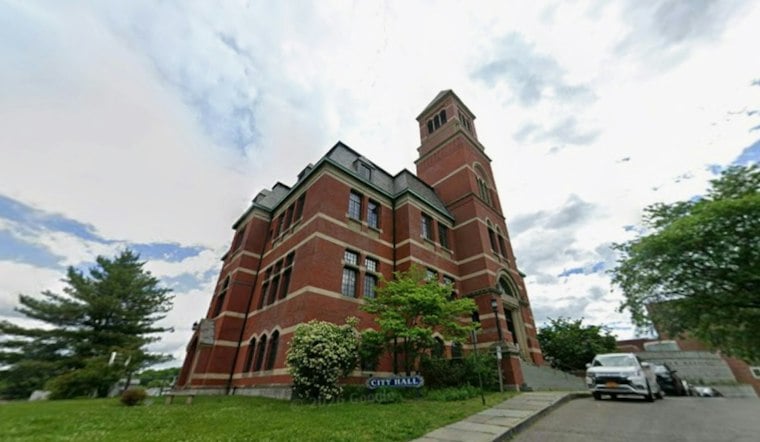
Kingston's Common Council could vote as soon as December on a settlement agreement that would bring an end to the last lawsuit brought against the city stemming from the controversial Chestnut Hill boarding house. Under the proposed deal, property owner Joseph Sangi would agree to sell the shuttered building at 106 W. Chestnut St., while the city would waive certain fees and fines and hold off on enforcing a $73,500 judgment against him.
The council's Finance and Audit Committee voted 5-0 to send the settlement agreement to the full council, according to the Daily Freeman. The Chestnut Hill boarding house occupied 106 W. Chestnut St.
What the Settlement Would Require
The proposed agreement relates to a federal lawsuit Sangi filed against Kingston in March 2025 alleging discrimination against the boarding house's disabled residents. As part of the settlement, the city has agreed not to continue enforcing a $73,500 judgment against Sangi and Chestnut Hill, provided he complies with the settlement's terms, and has also agreed to waive collection of outstanding Building Department fees and fines.
In exchange, Sangi would agree to sell the closed property and drop his notice of appeal of Justice David Gandin's ruling in state Appellate Court. Three other plaintiffs in the litigation, not including Sangi, would each receive a $2,000 settlement for their claims under the federal lawsuit.
A Long Legal Fight Over the Property
The dispute over the boarding house has stretched across years. A federal court denied Sangi's request to keep operating the boarding house while a lawsuit over the city's permit denial played out, a decision that dates to September 2023.
The parties reached a resolution once before. In 2017, a federal judge temporarily barred the city from removing residents while the first disability-discrimination lawsuit proceeded. After more than two years of settlement discussions, the city granted a zoning variance and a special-use permit in 2019, allowing the home to operate under conditions and with a permit subject to renewal. That arrangement set up the later disputes over the city’s decisions on renewal applications. The federal court’s 2023 decision recounts that earlier settlement and permit history.
The address has a much longer history than the current lawsuits: a federal court’s 2026 account says the property had served as a boarding house for ill or disabled people since the 1950s. The zoning dispute intensified in 2014, when the city challenged the use after Chestnut Hill NY sought a building permit to move a kitchen sink. The company argued the home was a lawful pre-existing use; the city said boarding houses were not permitted in the residential zone. The court’s history of the property traces the dispute back to that permit application.
In January 2026, Gandin ordered Sangi to pay the city a total of $73,500, a $500-per-day penalty for 147 days the boarding house was found to have been intentionally and unlawfully operated, covering the period from July 23, 2025, through December 18, 2025 — the date the state Supreme Court granted a permanent injunction against the property. Even after that injunction, the fight was not over: in April 2026, Gandin found the continued operation of the boarding house in civil contempt of the court's closure order, citing a March 19 register that showed 12 residents still living there.
The pending settlement is distinct from a federal case filed in 2023 over the city’s refusal to renew the home’s permit that year. A judge denied the plaintiffs’ request for an order keeping the home open while that case proceeded; in March 2026, the court granted summary judgment to the city and dismissed the case. The judge recognized evidence of earlier community opposition but concluded the record did not support a finding that disability discrimination motivated the permit denial. The March 2026 ruling explains the court’s conclusion.
The Boarding House's Closure
The boarding house closed in spring 2026.
Part of a Broader Pattern of Settlements
The settlement would end the last lawsuit stemming from the boarding house. The city has also resolved high-profile litigation brought by another property owner.
That other case involved the Pike Plan canopies, which were demolished in mid-February 2026. In July 2026, the Common Council voted unanimously to settle all seven lawsuits filed by developer Neil Bender's William Gottlieb Real Estate over the demolition, agreeing to pay the firm $200,000 — an amount that worked out to about $25,000 per building across Bender's eight properties. The city also agreed to settle claims for other Pike Plan buildings at $1,000 per deeded linear foot, with the overall Pike Plan settlement totaling $1,135,370 across 31 buildings.
If the full council approves the agreement as soon as December, it would mark the formal end of years of litigation over a property that became one of the more contentious land-use disputes in recent Kingston history.



