

























































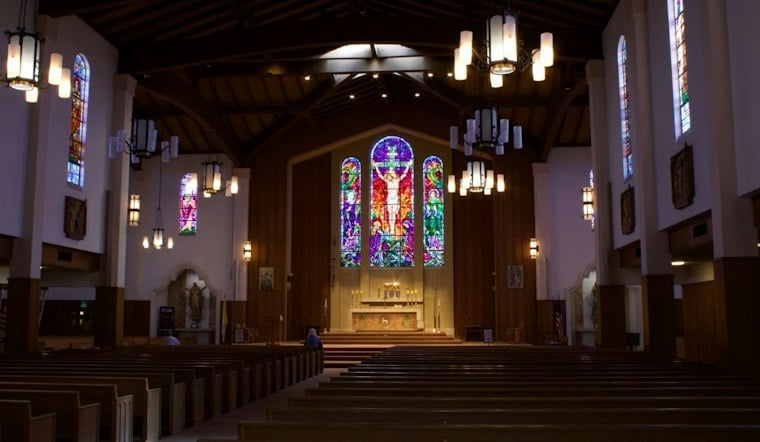
The Diocese of Orange broke ground this week on a 21-home private housing development at Our Lady of Guadalupe parish in La Habra, converting a patch of land once used occasionally as a softball field into two-story townhomes designed to help pay for Catholic ministries for decades to come. Bishop Kevin Vann led the groundbreaking service and blessing, praying for construction workers' safety and the project's successful completion.
The 1.6-acre site sits south of the church, and the plan calls for 19 homes offered at market rates alongside two reserved for moderate-income households, according to the Orange County Register. The homes will range from 1,500 to 1,700 square feet and come with two-car garages, and Shea Homes of California will serve as construction manager while Western National Properties handles property management once the units are ready for tenants.
The development is intended to provide rental income over the long term to help fund Catholic ministries.
A Long-Term Investment in the Church's Mission
Vann called the project a lasting investment in the church's mission.
Cameron said construction crews could begin pouring foundation slabs in December 2026 or January 2027, weather permitting. The diocese plans to evaluate how the La Habra development performs before considering similar projects on other church properties, and Cameron said the diocese will weigh other opportunities if this one works out.
Part of a Broader Southern California Pattern
Southern California churches have increasingly been turning to excess properties to help address housing needs and sometimes generate income, a trend reflected in several recent projects across Orange County.
Other comparable projects include Orchard View Gardens, a 66-unit affordable complex on St. Joseph's Episcopal Church grounds in Buena Park where a dozen units serve as supportive housing for previously homeless seniors, as the Los Angeles Times has reported. Santa Angelina, built at Church of the Blessed Sacrament in Placentia, provides 65 apartments on that church campus, according to National CORE. Wesley Village, an affordable complex for seniors and multigenerational families in Garden Grove, opened in 2017.
The church-land projects in Orange County vary sharply in scale and affordability. Garden Grove’s Wesley Village, developed with Jamboree Housing on unused church land, opened in 2017 with family and senior apartments and a community-services building, including a Head Start center, as the county’s housing-element inventory details. Buena Park’s Orchard View Gardens is a 66-unit affordable development, with 12 apartments designated as supportive housing for formerly homeless seniors. La Habra’s 21 homes are a smaller, primarily market-rate rental project, with two units reserved for moderate-income households.
Unlike some of those developments, the La Habra project did not seek a density bonus or make use of Senate Bill 4, the 2023 state law that helps with local zoning by removing some planning restrictions and guaranteeing by-right approval for qualifying residential projects on faith-based land, as The Real Deal has reported. A UC San Diego Center for Housing Policy and Design report found that faith-based organizations own 96% of the roughly 3,600 acres eligible for housing approval under SB 4 in San Diego County, though only 2.3% of those eligible parcels are officially designated as vacant. Statewide, the law's impact has so far been modest: as of July, 94 units had been permitted under SB 4 but none had been completed, according to the California Department of Housing and Community Development as reported by the San Francisco Chronicle.
That mix matters under California’s Senate Bill 4, which creates a streamlined, by-right approval route for qualifying housing on religious and higher-education land. The law requires units to serve lower-income households, while allowing up to 20% for moderate-income residents, up to 5% for staff of the land-owning institution, and a manager’s unit; rental units must carry long-term affordability restrictions. The state’s housing department says the law runs through Jan. 1, 2036. La Habra’s project has a market-rate majority and two homes reserved for moderate-income households, and received city approval.
La Habra's own path through city approval came earlier, when the City Council voted 4-1 last year to approve the project, which was designed as six two-story buildings with two parking spaces and a small backyard for each unit, accessible from Walker Street, per the Register's earlier coverage.
The city’s approval came after a public hearing in which council members raised questions about traffic, neighborhood safety, fire access, trash pickup and the rents for both market-rate and moderate-income units. The council ultimately approved the development permit and an agreement restricting two homes to moderate-income households by a 4-1 vote on March 17, 2025, the official meeting minutes show. Those concerns place the project’s promised housing and long-term parish revenue alongside practical questions about how a new residential enclave will fit into the surrounding neighborhood.





