

























































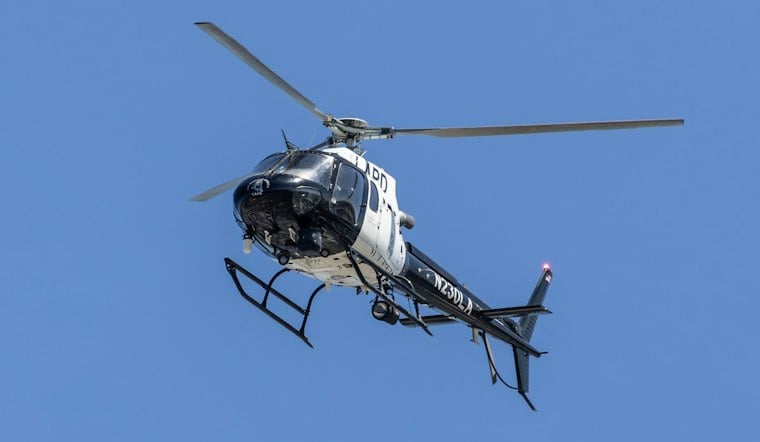
An LAPD helicopter pilot tracking a hidden suspect over Echo Park on Tuesday was forced to break off his position after military helicopters crowded into the same airspace and failed to respond to his radio calls, according to police officials. The pilot, flying as part of the LAPD's Air 3 unit, did not hide his frustration once back on the air, venting that the encounter had cost him his view of a suspect he was trying to track from above.
Air 3 Changes Course Mid-Search
According to the New York Post, the LAPD Air 3 crew was circling a call in Echo Park on Tuesday when it received an alert about nearby aircraft, according to LAPD Officer Eisenman. The pilot altered his helicopter's flight path to avoid the approaching military aircraft, and the crew attempted to make contact with the military pilots over a shared aviation radio frequency used by aircraft operating in the area. LAPD officials told the outlet the military helicopters did not respond to those radio transmissions, and Air 3 changed its flight profile out of caution after getting no answer.
Audibly irritated on the radio, the pilot said, “You guys just pushed me out of a spot. I got a suspect hiding. You guys got to pay attention, man. That's ridiculous.” He had also remarked that the military aircraft was “gonna ram me over, dude,” according to the same report. The military helicopters were seen flying over the 101 Freeway in Hollywood, according to CBS Los Angeles footage cited by the Post, and were believed to be operated by the U.S. Navy, per that station's reporting. The Post said it had contacted the Navy for comment.
What Remains Unclear
The reason the military aircraft did not respond to the LAPD crew's radio calls has not been established, and the exact distance between the helicopters during the encounter was not specified in reporting on the incident. Pilots operating in the area are expected to broadcast their locations over a common radio frequency, which is the channel the LAPD crew says it used without success.
The episode is the latest reminder of how congested the skies over Los Angeles can get. Former KTLA pilot Tim Lynn told the Los Angeles Times that news helicopters typically hold around 1,200 to 1,500 feet above the ground to stay above police helicopters and below commercial air traffic. Lynn also described an unwritten rule among news crews to hold position or hover during police pursuits, particularly when a chase circles back through a residential area. The Times piece noted that LA's airspace easily becomes crowded and, during fast-moving stories like car chases, can turn unpredictable and chaotic.
A Pattern of Close Calls
The Tuesday encounter follows a string of aviation safety concerns playing out at both the local and national level. The Times reported that an Army review of January 2025's deadly midair collision near Washington, D.C., which killed 67 people, identified two failed radio transmissions and limited visibility through night-vision goggles as contributing factors. That review recommended safety reviews of helicopter operations in major cities, with assessments covering Los Angeles and the Seattle-Tacoma region described as ongoing.
Closer to home, Reuters reported in March that the FAA was investigating a close call in which a United Boeing 737-800 on approach to John Wayne Airport encountered an Army Black Hawk crossing in front of it, with Flightradar24 data showing the aircraft were 525 feet apart vertically. The California Army National Guard said at the time that its helicopter was returning to Los Alamitos airfield along an established visual flight rules route after a routine training mission and was in contact with air traffic control. Reuters also noted the FAA cited a separate near-miss between an American flight and a police helicopter near San Antonio as part of its push for new rules.
The FAA has said it began using AI tools in February 2025 to flag hotspots with heavy mixed helicopter and airplane traffic, naming Van Nuys Airport and nearby Hollywood Burbank Airport as a primary focus in the Los Angeles area; the agency said it lowered the Van Nuys traffic pattern by 200 feet during a 2025 evaluation to see whether that eased conflicts with aircraft landing at Burbank. Separately, the Los Angeles Times has reported that NTSB data show 16 people have died in eight fatal news-helicopter crashes nationwide since 2000, underscoring the stakes every time aircraft share tight airspace over a dense city like Los Angeles.



